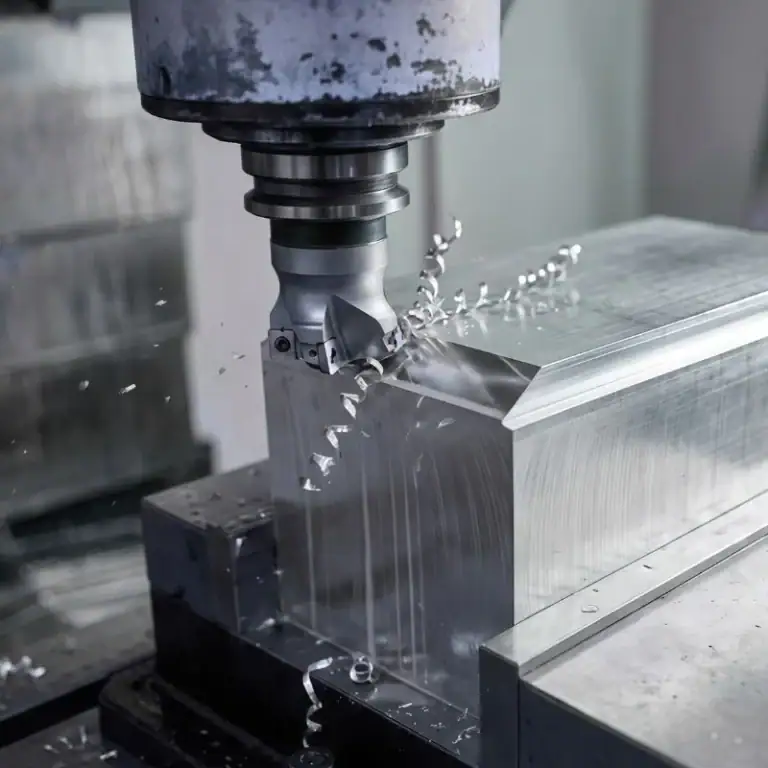
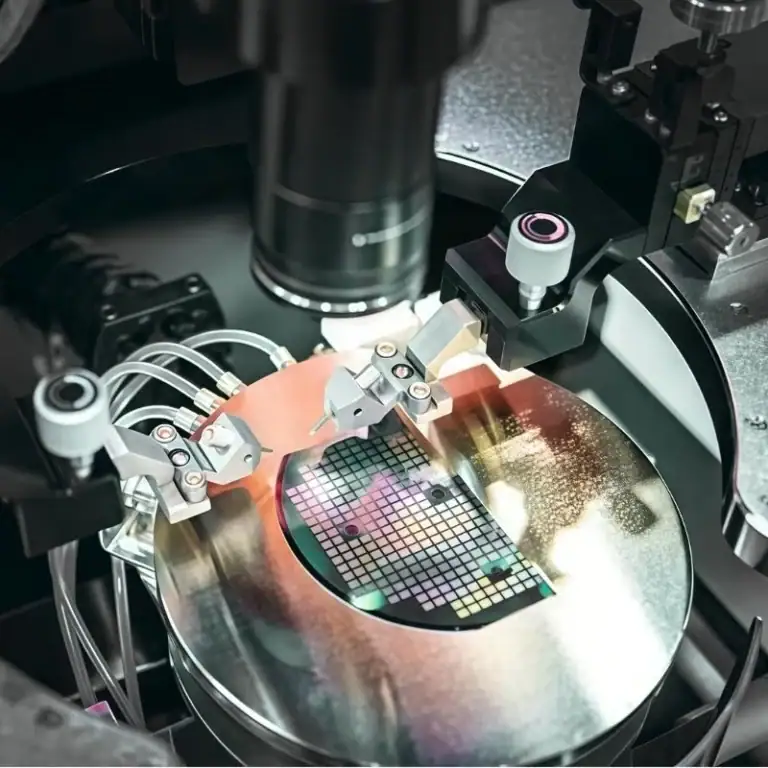
Carbon fiber composites are widely used in aerospace, automotive, drones, medical devices, and high-end equipment manufacturing due to their high strength, lightweight properties, and excellent corrosion resistance. However, during CNC milling, the machining stability of these materials is far lower than that of metals. Even slight improper operation can easily lead to delamination, burrs, fiber pull-out, or localized thermal damage. These defects not only affect appearance quality but may also weaken structural reliability. Therefore, comprehensive control is required from multiple aspects, including tooling, parameters, chip evacuation, and process strategy.
Why Carbon Fiber Composite Milling Is Prone to Delamination and Burrs
To effectively control machining defects, it is first necessary to understand their root causes and optimize from the source.
Instability Caused by Fiber Layup Structure
Carbon fiber composites are composed of alternating layers of fibers and resin matrix. Different layup orientations exhibit different mechanical responses, leading to uneven cutting forces during machining.
- Properly plan cutting direction to avoid sudden impact on edges.
- Design toolpaths based on layup angles to reduce fiber pull-out.
Use smoother tool motion in thin-wall and edge regions to reduce localized stress concentration.
Tool Wear Leads to Degraded Cutting Quality
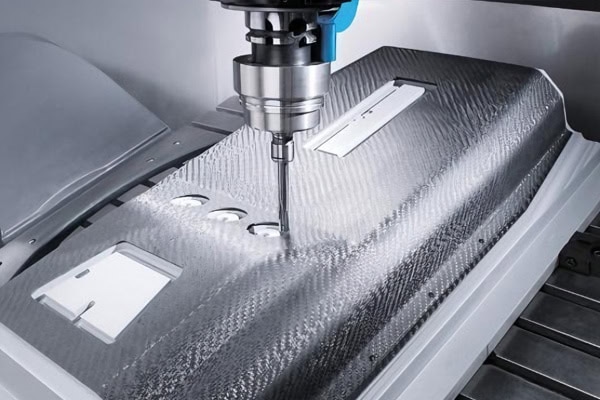
Carbon fiber materials are highly abrasive, causing tools to dull quickly during machining. This changes the cutting mechanism from clean shearing to tearing and extrusion. Therefore, high-wear-resistant PCD tools or diamond-coated tools should be preferred. Tool condition must be continuously monitored to avoid using significantly worn edges for finishing operations. A tool life management system should also be established to reduce quality instability caused by tool wear variation.
Selecting Proper Tools to Control Delamination and Burrs
Tool performance directly determines fiber cutting quality and is a key factor in controlling machining defects.
Use High Wear-Resistant Tool Systems
For carbon fiber composites, wear resistance and edge stability should be prioritized. PCD tools are suitable for high-strength, long-cycle batch production, while diamond-coated carbide tools offer a good balance between cost and performance. Maintaining a sharp cutting edge helps achieve clean shearing rather than fiber tearing.
Optimize Tool Geometry Design
Tool structure directly affects cutting force direction and material failure behavior.
- Use sharp edge designs suitable for composites to reduce fiber tearing.
- Adjust helix angle appropriately to reduce fiber lifting effects.
Use specialized tools for holes, slots, and thin-wall structures to improve local machining stability.
Reducing Machining Defects Through Cutting Parameters
Based on proper tool selection, optimized parameters can further stabilize the machining process.
Optimize Spindle Speed and Feed Rate Matching
Improper parameter combinations may cause heat accumulation or excessive impact.
- Match spindle speed according to material properties and tool specifications.
- Maintain stable feed to ensure continuous cutting rather than repeated friction.
Differentiate roughing and finishing parameters to avoid excessive load in later operations.
Control Cutting Depth and Radial Load
Excessive single-pass cutting volume significantly increases delamination risk.
- Use a layer-by-layer material removal strategy to gradually reduce thickness.
- Reduce cutting load in thin-wall areas to prevent structural deformation.
Use small stock allowance in finishing to improve edge quality and dimensional accuracy.
Strengthening Chip Evacuation and Workholding Control
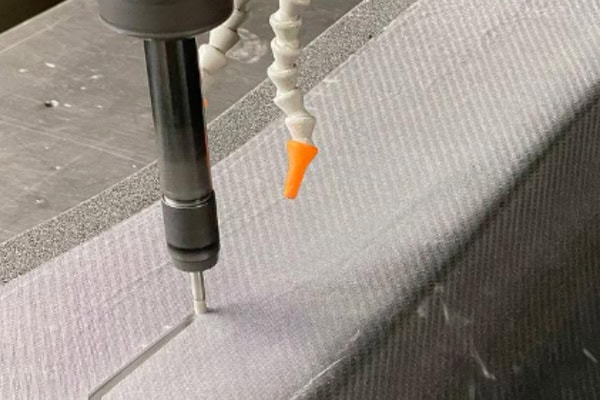
Carbon fiber dust and chips, if not removed in time, can affect machining stability and equipment safety.
Improve Chip Removal and Dust Extraction Efficiency
Carbon fiber dust is both abrasive and hazardous and must be properly controlled.
- Use vacuum extraction systems to remove dust during machining.
- Keep the machining area clean to avoid secondary cutting contamination.
Optimize chip evacuation paths in deep grooves and enclosed structures to prevent accumulation.
Improve Workholding Stability
Improper clamping can amplify vibration and local deformation. Therefore, support points should be added based on structural characteristics to reduce thin-wall vibration. Clamping force should be evenly distributed to avoid local crushing. For complex or large parts, vacuum fixtures can be used to improve overall stability. Stable workholding ensures the tool follows the intended path, reducing delamination and burr formation.
Achieving More Stable Composite Milling Through Toolpath Strategy
For high-precision requirements, optimizing tools and parameters alone is not sufficient; machining paths must also be systematically designed.
Optimize Entry and Exit Strategies
Improper tool entry can cause sudden impact loads.
- Avoid vertical plunging into the material to reduce shock.
- Use ramp or arc entry to gradually build cutting force.
Leave finishing allowance in critical contour areas to reduce edge defects.
Develop Dedicated Processes for Key Structures
Thin walls, holes, and edges are high-risk defect areas and require special control.
- Use light cutting strategies for thin-wall regions to reduce lateral force impact.
- Assign separate finishing operations for holes and slots to improve local quality.
- Use sacrificial layers or auxiliary supports when necessary to protect critical edge structures.
Through zoned process design, overall machining consistency can be significantly improved.
Conclusion
Delamination and burrs in carbon fiber composite milling are fundamentally the result of combined effects from tool condition, cutting parameters, material structure, workholding method, and toolpath strategy. Only through systematic pre-machining analysis and tailored process planning for different structures can stable and high-quality machining be achieved. TiRapid provides customized CNC milling solutions for carbon fiber composite parts, helping customers improve edge quality and batch consistency while ensuring dimensional accuracy.