Turbine blades are made from materials selected for the temperature, mechanical loads, and environment of their operating stage. Nickel-based superalloys are common in high-temperature gas turbines, while heat-resistant steels are widely used in steam turbines. Some designs use cobalt-based alloys, titanium-based materials, or ceramic matrix composites.
The material name alone does not define a finished blade. The alloy grade, manufacturing route, heat treatment, grain structure, coatings, and inspection requirements can all influence performance. This guide explains the main turbine blade materials, how their properties differ, and what engineers and buyers should specify before manufacturing.
What Are Turbine Blades Made Of?
Turbine blades are commonly made from nickel-based superalloys, heat-resistant steels, and other materials chosen for the service conditions of a particular turbine stage. Some applications also use cobalt-based alloys, titanium aluminides, or ceramic matrix composites. No single material is suitable for every blade.
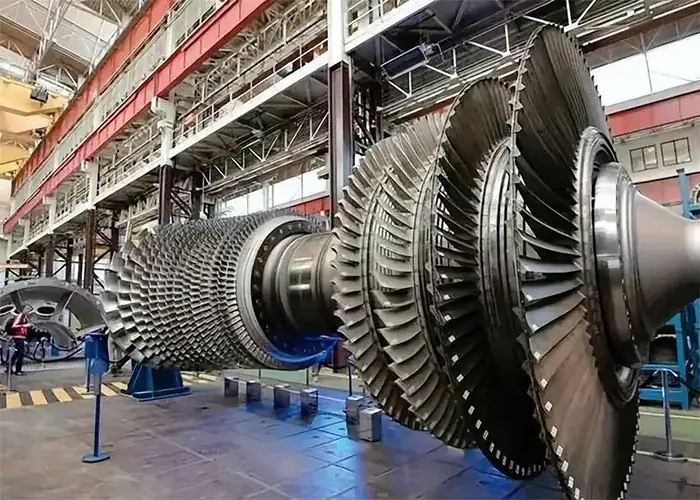
A blade in the hot section of a gas turbine faces a different environment from a blade in a steam turbine. Even within one engine, the requirements can change from stage to stage. Temperature, rotational loading, vibration, oxidation, and exposure time all influence the selection.
The following table provides a starting point for comparison. Actual suitability depends on the specific grade, condition, design, and approved application.
| Material Family | Where It May Be Used | Main Selection Consideration |
| Nickel-based superalloys | Hot-section gas turbine blades | High-temperature strength and creep resistance |
| Cobalt-based alloys | Selected hot-section components, including some vanes | High-temperature corrosion and wear behavior |
| Heat-resistant and stainless steels | Many steam turbine blades and selected cooler turbine stages | Strength, corrosion resistance, and manufacturing practicality |
| Titanium alloys | Fan and compressor blades, plus selected lower-temperature applications | Low density and strength relative to weight |
| Titanium aluminides | Selected low-pressure turbine blades | Lower density with suitable elevated-temperature capability |
| Ceramic matrix composites | Selected high-temperature turbine components | High-temperature capability, low density, and protection requirements |
The term turbine engine blades can also be used loosely to describe blades throughout an engine. For material selection, it is important to identify whether the component is a fan blade, compressor blade, turbine blade, or stationary vane.
Which Materials Are Used For Turbine Blades?
The main turbine blade material families include nickel-based superalloys, cobalt-based alloys, heat-resistant steels, titanium-based materials, and ceramic matrix composites. Each family offers a different balance of strength, environmental resistance, density, and manufacturability.
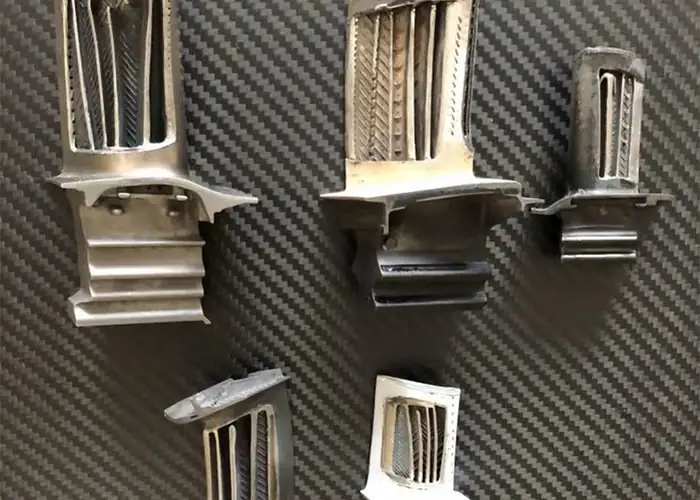
Nickel-Based Superalloys
Nickel-based superalloys are widely used for blades exposed to severe temperatures in gas turbines. They are designed to retain strength and resist creep when exposed to heat and mechanical stress for extended periods.
Their properties come from alloy composition and carefully controlled microstructure. Depending on the grade, alloying and heat treatment form strengthening phases that help the material resist deformation. The exact balance of strength, oxidation resistance, and processability varies between alloys.
Some hot-section blades are investment cast with controlled grain structures. Others use different material forms and manufacturing routes suited to their design. A nickel alloy suitable for a disk, casing, or machined prototype should not automatically be treated as suitable for a highly loaded hot-section blade.
For procurement, a description such as “nickel alloy” is too broad. The drawing or purchase specification should identify the required grade, material form, and condition.
Cobalt-Based Alloys
Cobalt-based alloys can provide useful resistance to high-temperature corrosion and wear. They are used in selected turbine components, including some stationary vanes and other parts exposed to aggressive environments.
Material choice depends on the actual temperature, loading, fuel chemistry, and required service life. A cobalt-based alloy is not automatically interchangeable with a nickel-based superalloy. Different alloys can respond differently to casting, heat treatment, repair, and coating.
When reviewing a cobalt alloy, engineers should consider the complete component requirement rather than selecting it solely for one property. Buyers should also verify the specified grade and approved supply route before comparing alternatives.
Heat-Resistant Steels And Stainless Steels
Heat-resistant steels and stainless steels are used in many steam turbine blades. Certain steel grades provide a practical combination of strength, corrosion resistance, and machinability for their intended operating conditions.
The material requirements vary across a steam turbine. A high-temperature stage may need stronger creep resistance, while a lower-temperature stage can face moisture-related corrosion or droplet erosion. The same steel grade should not be assumed suitable for every location.
Some turbine blades use chromium-containing stainless steels. The appropriate grade and heat treatment depend on the blade design, steam conditions, and turbine manufacturer’s requirements. In particularly demanding steam applications, other alloys may also be specified.
Titanium Alloys And Titanium Aluminides
Titanium alloys are valued for their low density and strength relative to weight. In aircraft engines, they are commonly associated with fan and compressor components, where reducing rotating mass is important.
A fan blade and a high-pressure turbine blade operate in different thermal environments. A conventional titanium alloy used in the front of an engine should not be assumed suitable for the hottest turbine stages.
Titanium aluminides are a distinct group of titanium-based intermetallic materials. They are used for selected low-pressure turbine blades because they offer a lower-density alternative for appropriate designs. Their material behavior and processing requirements differ from those of conventional titanium alloys.
The alloy designation, intended stage, and approved manufacturing route should therefore be stated clearly. “Titanium blade” alone does not identify the material or its operating capability.
Ceramic Matrix Composites
Ceramic matrix composites, often called CMCs, combine ceramic fibers with a ceramic matrix. They are investigated and used in selected high-temperature engine components because they can offer low density and useful high-temperature capability.
Their design and production differ substantially from those of metallic blades. Fiber architecture, processing, damage tolerance, joining, and environmental protection are important considerations. Some applications also require environmental barrier coatings.
A ceramic composite should be evaluated as a complete material system for a defined component. It should not be treated as a direct replacement for a metal alloy based only on temperature capability.
How Do Materials Differ Between Jet Engines And Steam Turbines?
Jet engine hot-section blades commonly use nickel-based superalloys, while many steam turbine blades use heat-resistant or stainless steels. Within each machine, material selection changes with the blade’s location, temperature, loading, and exposure environment.
Jet Engine Hot-Section Blades
Hot-section turbine blades extract energy from combustion gas to drive the engine’s compressor and other rotating components. Their materials must withstand a combination of high temperature, centrifugal loading, vibration, and chemical attack.
Nickel-based superalloys are widely used in these demanding stages. For some designs, controlled solidification produces a directionally solidified or single-crystal structure. Cooling features and protective coatings can also be part of the design.
These features work together. An alloy selected for an uncooled blade may not be the same as one selected for a cooled blade with a particular coating and internal geometry.
Compressor And Fan Blades
The compressor and fan are located upstream of the combustor. Their blades move or compress incoming air rather than extract power from hot combustion gas.
Titanium alloys are common in many fan and compressor applications because low rotating mass is valuable. Steel and nickel-based materials may also be selected for particular compressor stages or designs, depending on the operating conditions.
The distinction matters when interpreting the question “what are jet turbine blades made of?” A source discussing titanium fan blades may describe the same engine, but it is not necessarily describing the material used in the engine’s hottest turbine stage.
Steam Turbine Blades
Steam turbine blades extract energy from steam. Their operating environment differs from that of a combustion-gas turbine, and the conditions change as steam passes through the machine.
Heat-resistant steels and stainless steels are common choices for many steam turbine blade applications. Hotter stages require attention to strength and creep, while wet-steam regions may require particular attention to erosion and corrosion.
Selecting a steam turbine material also requires more detail than choosing a family name. Steam chemistry, moisture, operating cycles, blade size, and the specified heat treatment can affect the final decision.
Which Turbine Blade Material Properties Matter?
The most important turbine blade material properties are the ones that address the actual operating loads and environment. These commonly include high-temperature strength, creep resistance, fatigue behavior, oxidation and corrosion resistance, erosion resistance, density, and manufacturability.

High-Temperature Strength And Creep Resistance
A rotating blade carries mechanical load while exposed to heat. The material must retain enough strength at its operating temperature to support the intended geometry and loading.
Creep is time-dependent deformation under sustained stress. If a blade gradually changes shape, clearances and aerodynamic performance can be affected. In severe cases, creep damage can contribute to failure.
Creep resistance should be assessed at the relevant material temperature, stress, and exposure duration. A room-temperature strength value cannot by itself establish whether a material is suitable for a hot turbine stage.
Fatigue And Thermal Fatigue
Fatigue damage can develop when a blade experiences repeated loading. Sources include vibration, changes in rotational speed, and repeated operating cycles.
Thermal fatigue involves repeated temperature changes that cause expansion and contraction. Temperature gradients within a component can create additional stress, especially during starting, shutdown, or rapid operating changes.
The assessment depends on the material, geometry, surface condition, and expected duty cycle. A material with good creep resistance still needs an appropriate fatigue evaluation for the intended blade.
Oxidation, Corrosion, And Erosion Resistance
Hot gas can react with a blade surface and cause oxidation. Contaminants in the operating environment can also contribute to hot corrosion. The rate and form of damage depend on the alloy, surface protection, temperature, and exposure conditions.
In steam turbines, water droplets or particles can cause erosion in susceptible regions. Corrosion and erosion can act together, particularly when the surface is repeatedly damaged and exposed.
A smooth new surface does not guarantee long-term resistance. Material selection should consider the operating environment and any required surface protection.
Density And Manufacturability
Density affects the mass of a rotating blade and contributes to the loads experienced by the assembly. Lower-density materials can be attractive, especially in aircraft engines, but density is only one part of the decision.
The material must also be produced in the required form and manufactured into a conforming component. An alloy with attractive high-temperature properties may be difficult to cast, machine, inspect, or repair for a particular geometry.
Engineers should compare the complete design and production requirements rather than ranking materials by one property.
How Do Casting Structure, Coatings, And Cooling Affect Material Selection?
A turbine blade’s performance depends on more than its alloy composition. Grain structure, heat treatment, protective coatings, and cooling features can all affect how the material performs in service and how the finished part must be manufactured and inspected.
Equiaxed, Directionally Solidified, And Single-Crystal Structures
A cast alloy can have different grain structures depending on its solidification process. These structures affect how the material responds to load and temperature.
An equiaxed structure contains grains oriented in different directions. Directional solidification is controlled to produce grains aligned generally along a preferred direction. Single-crystal casting aims to form the component as one crystal without conventional grain boundaries in the blade.
These are manufacturing and microstructure distinctions, not simply different names for the same material. A blade machined from ordinary stock may reproduce an external profile without reproducing the specified single-crystal structure.
The drawing and material specification should identify the required structure when it is important to the component’s function.
Coatings And Environmental Protection
A coating can help protect the blade substrate from its operating environment. Metallic coatings may provide oxidation or corrosion protection, while thermal barrier coating systems are used in selected hot-section applications to reduce heat reaching the underlying material.
A coating system can include multiple layers, each with a specific role. Its performance depends on the substrate, preparation, application process, operating environment, and condition in service.
A coating does not make any base material suitable for any temperature. The alloy and coating system must be selected and qualified together for the intended design.
Cooling Features And Internal Passages
Some hot-section blades use internal cooling passages and small cooling holes. Cooling air helps control metal temperature during operation.
Complex internal passages can be formed during casting using cores. Later operations may create or finish external cooling holes and other features. The required route depends on the blade design and manufacturing specification.
Cooling affects the material decision because the local metal temperature may differ from the surrounding gas temperature. It also affects inspection, since an external surface measurement alone cannot establish whether internal passages are clear and conforming.
How Does Blade Material Affect Manufacturing And Inspection?
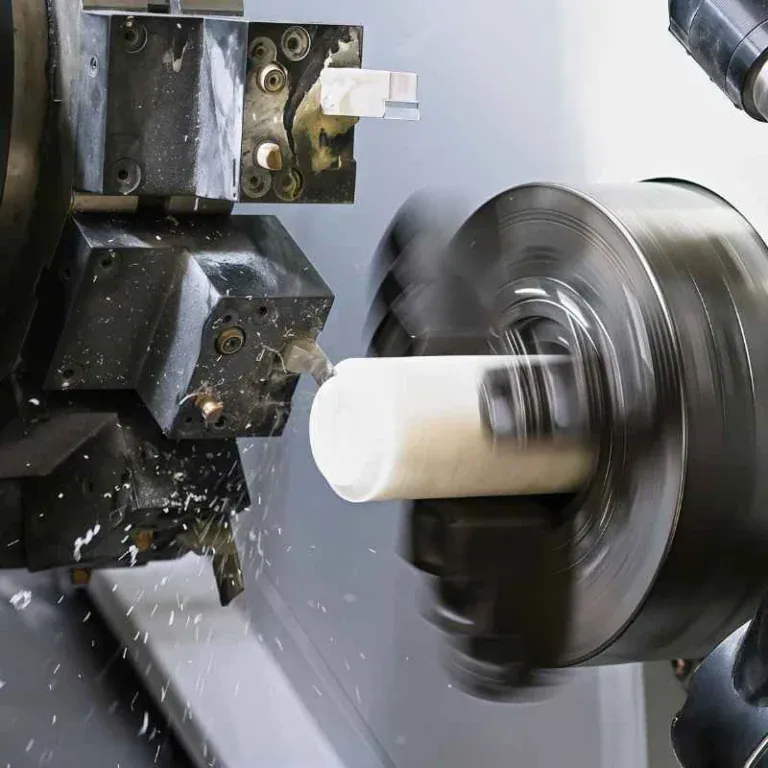
Blade material influences the choice of blank, cutting tools, fixtures, finishing operations, and inspection methods. Manufacturing plans must preserve both the required geometry and the specified material condition.
A blade may begin as a casting, forging, or solid stock, depending on its design and approved route. A near-net casting can already contain much of the airfoil shape, while a solid blank requires more material removal to produce the external profile.
Nickel-based superalloys can present machining challenges because the cutting zone must be controlled while producing complex surfaces. Tool selection, engagement, heat, and vibration all matter. Thin blade sections also become less rigid as material is removed.
Steel and titanium-based materials have different cutting behavior. Tooling and parameters should be developed for the specific grade and condition, rather than transferred directly from another material family.
Inspection must match the feature being checked. Coordinate measurement or optical scanning can evaluate defined external geometry. Other methods may be needed for material condition, internal features, coating condition, or specified defects.
A dimensional report does not replace a material certificate or a required internal inspection. The inspection plan should identify what is measured, how the part is aligned, and the manufacturing condition in which acceptance takes place.
For a more detailed explanation of machining steps, see TiRapid’s article on how turbine blades are made.
How Should Engineers And Buyers Specify Turbine Blade Materials?
A useful turbine blade specification identifies the exact material and its required condition, then connects those requirements to the drawing, manufacturing route, and acceptance documents. This allows suppliers to assess the same scope and identify uncertainties before quoting.
| Information | What To Provide |
| Component and application | Blade or vane, turbine type, stage, and intended use |
| Material | Exact alloy grade and applicable material specification |
| Starting condition | Casting, forging, stock, or customer-supplied blank |
| Material condition | Required heat treatment, grain structure, or other specified condition |
| Geometry | Current drawing and CAD model, including critical profiles and attachment features |
| Surface requirements | Surface texture, permitted edge finishing, and any coating requirements |
| Inspection | Required dimensional, material, internal, or surface checks |
| Documentation | Material traceability, certificates, inspection reports, and applicable approvals |
| Order details | Quantity, delivery requirements, and responsibility for the blank |
If an alternative material is proposed, compare more than its name or nominal composition. Review the required form, heat treatment, properties, manufacturing route, and acceptance requirements. For an existing design, material substitution should follow the responsible engineering organization’s approval process.
For a prototype, make its intended purpose clear. A visual model, a machining trial, and a service-intended component can have very different material and verification requirements, even when their external shapes are similar.
FAQs
Why Are Some Turbine Blades Made From Single Crystals?
Single-crystal blades have no conventional grain boundaries in the blade. This structure can improve resistance to high-temperature creep in designs that require it. The alloy and casting process must be specified together.
Are Titanium Alloys Used In Jet Engine Turbine Blades?
Titanium alloys are commonly used in fan and compressor blades. Titanium aluminides are also used in some low-pressure turbine blades. Material suitability depends on the engine stage and operating conditions.
Why Do Some Turbine Blades Have Internal Cooling Passages?
Internal passages carry cooling air through the blade to help control metal temperature during operation. Their design depends on the blade geometry, operating conditions, and cooling requirements.
Conclusion
Turbine blades are made from different materials because their operating conditions differ. Nickel-based superalloys are common in hot gas turbine stages, heat-resistant steels are widely used in steam turbines, and titanium-based materials serve selected applications where their properties suit the design.
A reliable material choice considers the alloy grade together with its condition, manufacturing route, protective system, and inspection requirements. Clear specifications help engineers and buyers compare feasible manufacturing proposals.
TiRapid provides custom CNC machining services for engineered parts. Send your drawing and CAD model with the material grade, blank condition, quantity, critical features, and inspection requirements for a project-specific review.