
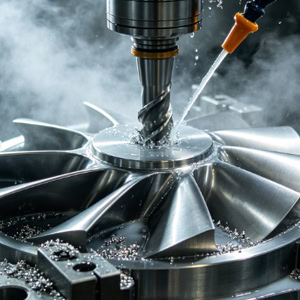
High-temperature alloys, with their excellent heat resistance, corrosion resistance, and high strength, are widely used in high-end manufacturing fields such as aerospace, energy equipment, and gas turbines. However, these advantages also make them typical difficult-to-machine materials. During CNC milling, cutting heat tends to concentrate at the tool tip and machining zone, while poor heat dissipation further accelerates tool wear, workpiece deformation, and surface defects. The core challenge in high-temperature alloy milling is not only whether the material can be cut, but how to continuously control heat so that machining accuracy, tool life, and production efficiency remain stable.
Why High-Temperature Alloys Generate Significant Cutting Heat
The material properties of high-temperature alloys make heat management during machining more complex, and empirical parameters from conventional metal machining are often not directly applicable.
High Material Strength Leads to High Cutting Load
High-temperature alloys can maintain high strength and hardness even under elevated temperatures, meaning cutting tools must withstand greater cutting resistance when engaging the material.
- Cutting forces are relatively high during machining, resulting in increased heat generation per unit time.
- Work hardening is significant, and tools tend to heat up when repeatedly cutting hardened layers.
- Cutting heat concentrates near the cutting edge, placing the tool in a high-temperature environment.
High-temperature alloy machining cannot rely solely on increasing cutting speed for efficiency; it must be controlled from both cutting load and heat distribution perspectives.
Limited Thermal Conductivity Restricts Heat Dissipation
Some high-temperature alloys have relatively low thermal conductivity, making it difficult for cutting heat to quickly dissipate through the workpiece. As a result, a large amount of heat accumulates in the cutting zone, causing rapid temperature rise at the tool tip, accelerating tool wear and increasing the risk of chipping. It can also affect dimensional stability and even lead to microstructural changes and machining defects. Therefore, milling high-temperature alloys requires not only reducing heat generation but also promptly removing heat from the machining area.
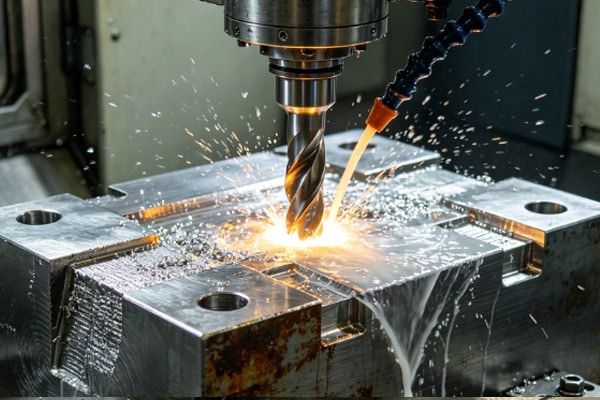
How CNC Milling Controls Machining Temperature in High-Temperature Alloys
Heat management cannot rely on a single measure; it requires integrating tooling, cutting parameters, and cooling strategies into a complete machining solution.
Reasonably Reduce Cutting Speed
Cutting speed has a direct impact on machining temperature, and excessive speed can quickly push the tool into a high-temperature state.
- Select appropriate cutting speeds based on material grade, tool material, and machining process.
- Focus on controlling cutting load during roughing, while balancing surface quality and dimensional stability during finishing.
- Avoid maintaining excessively high cutting speeds for long periods in pursuit of cycle time reduction.
Proper speed control reduces thermal shock to the tool and creates stable machining conditions.
Maintain a Stable Feed Condition
If feed parameters are too low, the tool may rub against the material surface; if too high, it may cause sudden increases in cutting load. Therefore, a balanced cutting rhythm must be maintained.
- Increase the effective cutting ratio and reduce prolonged tool rubbing.
- Adjust feed per tooth according to tool diameter and number of flutes to stabilize the cutting process.
- Avoid frequent changes in cutting load to reduce cyclic temperature fluctuations.
A stable feed condition helps distribute and release machining heat more evenly.
Use Appropriate Depth and Width of Cut
Proper control of radial and axial cutting engagement can reduce localized thermal load on the tool. During roughing, layered material removal helps reduce heat concentration per pass. During finishing, cutting load should be reduced to ensure dimensional accuracy and surface quality. For thin-walled structures, excessive cutting force that may cause deformation should be avoided. Proper allocation of machining allowance improves overall milling stability.
Tool Selection Directly Affects Heat Control Performance
High-temperature alloys require high tool heat resistance and stability, making tool selection a critical part of thermal management.
Select High-Temperature-Resistant Tool Materials
Carbide tools offer good overall performance in high-temperature alloy machining, and coatings can further improve heat and wear resistance.
- Select appropriate tool grades and coatings based on the material.
- Use sharp cutting edges with suitable strength.
- Use different tool structures for roughing and finishing.
Reduce unnecessary friction and improve cutting efficiency.
Optimize Tool Geometry
Tool geometry affects cutting force, chip evacuation, and heat distribution.
- Optimize helix angle and rake angle to reduce cutting resistance.
- Improve chip flute design to prevent chip accumulation.
- Reduce tool overhang to increase rigidity.
A stable tool structure helps reduce vibration and localized temperature rise.
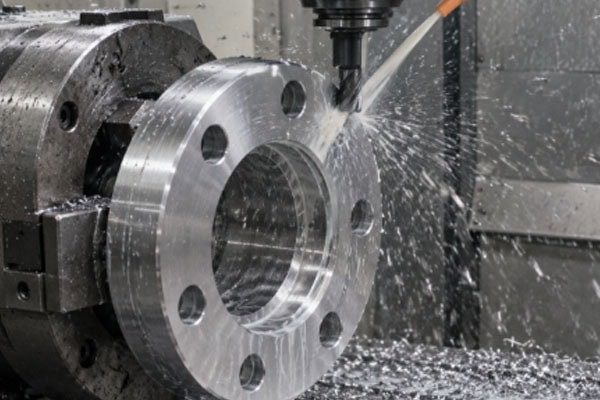
Cooling Methods Determine Whether Heat Can Be Removed in Time
Cooling is not only for temperature reduction but also affects chip evacuation and tool life.
Use High-Pressure Cooling Technology
High-pressure cooling allows coolant to more effectively reach the cutting zone between tool and workpiece, quickly removing heat generated during machining.
- Improve coolant delivery to the cutting point.
- Help flush away hot chips and prevent re-cutting.
- Reduce temperature at the tool tip and slow tool wear.
High-efficiency cooling is especially important for deep cavities and complex structures.
Maintain a Stable Cooling System
Insufficient coolant flow, improper nozzle positioning, or clogged pipelines can all reduce cooling performance. Therefore, the cooling system and filtration units should be regularly inspected. Nozzle direction should be adjusted according to tool position to ensure accurate coolant coverage of the cutting zone. Coolant performance should also remain stable to avoid degradation over time. Only under stable and reliable cooling conditions can temperature control be truly effective.
Improving Overall Thermal Stability Through Process Optimization
After tool, parameters, and cooling are determined, machining path optimization is still required to reduce heat concentration.
Use Dynamic Milling and Smooth Toolpaths
Dynamic milling helps maintain relatively stable cutting loads and avoids sudden engagement with large material volumes.
- Reduce instantaneous tool load and temperature spikes.
- Minimize heat accumulation caused by repeated cutting.
- Improve stability in complex contour machining.
Well-designed toolpaths shift high-temperature alloy machining from pure speed pursuit to a balance between efficiency and stability.
Reasonably Arrange Roughing and Finishing Sequence
For high-precision high-temperature alloy parts, staged machining can reduce the impact of thermal stress on final dimensions.
- Perform stable roughing first to quickly remove most material.
- Introduce cooling or intermediate stabilization steps as needed.
- Use finishing operations to control dimensional accuracy and surface quality.
This approach reduces the impact of heat and stress from earlier stages on final precision.
Conclusion
The difficulty of heat control in high-temperature alloy milling stems from the material’s high strength and low thermal conductivity, which cause heat to accumulate easily in the machining zone. Achieving stable machining results requires systematic optimization across cutting parameters, tool selection, cooling systems, and toolpath strategies rather than relying on a single method. For high-precision and complex high-temperature alloy components, TiRapid can provide customized CNC milling solutions based on material characteristics and drawing requirements, ensuring accuracy while optimizing efficiency and cost control.