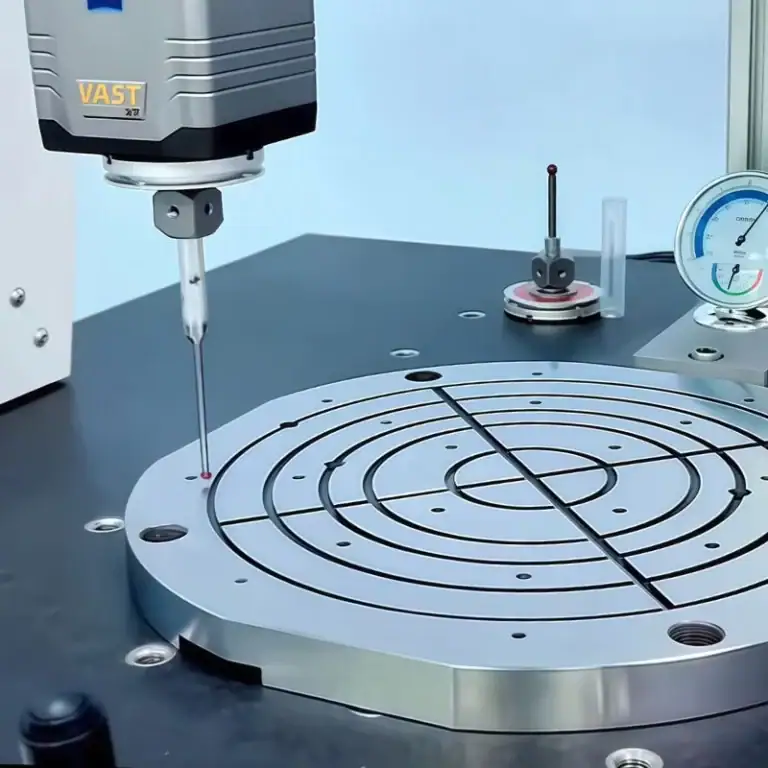
Semiconductor manufacturing depends on more than process recipes and advanced electronics. Behind wafer processing systems are thousands of precision mechanical components that position wafers, maintain vacuum, deliver gases, support motion, control temperature, and keep sensitive process areas clean. A small dimensional error, burr, particle source, or sealing defect can affect equipment stability and process repeatability.
Semiconductor equipment parts therefore require more than standard CNC machining. Material compatibility, tight tolerances, geometric control, surface condition, cleanliness, traceability, and repeat supply all matter. This guide explains common semiconductor equipment parts, materials, CNC machining methods, design considerations, finishing, cleaning, inspection, spare-part manufacturing, and supplier selection.
What Is Semiconductor Equipment And Why Do Its Parts Matter?
Semiconductor equipment includes the machines and process systems used to manufacture, handle, inspect, and package semiconductor wafers and devices. These systems rely on precision mechanical parts to maintain alignment, vacuum integrity, motion accuracy, thermal stability, and contamination control throughout production.
What Semiconductor Equipment Does
Semiconductor fabrication involves repeated deposition, etching, cleaning, coating, patterning, heat treatment, inspection, and material-handling steps. Each process requires equipment capable of maintaining tightly controlled conditions.
Mechanical components form the physical structure of those systems. Chambers contain process environments, stages position wafers, motion components control movement, and fittings or manifolds route gases and liquids.
Because many processes are sensitive to particles, leakage, temperature, and alignment, the mechanical quality of these parts can directly affect equipment performance.
Equipment Used In Semiconductor Manufacturing
Equipment used in semiconductor manufacturing includes deposition tools, etching systems, lithography-related equipment, cleaning systems, wafer-handling modules, metrology systems, thermal processing equipment, vacuum systems, and assembly or packaging equipment.
The exact mechanical requirements vary by machine. A structural plate may primarily need dimensional stability, while a chamber or vacuum flange may require strict sealing, surface quality, and contamination control.
Understanding where a part operates is therefore essential before selecting material, tolerance, finish, or machining strategy.
Why Precision Mechanical Parts Affect Equipment Performance
Precision mechanical parts determine how accurately different subsystems locate and interact with one another.
If a mounting plate is distorted, a motion module may lose alignment. If a sealing surface is not flat enough, vacuum performance can suffer. If a machined component retains burrs or particles, it may introduce contamination into a sensitive process area.
For this reason, semiconductor equipment parts should be treated as functional system components rather than ordinary machined hardware.
What Are Common Semiconductor Equipment Parts?
Semiconductor equipment parts range from large machined plates and process chambers to small shafts, fittings, brackets, vacuum interfaces, and alignment components. Their designs differ, but most require stable dimensions, controlled surfaces, repeatable assembly, and reliable material performance.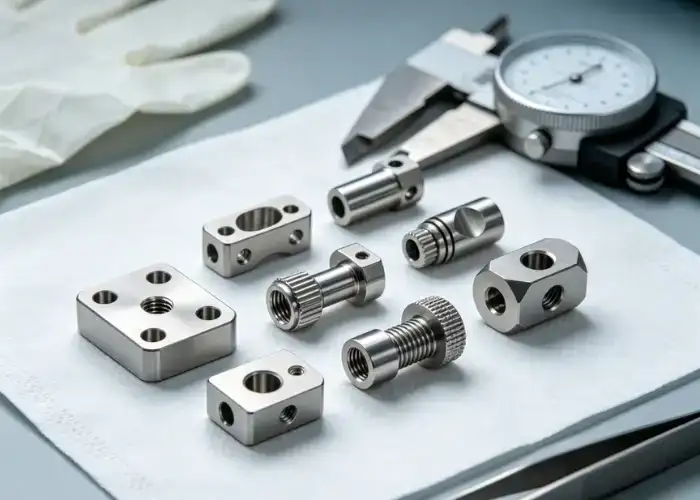
Process Chambers And Vacuum Components
Process chambers, chamber plates, lids, vacuum manifolds, adapters, and related components often operate under low-pressure conditions.
These parts may contain large pockets, sealing grooves, precision ports, bolt patterns, cooling channels, and critical mating surfaces.
Vacuum-facing components usually require careful control of surface finish, flatness, burrs, cleanliness, and material condition because leakage or contamination can affect system performance.
Wafer Handling And Motion Components
Wafer-handling systems use precision mechanical components to position and move wafers between process modules.
Typical parts include robot arms, end-effector components, motion brackets, shafts, carriers, alignment parts, and stage components.
These parts often require low mass, dimensional repeatability, smooth motion, and stable relationships between mounting and locating features.
Plates, Frames, Housings, And Structural Parts
Base plates, frames, housings, mounting blocks, and equipment structures support motion systems, optics, sensors, vacuum assemblies, and process modules.
Although these parts may appear simple, flatness, hole location, parallelism, and stiffness can be important because many other components reference them.
Large aluminum plates may also require careful machining sequences to control distortion.
Flanges, Fittings, Seals, And Gas Delivery Components
Gas delivery and vacuum systems depend on machined flanges, fittings, adapters, manifolds, valve bodies, and sealing interfaces.
These parts may need controlled bores, threads, sealing grooves, surface finish, and concentricity.
Material compatibility also matters because process gases, cleaning chemicals, and operating temperatures can vary significantly.
Fixtures, Tooling, And Alignment Components
Semiconductor equipment production and maintenance also rely on custom fixtures, calibration tools, alignment components, nests, gauges, and assembly tooling.
These parts often support repeatable positioning rather than direct wafer processing.
Their value comes from maintaining setup consistency, reducing assembly variation, and helping technicians reproduce service procedures.
Semiconductor Equipment Spare Parts
Semiconductor equipment spare parts are especially important for older tools, customized production lines, and systems where original components have long lead times or are no longer readily available.
A replacement part must reproduce more than its basic outer shape. Critical interfaces, tolerances, finishes, material condition, and assembly relationships must also match the original design.
What Makes Semiconductor Equipment Parts Different?
Semiconductor parts often operate in conditions where small mechanical imperfections have outsized consequences. Tight dimensional control, vacuum compatibility, chemical resistance, low particle generation, thermal stability, and repeatability must be considered together rather than as separate requirements.
Tight Dimensional Tolerances
Tight tolerances may be required for locating features, precision bores, seal grooves, mating interfaces, and motion components.
Not every dimension needs the same tolerance. Applying unnecessary precision across the entire part increases machining and inspection cost.
The better approach is to identify functional dimensions and allocate tighter tolerances where fit, alignment, sealing, or motion actually depends on them.
Precision Datums And Geometric Control
Dimensions alone do not fully define how surfaces and features relate.
GD&T requirements such as position, flatness, parallelism, perpendicularity, and runout can be important for semiconductor equipment because assemblies often rely on multiple interacting datums.
A part may have every individual dimension within tolerance and still fail assembly if its geometric relationships are incorrect.
High-Vacuum And Ultra-High-Vacuum Compatibility
Vacuum components require special attention to sealing surfaces, material condition, trapped volumes, threads, cavities, and cleanliness.
Surface defects or poor flatness can contribute to leakage, while contamination can increase outgassing.
Design and machining should therefore consider how the part will be cleaned, assembled, and exposed to vacuum—not only whether its dimensions meet the drawing.
Low Particle Generation And Contamination Control
Burrs, loose chips, abrasive residues, cutting fluids, fingerprints, and damaged coatings can all become contamination sources.
Sharp internal edges and inaccessible cavities can also trap debris.
This is why deburring, cleaning, handling, and packaging are part of the manufacturing process rather than optional finishing steps.
Chemical And Corrosion Resistance
Equipment parts may contact cleaning agents, process gases, coolants, or corrosive environments.
Material selection and surface treatment must match those conditions.
A material that machines easily is not necessarily appropriate if it reacts with the process environment or creates contamination risk.
Thermal Stability And Repeatability
Temperature changes can shift dimensions and alignment.
Large plates, thin sections, and assemblies with mixed materials are particularly sensitive to thermal expansion.
Machining strategy should also account for heat because a part measured immediately after heavy cutting may not have the same dimensions after returning to room temperature.
What Materials Are Used For Semiconductor Equipment Parts?
Material selection for semiconductor equipment depends on machinability, strength, corrosion resistance, vacuum compatibility, thermal behavior, electrical properties, cleanliness, and cost. No single material is suitable for every component.
Aluminum Alloys
Aluminum alloys are widely used for chambers, plates, brackets, housings, and structural parts.
They combine low density, good machinability, thermal conductivity, and relatively low manufacturing cost.
Aluminum is also compatible with surface treatments such as anodizing, although coating thickness and dimensional change must be considered on precision interfaces.
Stainless Steel
Stainless steel is common where corrosion resistance, strength, cleanability, or vacuum performance is important.
Grades such as 304 and 316 families are frequently used in fittings, vacuum parts, hardware, and process-related components.
Compared with aluminum, stainless steel generally requires lower cutting speeds and more attention to tool wear and heat.
Titanium And Nickel Alloys
Titanium and nickel-based materials are selected for demanding chemical, thermal, or mechanical environments.
They offer excellent corrosion or high-temperature performance but are more difficult and expensive to machine.
Tool selection, cutting speed, heat control, and workholding become especially important for these materials.
Copper And Copper Alloys
Copper is useful when electrical or thermal conductivity is important.
It may appear in thermal management, power, electrical, or specialized process components.
Pure copper can be challenging to machine cleanly because of its ductility, while some copper alloys provide better machinability.
Engineering Plastics
PEEK, PTFE, PCTFE, POM, and other engineering plastics can be used for insulators, seals, guides, fixtures, and chemical-resistant components.
Plastic machining requires attention to thermal expansion, clamping force, moisture behavior, burr formation, and stress.
The dimensional strategy used for a metal component should not automatically be applied to plastic.
How To Match Material To Vacuum, Chemical, And Thermal Conditions
Material selection should begin with the operating environment.
Engineers should consider vacuum level, chemical exposure, temperature, mechanical load, cleanliness, conductivity, and required surface treatment.
Machinability is important for cost, but it should come after functional compatibility.
What Should Be Considered Before CNC Machining Semiconductor Parts?
Good semiconductor CNC machining begins before the machine starts cutting. Datum structure, tolerance chains, wall thickness, tool access, sealing features, thread design, cleaning access, and assembly requirements all influence whether a part can be produced reliably.
Datum Strategy And Tolerance Chains
Critical features should reference functional datums that reflect how the part assembles or operates.
A clear datum strategy helps machining, inspection, and assembly use the same coordinate logic.
It also reduces the risk of stacking multiple independent dimensions that create unnecessary tolerance accumulation.
Thin Walls And Distortion Risk
Large pockets and thin walls can reduce mass but increase deformation risk.
Residual stress in raw material, uneven stock removal, clamping force, and machining heat can all cause the part to move.
Roughing, stress-relief time, symmetrical material removal, and controlled finishing can improve stability.
Deep Pockets And Tool Accessibility
Deep cavities and narrow pockets require long tools, which reduce rigidity.
Long tool overhang increases vibration, deflection, and cycle time.
If design allows, larger internal radii, more open access, or alternative part orientation can significantly improve manufacturability.
Sealing Faces And Vacuum Interfaces
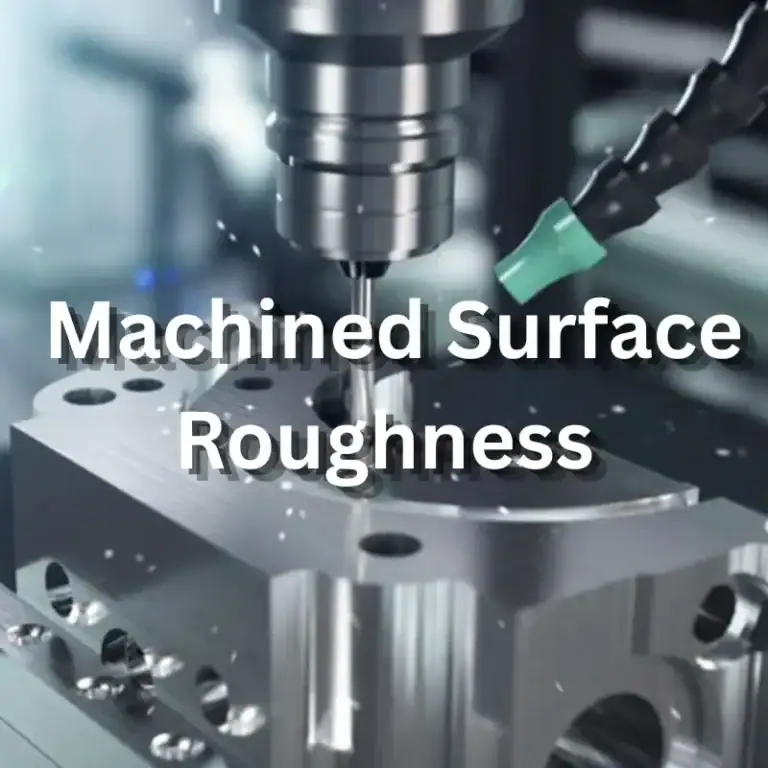
Sealing faces need special attention because roughness and flatness work together.
A surface can have an excellent Ra value but still leak if it is warped or contains scratches across the sealing path.
Seal groove dimensions, edge conditions, and surface direction should therefore be reviewed as a complete system.
Holes, Threads, And Assembly Features
Blind holes, threaded holes, dowel holes, counterbores, and precision bores often determine how the component assembles.
Depth, thread engagement, positional tolerance, and tool access should be reviewed early.
Overly tight position tolerances on every hole can add cost without improving actual assembly performance.
Design For Cleaning And Maintenance
Part geometry should not trap cutting fluid, chips, or cleaning residue.
Blind cavities, inaccessible corners, deep threaded holes, and small intersecting passages can be difficult to clean.
Designing for drainage, access, disassembly, and inspection can improve both manufacturing and equipment maintenance.
How Are Semiconductor Equipment Parts CNC Machined?
CNC machining for semiconductor equipment typically combines milling, turning, precision hole machining, multi-axis work, and controlled finishing. The objective is not simply to achieve dimensions but to preserve datum relationships, surface quality, cleanliness, and repeatability across production.
CNC Milling For Plates, Chambers, And Complex Features
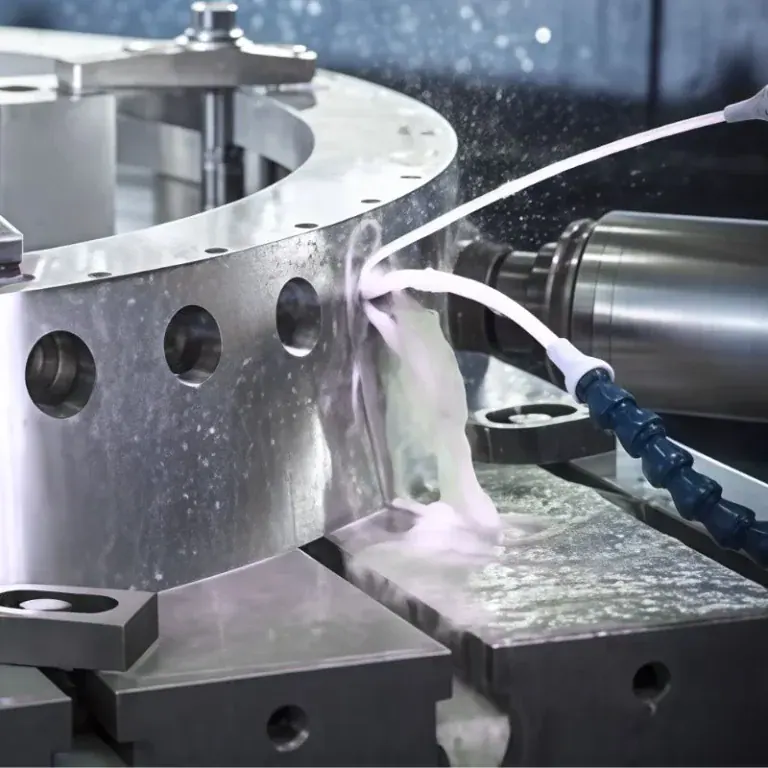
CNC milling is widely used for base plates, chamber components, housings, manifolds, and brackets.
Roughing removes bulk material, while finishing operations control flatness, wall position, sealing surfaces, and critical pockets.
Large aluminum parts may require multiple stages so the material can stabilize before final finishing.
CNC Turning For Shafts, Flanges, And Cylindrical Parts
Turning is efficient for shafts, spacers, sleeves, fittings, flanges, and round vacuum components.
Precision turning can control concentric diameters, grooves, threads, and sealing features in one setup.
Live tooling or mill-turn machines can also add cross holes and milled features without transferring the part.
5-Axis Machining For Complex Geometry
Five-axis machining is valuable when a component has multiple angled features, complex surfaces, or difficult tool access.
It can reduce repositioning and allow more features to be machined in one setup.
Fewer setups can improve relationships between critical holes, surfaces, and datums.
Precision Hole, Thread, And Sealing Surface Machining
Critical holes may require boring, reaming, interpolation, or other finishing methods instead of ordinary drilling.
Threads may be tapped, milled, or turned depending on size and application.
Sealing surfaces should be finished with a process capable of meeting both roughness and flatness requirements.
One-Setup Machining For Better Positional Accuracy
Each additional setup introduces a new opportunity for locating error.
Where practical, machining multiple related features in one setup improves positional consistency.
This is one reason multi-axis machining and mill-turn platforms can be useful for complex semiconductor components.
Prototype And Low-Volume Production
Semiconductor equipment development often involves engineering changes and low-volume parts before design stabilization.
CNC machining is well suited to this environment because it does not require dedicated production tooling.
Once the design is validated, the same process can be refined for repeat batches.
How Are Tolerances And Surface Quality Controlled?
Precision control requires the machining process, tooling, workholding, temperature, and inspection plan to work together. Semiconductor parts should not rely on final inspection alone to catch instability after machining is complete.
Dimensional Tolerance Control
Critical dimensions should be associated with appropriate cutting and inspection methods.
Bores may require boring or reaming, while precision thickness or parallel faces may need dedicated finishing passes.
Process capability should match the tolerance rather than relying on repeated adjustment after every part.
GD&T For Position, Flatness, And Perpendicularity
GD&T communicates how features relate to functional datums.
Position is useful for hole patterns, while flatness and perpendicularity are often important for mounting or sealing.
CMM inspection can be especially useful when multiple geometric relationships must be verified together.
Surface Roughness Requirements
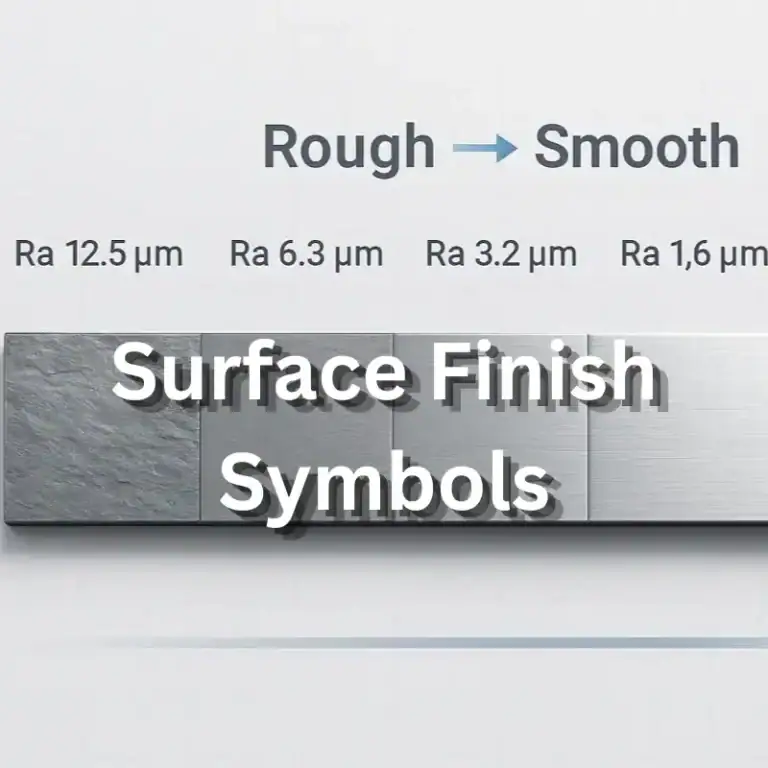
Surface roughness affects sealing, wear, contact, coating, and cleanability.
The lowest Ra value is not automatically the best choice.
The requirement should reflect actual function because finer finishes increase cycle time and may require additional processes.
Flatness And Sealing Surface Control
Flatness and roughness should be treated separately.
A smooth surface can still be geometrically warped.
Large sealing surfaces may require controlled workholding, balanced material removal, temperature stabilization, and carefully planned finishing passes.
Burr And Edge Control
Burrs can interfere with assembly and become particle sources.
Hole intersections, slots, threads, and cross-drilled features are common burr locations.
Deburring should remove loose material without changing critical edges, sealing surfaces, or precision geometry.
Thermal Control During Precision Machining
Cutting heat can affect both the machine and the workpiece.
Temperature-sensitive components may need to cool before final measurement.
For very tight tolerances, machining and inspection conditions should be controlled so measurements represent the stabilized part.
What Finishing Processes Are Used On Semiconductor Equipment Parts?
Surface treatment can improve corrosion resistance, cleanability, wear performance, or chemical compatibility, but it can also change dimensions and surface condition. Finishing must therefore be planned together with machining rather than added after dimensions are finalized.
Anodizing For Aluminum Parts
Anodizing is widely used on aluminum components for corrosion protection and surface performance.
Coating growth can affect bores, threads, sealing lands, and tight-fitting interfaces.
Critical areas may require masking or dimensional compensation before finishing.
Passivation For Stainless Steel
Passivation is used to improve the corrosion resistance of stainless steel surfaces by removing contaminants and supporting the protective oxide layer.
It is commonly considered for clean or corrosion-sensitive components.
The machining and cleaning process should avoid introducing contamination that reduces the effectiveness of the final surface.
Electropolishing For Clean And Corrosion-Resistant Surfaces
Electropolishing removes a controlled amount of material from a metal surface.
It can reduce microscopic peaks, improve cleanability, and enhance corrosion resistance.
However, because material is removed, dimensionally sensitive features should be evaluated before specifying the process.
Plating And Protective Coatings
Special coatings or plating may be required for wear, conductivity, corrosion resistance, or process compatibility.
Coating thickness can change dimensions and fit.
The drawing should make clear which dimensions apply before and after coating.
How Finishing Can Affect Dimensions And Tolerances
Finishing affects more than appearance.
Added or removed material can change diameters, threads, groove widths, and fits.
A manufacturing plan should therefore identify critical coated features before CNC programming begins.
Why Is Semiconductor Equipment Parts Cleaning Important?
Semiconductor equipment parts cleaning removes machining oils, chips, particles, abrasive residue, fingerprints, and other contaminants that could compromise vacuum performance, surface treatment, or equipment cleanliness. Cleaning requirements should be defined according to the part’s final environment.
Removing Oils, Chips, And Machining Residues
Machining generates contamination by definition.
Cutting fluid, chips, dust, polishing residue, and cleaning compounds can remain on the part after cutting.
Threads, pockets, intersecting holes, and internal channels deserve particular attention because they can retain debris.
Cleaning Before Surface Treatment
Surface treatments require properly prepared surfaces.
Oil or residue can affect coating adhesion and surface consistency.
Pre-treatment cleaning should therefore be compatible with both the base material and the finishing process.
Final Cleaning After Machining And Finishing
Final cleaning removes particles and residues introduced during machining, deburring, polishing, and finishing.
The cleaning method should not damage coatings, change dimensions, or leave new contamination.
Handling after cleaning is just as important as the cleaning process itself.
Particle And Contamination Control
Particle control depends on the entire workflow.
A clean part placed on a dirty bench or packed with shedding material can quickly become contaminated again.
Manufacturers should separate dirty machining operations from final cleaning, inspection, and packaging where required.
Clean Handling And Protective Packaging
Clean gloves, appropriate protective materials, capped ports, and sealed packaging can help preserve the final condition.
Packaging should protect critical surfaces from scratches and prevent foreign material from entering bores, channels, or vacuum interfaces during transport.
How Are Semiconductor Equipment Parts Inspected?
Inspection verifies dimensional accuracy, geometric relationships, surface quality, material identity, and documentation. A strong inspection plan focuses on features that affect equipment performance rather than measuring every dimension with the same method.
First-Article Inspection
First-article inspection confirms that the initial manufacturing process produces a part that matches the drawing.
It is especially useful for new parts, revised designs, or transferred production.
Any issue found at this stage can be corrected before repeat production.
CMM And Dimensional Inspection
CMM inspection is useful for hole patterns, datum relationships, profiles, perpendicularity, and complex geometry.
Micrometers, bore gauges, height gauges, and other conventional tools remain useful for simple dimensions.
The instrument should match the feature and tolerance.
Surface Roughness And Flatness Inspection
Surface roughness may be measured with a profilometer, while flatness may require CMM, surface plate methods, or other suitable equipment.
These characteristics should not be confused.
A sealing surface may need both to meet separate acceptance requirements.
Material Verification And Traceability
Material certificates, lot identification, or other traceability records may be required depending on the project.
Maintaining material identity becomes especially important when similar-looking alloys have different chemical, vacuum, or mechanical performance.
In-Process And Final Inspection
Waiting until final inspection to discover a process problem can be expensive.
Critical dimensions may be checked between roughing and finishing or after key setups.
This allows tool offsets or process conditions to be corrected before the part is complete.
Revision Control And Quality Documentation
Semiconductor equipment designs may change over time.
Manufacturers should ensure that CNC programs, drawings, inspection plans, and production records all correspond to the correct revision.
This is essential for repeat orders and spare-part supply.
How Are Semiconductor Equipment Spare Parts Manufactured?
Semiconductor equipment spare parts must reproduce the functional interfaces of the original component while maintaining reliable documentation for future orders. This may involve existing drawings, CAD data, measured samples, or reverse engineering.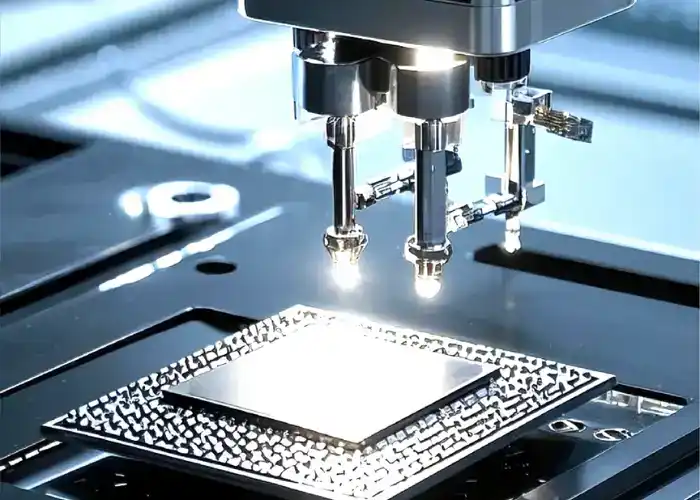
Manufacturing From Existing Drawings And CAD Models
The best situation is when current drawings and models are available.
The manufacturer can review material, tolerances, finishes, and critical features before creating the machining process.
Any conflict between the drawing and model should be clarified first.
Reverse Engineering Legacy Parts
Legacy equipment may no longer have complete design data.
In these cases, an existing sample can be measured and modeled.
Reverse engineering should focus on functional features such as interfaces, datums, fits, sealing surfaces, and assembly geometry rather than copying every worn dimension.
Reproducing Critical Fits And Interfaces
A spare part must fit the existing machine.
Mounting patterns, locating features, thread forms, shaft fits, connector positions, and sealing interfaces are therefore critical.
Small errors in these features can make an otherwise well-machined replacement unusable.
Prototype Validation Before Repeat Production
For reverse-engineered or modified parts, producing a small validation batch reduces risk.
Fit, function, assembly, and cleanliness can be checked before committing to repeat supply.
Once validated, the manufacturing process can be locked down.
Revision Control For Future Reorders
A spare-part program becomes more valuable when the supplier preserves approved drawings, programs, inspection methods, and revision history.
Future orders can then reproduce the validated component without restarting the engineering process.
How To Choose A CNC Supplier For Semiconductor Equipment Parts
The right supplier should combine machining capability with process discipline. Semiconductor equipment manufacturers need more than a shop that can reach a dimension once, they need repeatable machining, controlled materials, reliable finishing, inspection, cleaning, documentation, and future supply.
Tight-Tolerance Machining Experience
Experience with precision bores, sealing faces, datum structures, thin walls, and multi-setup parts reduces manufacturing risk.
The supplier should understand how tolerances affect process planning rather than simply agreeing to every drawing requirement.
Material And Process Control
Material identification, stock condition, tooling, heat control, deburring, and finishing all influence final quality.
A controlled process is especially important when repeat orders must match earlier production.
Multi-Axis Machining Capability
Multi-axis equipment can reduce setups and improve access to complex parts.
However, machine capability alone is not enough.
Programming, fixturing, tool control, and inspection must support the same level of precision.
Finishing, Cleaning, And Inspection Support
A supplier that coordinates machining, finishing, cleaning, and inspection can reduce handoff risk.
Critical interfaces should be protected throughout the entire workflow.
Clear responsibility for final acceptance also simplifies project management.
Prototype-To-Production Flexibility
Semiconductor equipment development frequently changes.
A useful supplier should be able to support one-off engineering parts, prototypes, low-volume builds, and repeat production without forcing every project into the same manufacturing model.
Traceability And Repeat Supply Capability
Repeatability matters over months or years.
A supplier should maintain part revisions, programs, inspection records, approved processes, and material information so future batches can be reproduced consistently.
FAQs
Can Semiconductor Equipment Parts Be Reverse Engineered From Existing Samples?
Yes. Reverse engineering can be effective for legacy or unavailable components, but worn dimensions should not automatically be copied. Functional interfaces, original fits, datums, and operating conditions should be evaluated before creating the replacement model.
How Should Vacuum Sealing Surfaces Be Specified?
Vacuum sealing surfaces should be defined using the geometry and texture that the seal design actually requires. Flatness, surface roughness, scratches, groove dimensions, and edge condition may all matter, so specifying only a low Ra value is often insufficient.
Are Engineering Plastics Suitable For Semiconductor Equipment?
Yes, depending on the environment. Materials such as PEEK, PTFE, and other engineering plastics can be useful for insulation, chemical resistance, low friction, or fixtures. Temperature, vacuum behavior, dimensional stability, and contamination requirements should be checked first.
When Should A Semiconductor Part Be Machined In One Setup?
One-setup machining is valuable when multiple features have tight positional relationships or when re-clamping would introduce alignment error. It is not necessary for every part, so the benefit should be balanced against machine complexity and cost.
Conclusion
Semiconductor equipment parts demand a coordinated manufacturing approach because precision, vacuum performance, surface quality, cleanliness, material compatibility, and repeatability are closely connected. Reliable production begins with clear design requirements and continues through material selection, CNC machining, finishing, cleaning, inspection, and revision control. The best manufacturing plan applies tight controls to critical features while avoiding unnecessary complexity on nonfunctional areas.
At TiRapid, we provide precision CNC machining and manufacturing services for semiconductor equipment parts, prototypes, and repeat production. Our team supports complex milling, turning, multi-axis machining, material control, surface finishing, inspection, and quality documentation to help customers achieve reliable parts with stable lead times and repeatable performance.