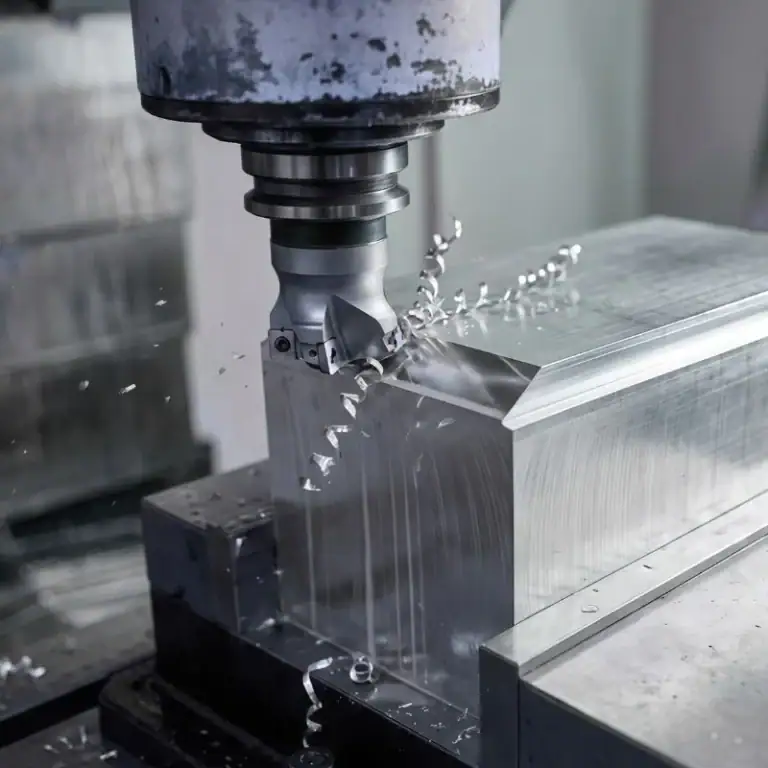
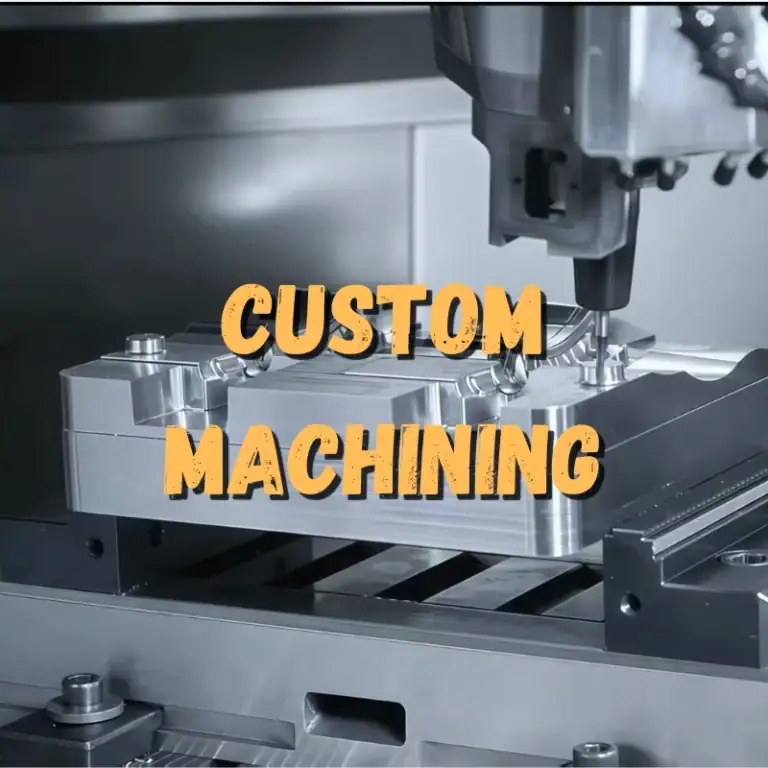
In precision part machining, deep cavity structures have always been one of the more challenging aspects of CNC milling due to their complex internal walls, deep machining areas, and high precision requirements. Among these challenges, poor chip evacuation is a critical factor affecting machining quality. If chips cannot be removed in time, it may not only cause abnormal tool wear but also lead to surface scratches, dimensional deviations, and reduced machining efficiency. For high-precision products such as aerospace components, molds, and mechanical structural parts, improving chip evacuation capability in deep cavity milling is key to enhancing machining stability and product quality. By properly selecting tools, optimizing machining parameters, and improving cooling methods, the negative impact of chip evacuation issues can be effectively reduced.
Why Is Chip Evacuation Difficult in Deep Cavity Milling?
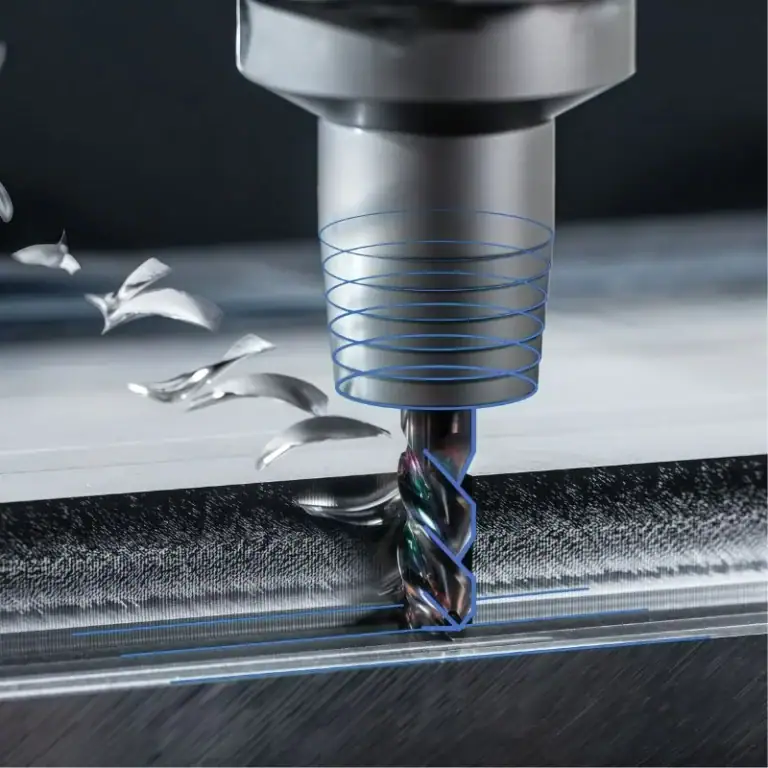
Compared with conventional milling, deep cavity machining environments are more enclosed, making it harder for chips generated during cutting to be removed quickly, which increases the likelihood of machining issues.
Limited Machining Space Leads to Chip Accumulation
Deep cavity structures typically have a high depth-to-width ratio. Once the tool enters the workpiece, the cutting zone is far from the external space, limiting the natural chip evacuation path.
- Chips tend to remain in the machining area, causing re-cutting and affecting surface quality.
- Accumulated chips increase friction between the tool and workpiece, raising machining temperature.
- Long-term buildup may cause tool jamming and increase the risk of tool breakage.
Improving the chip evacuation environment inside deep cavities can reduce re-cutting and enhance process stability.
Tool Structure Affects Chip Evacuation Performance
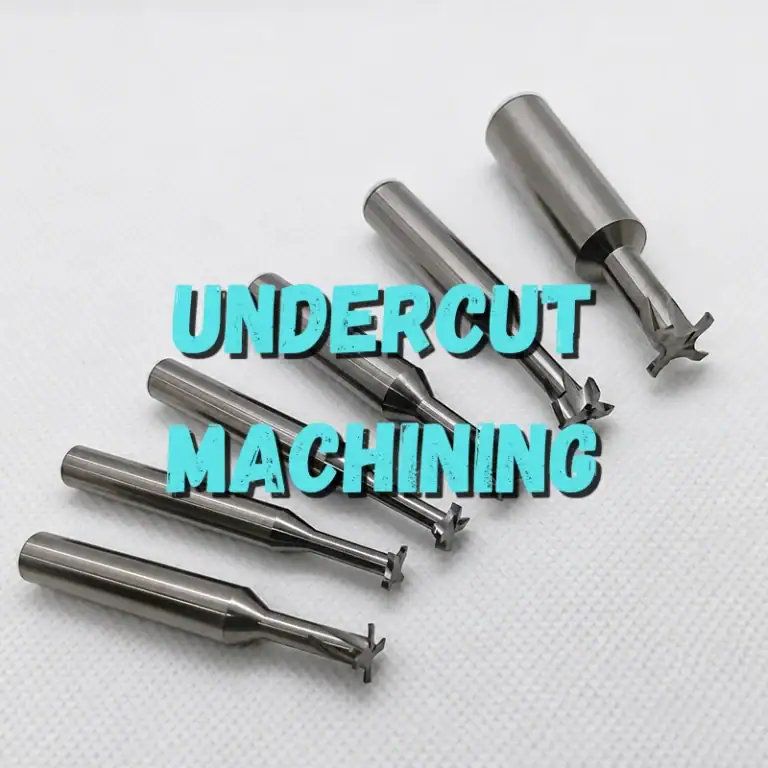
As the direct cutting element, tool geometry—including flute design, number of flutes, and tool length—significantly affects chip evacuation efficiency.
- Too many flutes may reduce chip space, making evacuation more difficult.
- Insufficient flute depth can lead to chip clogging.
- Excessive tool overhang reduces rigidity, increases vibration, and negatively impacts chip removal.
Selecting a tool structure suitable for deep cavity machining can effectively improve cutting smoothness.
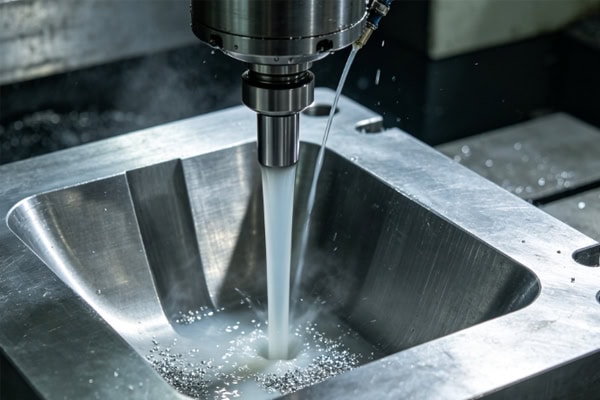
Optimizing Tool Selection to Improve Chip Evacuation in Deep Cavities
Tool selection is a key factor in solving chip evacuation issues in deep cavity milling and must be matched according to material properties and machining depth.
Use Tools with Large Chip Flutes
For deep cavity machining, tools with larger chip-carrying capacity are generally required.
- Improve chip holding capacity and prevent clogging during machining.
- Accelerate chip evacuation and reduce the likelihood of re-cutting.
- Reduce heat buildup on the tool and extend tool life.
A well-designed flute geometry ensures smoother cutting performance.
Control Tool Overhang Length
Deep cavity machining often requires long tools, but excessive overhang reduces rigidity and affects stability. In practice, unnecessary tool extension should be minimized to improve system rigidity, reduce vibration, prevent chip retention or poor evacuation, and enhance dimensional control. Optimizing tool length while meeting machining depth requirements can improve both chip evacuation and overall machining stability.
Use Tool Types Suitable for the Material
Different materials produce different chip forms, so tool selection must be matched accordingly.
- For aluminum alloys, attention should be paid to chip continuity and built-up edge issues.
- For stainless steel, tools with higher heat and wear resistance are required.
- For high-hardness materials, high-performance tools are needed to reduce cutting load.
Adjusting tool configuration based on material characteristics helps reduce chip evacuation issues and improves CNC milling efficiency.
Adjusting Machining Parameters to Reduce Chip Accumulation
Machining parameters also play a decisive role in chip evacuation performance during deep cavity milling.
Reasonably Reduce Cutting Load
If the cutting volume per pass is too large in deep cavity machining, excessive chips will be generated, making evacuation difficult.
- Control cutting depth to avoid excessive chip generation in a short time.
- Use layered machining strategies to remove material gradually.
- Reduce tool load to improve machining stability.
Proper allocation of machining allowance helps prevent chip concentration issues.
Optimize Feed Rate and Spindle Speed Matching
Spindle speed and feed rate must be properly balanced; otherwise, chip formation may be negatively affected.
- Avoid excessively low feed rates that increase friction and produce fine fragmented chips.
- Maintain stable cutting conditions to facilitate chip evacuation.
- Improve material removal efficiency and shorten machining time.
Scientific parameter optimization ensures more stable cutting and reduces chip evacuation pressure.
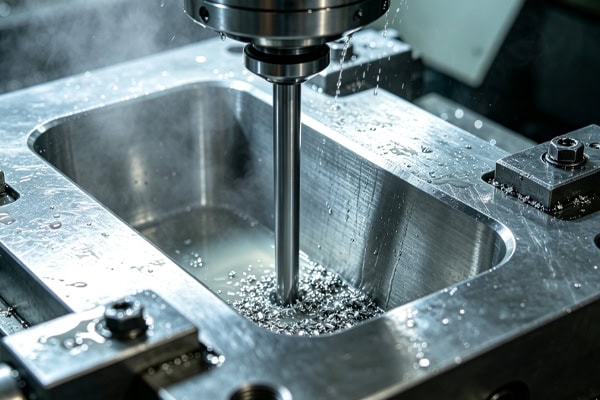
Improving Cooling Methods to Enhance Chip Evacuation Efficiency
Cooling systems are not only used for temperature reduction but also help remove chips from the machining area.
Use High-Pressure Coolant for Chip Evacuation
Conventional cooling methods may have limited coverage in deep cavities, while high-pressure coolant provides better assistance. It uses fluid pressure to remove chips, reduces chip residence time, improves machining continuity, lowers tool temperature, and reduces thermal wear, thereby improving overall machining quality.
Use Air Cooling or Assisted Chip Blowing
For certain materials, air cooling systems can also effectively improve chip evacuation in deep cavities.
- Quickly remove chips from the machining area.
- Prevent chips from re-entering the cutting zone.
- Maintain a clean and stable machining environment.
A proper combination of cooling and air-blowing methods can further improve machining reliability.
Improving Deep Cavity Milling Performance Through Machining Strategies
Well-designed toolpath planning is also an important way to solve chip evacuation problems.
Optimize Toolpath Planning
Advanced CAM programming allows engineers to design more efficient machining paths.
- Reduce repeated tool passes over the same area.
- Improve utilization of chip evacuation space.
- Minimize non-productive movements.
Optimized toolpaths not only improve chip evacuation but also increase machining efficiency.
Use Multi-Stage Machining Strategies
Complex deep cavity parts are usually not suitable for single-pass machining and require a well-structured process.
- Perform rough machining first to remove most of the material quickly.
- Use semi-finishing and finishing to ensure dimensional accuracy.
- Reduce cutting load during finishing stages.
A well-planned process reduces machining risks and improves part quality.
Conclusion
The stability of deep cavity milling depends on a systematic coordination of tool selection, cutting parameters, cooling methods, and toolpath planning rather than optimization of a single factor. Only through integrated process optimization can chip retention risks be continuously reduced and machining consistency improved. Leveraging mature CNC machining capabilities and engineering expertise, TiRapid provides stable and reliable manufacturing support for complex structural parts, helping customers achieve high-precision and high-efficiency production goals.