Material costs have a direct impact on the manufacturing cost of CNC-turned components. This is particularly important when machining stainless steel, copper alloys, titanium alloys, aluminum alloys, and high-strength alloy materials, where raw material prices can be relatively high. Excess material, chips, remnants, and defective components generated during machining can all increase production expenses. Proper material management can reduce the manufacturing cost per component, improve raw material utilization, decrease scrap handling requirements, and improve the economics of batch production. CNC turning is inherently programmable and digitally controlled, making it possible to reduce material waste through optimized blank dimensions, appropriate machining allowances, improved tool paths, reduced workholding errors, and controlled cutting parameters. For shafts, sleeves, flanges, fittings, threaded components, and other rotational parts, a well-designed turning process can convert a greater percentage of the raw material into useful products while reducing unnecessary cutting. Manufacturers can also combine automated loading and unloading, in-process inspection, tool life management, and production data tracking to continuously control material consumption. This allows CNC turning operations to maintain dimensional accuracy and surface quality while achieving more efficient material utilization.
Optimize Blank Dimensions to Reduce Material Loss
Blank dimensions are an important factor affecting material utilization in CNC turning. If the blank diameter or length is significantly larger than required, the machining process must remove a greater amount of excess material, increasing cutting time and generating more chips. In batch production, even a small amount of additional material consumed per component can become a significant cost after hundreds or thousands of parts are produced. Blank dimensions should be determined according to the finished component size, machining allowance, workholding requirements, and subsequent operations. For bar-stock turning, manufacturers can select a bar diameter close to the maximum component diameter. For discs or short shafts, the blank length can be determined according to the finished component length, clamping requirements, facing allowance, and cutoff allowance. Optimizing blank dimensions reduces unnecessary material consumption before machining even begins and creates a better foundation for efficient turning production.
Select an Appropriate Bar Diameter
CNC turning frequently uses round bar stock as the raw material, and bar diameter directly affects how much material must be removed during machining. If a component requires a relatively small finished external diameter but a significantly larger bar is consistently used, a large amount of material will be removed during roughing. Manufacturers can select standard bar sizes based on the maximum component diameter, tool capability, and workholding requirements.
- Select bar stock according to maximum component diameter
- Prioritize sizes close to the finished diameter
- Reduce unnecessary radial machining allowance
- Purchase according to standard material specifications
- Standardize bar sizes for batch production
- Control the number of different material specifications in inventory
Selecting an appropriate bar diameter reduces roughing time and chip generation while lowering tool loads. This is especially valuable when machining expensive materials because every reduction in unnecessary cutting directly contributes to lower material consumption.
Properly Control Bar Length
Bar length also affects material utilization. When components are relatively short, excessive clamping length and cutoff allowance can create a large amount of unusable remnant material. The cutting length should be calculated according to fixture requirements, clamping length, cutoff width, facing allowance, and finished component length.
Appropriate cutting lengths allow more components to be produced from each bar while reducing the quantity of leftover material. For batch production, manufacturers can establish standardized cutting lengths according to actual component dimensions, allowing operators to follow consistent cutting specifications and reducing manual measurement errors.
Optimize Machining Allowances to Reduce Unnecessary Cutting
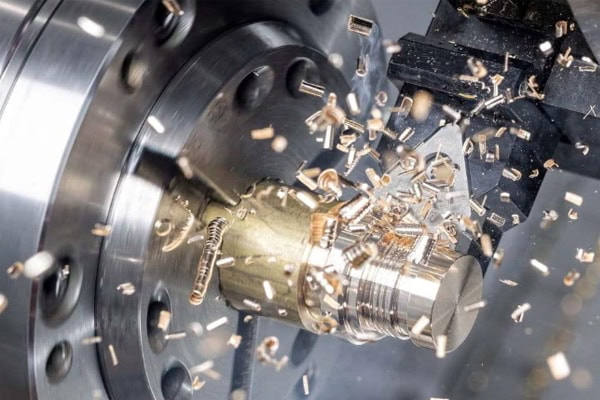
Machining allowance directly determines how much raw material must be removed during CNC turning. Excessive allowance increases roughing time, tool wear, and chip generation, while insufficient allowance may prevent complete removal of surface defects from the blank and make it difficult to achieve the required final dimensions. Appropriate machining allowances should be determined according to material condition, blank accuracy, component dimensions, tolerance requirements, and machine tool accuracy. For precision-drawn, forged, or high-quality bar stock, machining allowances can often be reduced. For blanks with greater surface or dimensional variation, additional allowance may be required. CNC programs can also distribute machining allowances between roughing and finishing operations so that roughing removes the majority of excess material while finishing only removes the material necessary to achieve final dimensions and surface quality.
Properly Control Roughing Allowances
The purpose of roughing is to remove excess material efficiently, but maximum cutting volume is not always the best solution. Excessive cutting depth can increase tool loading, cause vibration, lead to edge chipping, and even deform the component, affecting subsequent finishing operations. Selecting a suitable cutting depth according to material hardness, machine rigidity, and tool performance creates a better balance between material removal efficiency and machining stability.
- Set an appropriate cutting depth
- Control roughing allowance
- Reduce repeated cutting
- Lower tool loading
- Reduce machining vibration
- Improve material removal efficiency
Stable roughing can remove the majority of excess material in a relatively short time while reducing scrap caused by machining abnormalities. For high-volume production, this stability helps control average material consumption per component.
Maintain Stable Finishing Allowances
Finishing does not need to remove large quantities of material. Its primary purpose is to achieve final dimensions and surface quality. Excessive finishing allowance increases machining time and tool wear, while insufficient allowance may prevent complete removal of roughing marks. Maintaining a consistent allowance after semi-finishing allows the finishing tool to remove a predictable amount of material and reduces unnecessary passes.
Uniform finishing allowance also helps maintain stable cutting conditions and consistent tool loading, improving surface quality and dimensional consistency. For precision components, stable allowance management can reduce rework and scrap while indirectly lowering material waste.
Optimize CNC Program Paths to Reduce Unnecessary Cutting
CNC programs determine not only the final dimensions of a component but also influence material consumption and machining time. Efficient tool paths reduce air cutting, repeated cutting, and unnecessary tool movements, allowing the tool to process required areas more directly. For simple shafts, rough-turning cycles can be optimized to reduce repeated movements. For components with steps, grooves, and threads, tool paths can be arranged according to machining sequence to reduce unnecessary retracts and repositioning. Program optimization can also prevent tools from repeatedly cutting areas that have already been machined, reducing tool wear and unnecessary chip generation. CNC simulation software can be used to verify programs and identify repeated paths or inefficient movements before production begins.
Reduce Air Cutting and Repeated Passes
Tool movement without material removal does not directly consume material, but it increases machining time and can cause unnecessary tool travel through already-machined areas. Optimizing program paths allows the tool to move shorter distances within safe operating limits and reduces unnecessary movement.
- Shorten tool travel distance
- Reduce repeated machining
- Optimize retract paths
- Arrange machining sequences properly
- Reduce air-cutting time
- Lower tool wear
An efficient program path ensures that each cutting movement has a clear machining purpose while reducing unnecessary material removal.
Use Appropriate Machining Cycles
CNC systems generally provide various turning cycles for external turning, internal boring, facing, threading, and other operations. Proper use of these cycles can reduce repetitive programming and allow tools to follow stable machining paths. For batch production, standardized program templates can be developed for common component structures, reducing programming errors.
Once the program is stable, dimensional differences between components can also be reduced, minimizing scrap and material loss caused by programming errors.
Improve First-Pass Yield to Reduce Material Waste
Material waste does not only come from chips and remnants. Defective components are also a significant source of material loss. If a component is scrapped because of dimensional deviations, incorrect threads, surface defects, or machining deformation, the entire amount of raw material invested in that component becomes a loss. Improving first-pass yield requires control of program verification, tool management, fixture positioning, cutting parameters, and in-process inspection. This is particularly important when machining expensive materials because a single defective component can create significant economic loss. First-piece inspection, critical-dimension sampling, and in-process measurement can identify machining trends early and prevent large quantities of components from being produced with the same defect.
Perform First-Piece Inspection
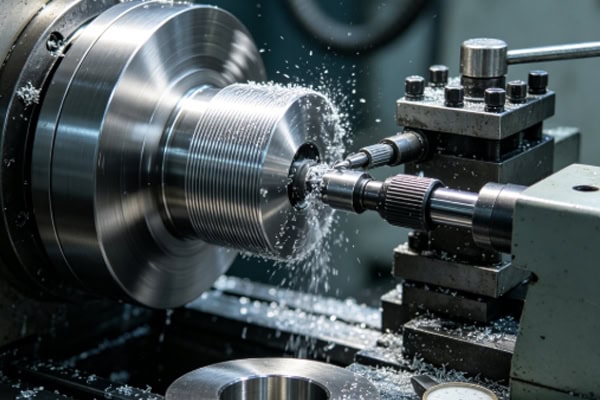
After batch production begins, the first component should undergo comprehensive dimensional inspection to confirm that the program, tool compensation, and workholding conditions meet production requirements. Continuous machining should begin only after the first component has been verified, reducing the risk of batch scrap caused by programming errors or dimensional deviations.
- Check external diameter
- Check internal bore dimensions
- Check component length
- Check groove width and depth
- Check threads
- Check surface quality
- Confirm critical tolerances
First-piece inspection can identify problems while material consumption is still low, making it an important method for controlling batch material waste.
Strengthen In-Process Dimensional Inspection
During continuous turning, tools gradually wear and machine temperature may change, potentially causing dimensional drift. Regular sampling or in-process measurement can detect dimensional changes and allow tool compensation to be adjusted in time.
Timely dimensional correction prevents large quantities of out-of-tolerance components from being produced and reduces rework and scrap. For high-precision automated production lines, in-process inspection systems can automatically collect critical dimensional data and improve process control efficiency.
Improve Tool Management to Reduce Scrap Caused by Machining Abnormalities
Tool condition directly affects material removal quality. When a tool becomes excessively worn, cutting resistance increases, surface quality deteriorates, and component dimensions may gradually shift. If a tool chips or fails unexpectedly, serious surface defects may occur, potentially causing the component to be scrapped. Establishing a tool life management system allows manufacturers to define appropriate replacement criteria according to machining quantity, cutting time, and actual tool wear. Different materials require cutting inserts with suitable materials and geometries to maintain stable cutting conditions. Effective tool management reduces abnormal machining and unexpected scrap while extending tool service life.
Select Suitable Tools According to Material
Aluminum alloys, copper alloys, stainless steel, carbon steel, alloy steel, and engineering plastics have different cutting characteristics and should not be processed with identical tool configurations. Selecting tools according to material hardness, toughness, and thermal conductivity can reduce cutting resistance and abnormal wear.
- Use sharp tools for aluminum alloys
- Prioritize chip evacuation for copper alloys
- Use wear-resistant tools for stainless steel
- Select stable cutting tools for carbon steel
- Use high-strength tools for alloy steel
- Control cutting heat when machining engineering plastics
Proper material-tool matching reduces abnormal tool damage, improves machining stability, and lowers material scrap caused by tool-related problems.
Establish Tool Life Records
Recording tool usage time, machining quantity, material type, and wear condition helps manufacturers determine appropriate tool replacement intervals. Tools should not be replaced only after complete failure, but they also should not be discarded prematurely while still performing effectively.
Production data can be used to establish more accurate tool life standards, allowing operators to schedule tool changes according to actual machining conditions and reducing unexpected quality problems.
Reuse Remnants and End Pieces to Lower Material Costs
Remnants and end pieces generated during CNC turning are not necessarily worthless scrap. Some remnants with suitable lengths and acceptable surface conditions can be reused for short components. Manufacturers can establish remnant classification and storage procedures, identifying materials according to type, specification, and length for future production use. Copper, aluminum, stainless steel, titanium alloys, and other materials that cannot be reused can be sorted and transferred through appropriate metal recycling channels to recover material value. Proper remnant utilization reduces raw material purchasing requirements and can also lower scrap handling costs.
Establish Remnant Classification Management
Remnants made from different materials should not be stored together without identification. They should be classified according to material, diameter, length, and condition. Clear labels allow production personnel to quickly locate remnants suitable for current orders.
- Classify by material
- Classify by diameter
- Classify by length
- Mark remaining quantities
- Record storage dates
- Prioritize usable remnants
Standardized remnant management improves material reuse and reduces the need to purchase full-length bar stock for short components.
Separate and Recycle Metal Chips
Metal chips generated during turning have recycling value, but chips made from different materials should be collected separately. Mixing aluminum, copper, stainless steel, and steel chips increases subsequent recycling difficulty and may reduce recovery value.
Separate collection and standardized storage allow scrap materials to be recycled more efficiently while keeping the machining area cleaner and better organized.
Use Automated Production to Further Reduce Material Waste
Automation can reduce errors caused by manual operations and make material utilization more consistent. Automated loading and unloading equipment can perform workpiece clamping and removal according to fixed programs, reducing inconsistencies in manual loading dimensions. Automated inspection systems can continuously monitor critical dimensions and issue warnings or stop equipment when abnormalities are detected, preventing large quantities of material from continuing through an incorrect machining process. Smart production systems can also record material consumption, qualified production quantities, scrap quantities, and remnants for each batch, providing data for purchasing and process optimization. For high-volume CNC turning, automated management makes material usage more transparent and helps manufacturers continuously identify opportunities to reduce waste.
Automated Cutting Improves Material Utilization
Automated cutting equipment can repeatedly cut bars according to programmed lengths, reducing errors caused by manual measurement. For components with the same specifications, standardized cutting programs can maintain consistent lengths for every bar.
Automated cutting not only improves production speed but also reduces remnant waste caused by excessive cutting lengths. For high-volume production, these savings become increasingly significant as production volume increases.
Digital Data Supports Material Control
Digital production management systems can record material purchases, actual consumption, production quantities, scrap quantities, and remaining material. Long-term data analysis can reveal the actual material utilization rate for different components and identify abnormal consumption.manufacturers can use historical data to optimize purchasing specifications and blank dimensions, reduce excess inventory, and improve material turnover efficiency.
CNC Turning Achieves Higher Material Utilization Through Process Optimization
Reducing material waste in CNC turning requires continuous optimization of blank specifications, cutting lengths, machining allowances, program paths, tool condition, quality inspection, remnant management, and automated production. Selecting bar stock close to the finished component dimensions can reduce roughing material removal. Properly planning machining allowances reduces repeated cutting. Optimizing CNC programs reduces unnecessary tool movements and material consumption. Strengthening first-piece and in-process inspection reduces batch scrap. Effective tool life management prevents material loss caused by tool abnormalities. Standardized remnant and chip recycling further improves resource utilization. For precision CNC machining companies working with high-value metals, material utilization affects not only manufacturing costs but also long-term production efficiency and resource management. Through continuous improvement of machining processes and production management, every bar, blank, and batch of material can deliver greater value. This approach allows manufacturers to reduce production waste while maintaining component accuracy and product quality, ultimately improving the overall economic efficiency of CNC turning operations.