With the development of intelligent manufacturing, automation equipment has been widely applied in industries such as electronics, automotive, new energy, medical, and food packaging. The stable operation of equipment depends not only on control systems but also on high-quality mechanical components. Stainless steel, with its high strength, corrosion resistance, and wear resistance, is a commonly used material in automation equipment. However, these parts often feature complex structures and high precision requirements, making it difficult for conventional machining to balance efficiency and quality. CNC precision machining, with its digital control and stable mass production capability, provides a reliable solution for stainless steel part manufacturing, helping companies improve quality and accelerate delivery.
Why Do Automation Equipment Use Stainless Steel Parts?
Automation equipment requires long-term stable operation. Stainless steel offers a balance of strength, durability, and machinability, making it suitable for various industrial environments.
Meeting High-Strength Application Requirements
Moving components and load-bearing structures in equipment require strong mechanical performance.
- Stainless steel offers excellent compressive and impact resistance, suitable for high-load environments.
- CNC machining enables precise dimensional control and improves part fit accuracy.
- Precision manufacturing reduces wear during long-term operation and enhances equipment stability.
High-quality stainless steel parts can effectively extend the service life of automation equipment.
Improving Corrosion Resistance
Many automation systems operate in humid, dusty, or chemically aggressive environments.
- Stainless steel provides excellent corrosion resistance.
- CNC machining maintains surface quality, providing a solid foundation for polishing and passivation processes.
- Selecting appropriate stainless steel grades based on application environments improves part reliability.
Superior corrosion resistance allows equipment to adapt to more complex production conditions.
Meeting Complex Machining Requirements
As automation equipment continues to evolve, part structures are becoming increasingly complex.
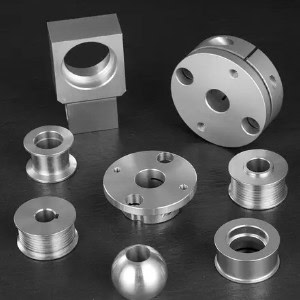
- CNC machining can produce deep holes, irregular contours, and precision grooves.
- Multi-axis machining improves the ability to form complex parts in a single setup.
- Custom machining supports non-standard automation equipment requirements.
Flexible machining methods meet diverse design requirements in automation projects.
| Automation Equipment Requirements | CNC Machining Solutions | Typical Applications |
| High-precision assembly | CNC precision milling | Mounting bases, connectors |
| High-strength components | Stainless steel precision machining | Brackets, transmission parts |
| Complex structures | 3-axis / 5-axis machining | Mechanical components |
| Rapid product development | CNC rapid prototyping | Prototype validation |
| Mass production | Standardized manufacturing process | OEM equipment parts |
How Does CNC Machining Improve Stainless Steel Part Manufacturing Efficiency?
Automation equipment manufacturing requires not only high-quality parts but also fast delivery and stable production capability.
Accelerating Product Development
During automation equipment development, parts often require multiple iterations and validations. CNC machining enables rapid prototyping directly from CAD drawings. Design modifications can be quickly reprogrammed without the need for new molds. It also supports prototyping, small-batch trial production, and mass manufacturing. This fast response capability significantly shortens the development cycle of automation equipment.
Ensuring Consistency in Mass Production
Equipment assembly relies on a large number of dimensionally consistent parts, making stability critical.
- CNC programs ensure consistency across different production batches.
- Automated machining reduces human error and improves yield rates.
- Precision inspection ensures key dimensions meet drawing requirements.
Stable manufacturing quality improves assembly efficiency and operational reliability.
Optimizing Overall Manufacturing Cost
Proper machining strategies help improve cost efficiency.
- CNC machining requires no dedicated molds, making it suitable for multi-variety, small-batch production.
- Precise machining reduces material waste and improves utilization.
- Lower rework and maintenance costs improve overall production efficiency.
A well-designed manufacturing process balances quality, efficiency, and cost control.

Application Scenarios of Stainless Steel Parts in Automation Equipment
As automation equipment continues to advance, stainless steel parts are widely used in multiple critical systems.
Automation Conveyor System Components
Conveyor systems require long-term continuous operation and high wear resistance. They typically require conveyor brackets, rail fixtures, and connecting components to ensure stable operation and reduce maintenance frequency. These parts must also meet customization requirements for different conveyor systems. High-precision machining further improves the reliability of automation conveyor equipment.
Industrial Robot Structural Components
Robotic systems require both strength and assembly precision.
- Supports manufacturing of joint connectors, mounting bases, and support components.
- Ensures motion system accuracy and improves positioning performance.
- Meets requirements for complex structures and high-load operation.
Professional machining capabilities enhance overall robot performance.
Automated Inspection Equipment Components
Inspection systems require strict dimensional and assembly accuracy.
- Machining inspection platforms, positioning fixtures, and mounting brackets.
- Ensures long-term stable operation of inspection equipment.
- Supports both prototype development and mass production.
High-quality stainless steel parts improve the efficiency of automated inspection systems.
How to Choose a Stainless Steel Parts Supplier for Automation Equipment?
Selecting a professional manufacturing partner helps ensure product quality and improve project delivery efficiency.
Evaluating Equipment and Technical Capability
Manufacturing automation equipment parts requires advanced machining capabilities.
- Availability of 3-axis, 4-axis, and 5-axis CNC machining.
- Extensive experience in stainless steel processing.
- Capability to manufacture complex structural components.
Mature machining capabilities ensure products meet design requirements.
Emphasizing Quality Management Systems
High-quality parts depend on strict quality control. Companies should establish comprehensive dimensional inspection processes, equip high-precision measurement tools, and implement full-process quality management. A robust inspection system ensures stable product delivery and helps reduce defect rates in mass production.
Providing Complete Manufacturing Services
Integrated machining services help reduce supply chain communication costs.
- DFM (Design for Manufacturability) analysis to optimize part design.
- Surface finishing services such as polishing, passivation, and sandblasting.
- Full coverage from rapid prototyping to small-batch and mass production.
Comprehensive manufacturing services enable more efficient automation equipment development.
With the continuous advancement of high-end equipment manufacturing, stainless steel parts play an increasingly important role in automation systems, especially in load-bearing structures and precision functional components. Leveraging CNC precision machining technology enables efficient complex structure fabrication, stable mass production, and rapid iterative development, helping companies improve overall equipment performance and market responsiveness. TiRapid provides CNC machining services for stainless steel parts in automation equipment, supporting end-to-end precision manufacturing from rapid prototyping to large-scale production.