In aerospace, automotive lightweighting, and high-end sports equipment, composite materials are being used more and more widely. However, one long-standing and difficult problem that comes with them is milling delamination. Many engineers encounter this situation: even when parameters seem correct, issues like fiber lifting, resin tearing, or interlayer separation still occur during machining. These not only affect appearance but also weaken structural strength. Especially in CNC milling, if process control is not properly managed, delamination becomes even more obvious. To truly solve it, a systematic optimization is required—from material properties and tool selection to machining strategy.
Why Composites Are Prone to Delamination During Milling
Composite materials such as carbon fiber and glass fiber reinforced materials have inherently anisotropic structures, which is the root cause of the problem.
Weak Interfaces Determined by Material Structure
In composite materials, the combination of fibers and resin creates interfaces that are highly susceptible to failure during cutting.
- Fibers provide the main strength but have weak transverse shear resistance, making them prone to breakage or pull-out under lateral forces.
- Resin acts as the bonding matrix but has limited heat resistance and toughness, making it prone to softening or cracking under local high temperatures or impact loads.
- Interlaminar bonding strength is much lower than that of metals, making delamination more likely under vertical separation forces.
- When cutting forces exceed interface strength, the process shifts from “cutting material” to “tearing structure,” leading to delamination.
The material structure itself determines that the machining window for composites is much narrower than for metals.
Force Direction Issues in CNC Milling
During CNC milling, changes in cutting force direction directly affect failure modes, and composites are highly sensitive to force direction.
- Climb milling can lift surface fibers, causing tearing and fuzzing.
- Excessive feed rate generates impact loads, leading to interlayer cracking.
- Tool dulling changes cutting from shearing to extrusion and friction, altering failure behavior.
- Increased friction leads to local temperature rise, further reducing resin strength.
Cutting force direction and tool condition are key dynamic factors influencing delamination.
Mismatch of Process Parameters
Delamination often results from improper parameter combinations.
- Too low spindle speed leads to excessive load per tooth and stress concentration.
- Too high feed rate creates impact loads that damage the resin matrix.
Improper toolpath design causes localized repeated loading. - When multiple factors combine, local defects can expand into overall failure.
Incorrect parameter matching is usually the direct trigger of delamination.
Starting from the Tool: The First Step to Reduce Delamination
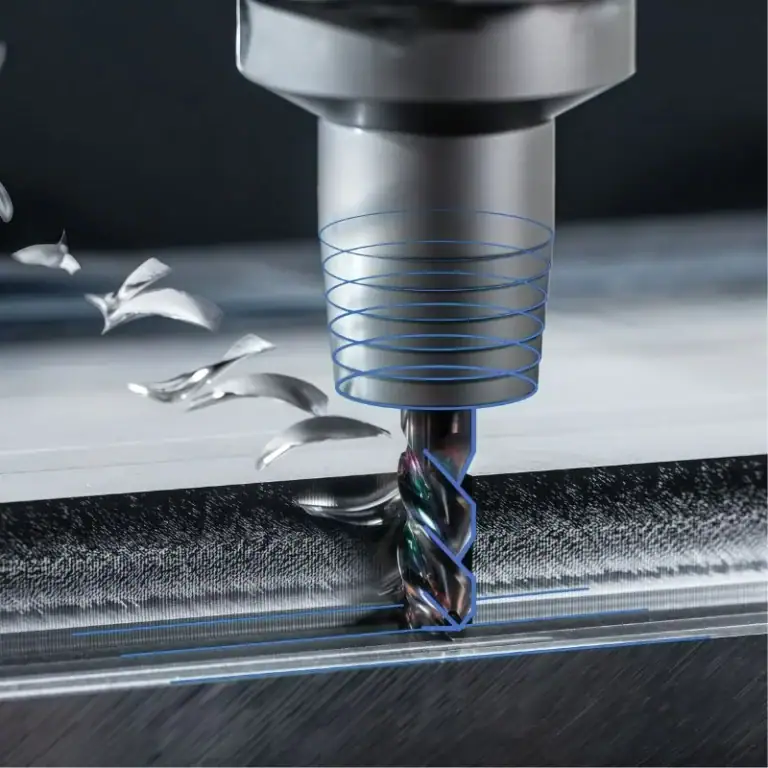
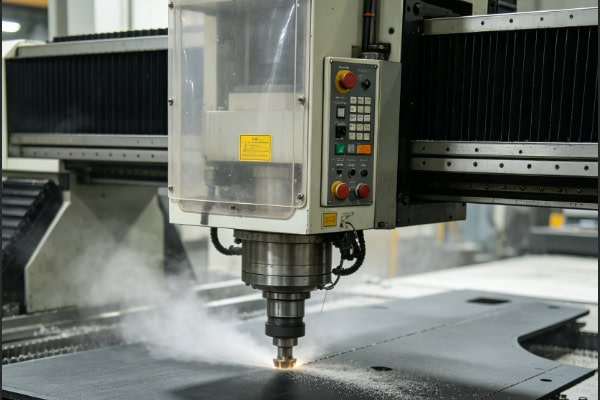
The tool is one of the most critical variables in controlling delamination, as it directly determines whether the material is “sheared cleanly” or “torn apart.”
Selecting Dedicated Composite Tools
In composite machining, priority should be given to tools specifically designed for fiber materials rather than general-purpose metal tools.
- Diamond-coated tools significantly improve wear resistance, maintaining long-term sharp cutting edges.
- Ultra-fine grain carbide tools enhance edge stability and reduce tearing caused by micro-chipping.
- Shear-type helical tools reduce fiber pull-out and delamination by optimizing cutting angles.
- Special structural designs modify the cutting path so the material is more likely to be “cut” rather than “ripped.”
Proper tool selection is the first line of defense against delamination and one of the most overlooked yet critical steps.
Optimization of Tool Geometry
Tool geometry directly changes the cutting mechanism and thus affects material failure behavior.
- Increasing rake angle reduces extrusion and promotes a more pure shearing action.
- Reducing helix angle lowers axial pulling force and decreases interlayer separation risk.
- Maintaining a sharp cutting edge ensures fibers are cleanly cut rather than dragged out.
- Optimized chip evacuation reduces secondary cutting and prevents additional surface damage.
Geometric optimization not only affects efficiency but also directly determines whether delamination occurs.
Tool Condition Management
Uncontrolled tool wear is one of the most common hidden causes of delamination, often accumulating unnoticed. Tool wear gradually turns cutting into extrusion, significantly increasing delamination risk. Dull edges cause continuous fiber pulling instead of clean cutting. Coating loss increases friction and local heat, accelerating resin softening. Delayed tool replacement leads to accumulated risk, eventually resulting in sudden large-area delamination. Tool maintenance and monitoring are essential for stable machining quality.
CNC Milling Parameter Optimization: Controlling Cutting Forces
In composite machining, controlling cutting force is more important than pursuing efficiency, because once force becomes unstable, delamination is almost inevitable.
Balance Between Speed and Feed
Proper parameter combinations can significantly reduce cutting impact and stabilize material failure behavior.
- Increasing spindle speed reduces load per cutting point and stabilizes cutting.
- Reducing feed rate decreases instantaneous impact loads and prevents sudden interface failure.
- Using small depth of cut with multiple passes distributes stress and reduces single-pass failure risk.
- Layered material removal improves process control and consistency.
A proper balance between speed and feed helps establish a stable window between efficiency and quality.
Toolpath Optimization
Toolpath design directly affects stress distribution and failure paths.
- Cutting along fiber direction reduces transverse tearing and improves surface integrity.
- Avoiding sharp turns prevents localized stress concentration and interlayer cracking.
- Helical entry ensures smoother and more continuous cutting.
- Gradual toolpaths reduce impact loads and allow controlled stress release.
Proper toolpath design is a key process method for reducing delamination.
Special Treatment of Delamination-Sensitive Areas
Different regions have different structural strengths, so risk control must be differentiated. Edge areas should use reduced feed rates to minimize exit tearing risk. Backing plates or supports can be added at exit points to absorb impact forces. Hole machining often requires secondary finishing to ensure edge quality. High-risk areas should have dedicated parameters for localized reinforcement. Targeted treatment significantly reduces local failure and improves overall yield.

Fixtures and Support: A Frequently Overlooked Key Factor
Unlike metals, composites have lower rigidity, so clamping and support directly affect machining results.
Improving Clamping Rigidity
Stable clamping is a fundamental condition for preventing delamination.
- Vacuum platforms provide more uniform support distribution.
- Local support blocks reduce elastic deformation in machining areas.
- Avoiding large unsupported spans reduces vibration amplification.
- Improved rigidity ensures a more stable and controllable cutting process.
Clamping rigidity directly determines whether additional disturbances occur during machining.
Reducing Vibration and Deformation
Proper fixture design significantly reduces instability during machining.
- Symmetrical clamping prevents uneven force distribution and warping.
- Controlled clamping force prevents material damage and internal stress.
- Avoiding excessive clamping reduces deformation caused by stress release.
- Optimized support layout improves overall structural stability.
Vibration and deformation are often hidden contributors to delamination, gradually accumulating during machining or use.
Exit Support Design
The tool exit stage is the most prone to delamination and must be carefully controlled. Backing plates help absorb impact forces during tool breakthrough. Sacrificial layers prevent edge breakout or tearing. Optimized exit paths reduce structural damage from sudden unloading. Reinforced local support significantly improves edge quality. Exit support is the final critical defense against delamination.
Process Strategy Upgrade: From Cutting to Controlled Fracture
True advanced composite machining is not simply material removal, but precise control of material failure behavior.
Prevention Over Post-Processing
In composite machining, issues must be controlled at the source rather than repaired later.
- Process optimization must take priority over any surface repair methods.
- Once delamination occurs, it is usually irreversible and weakens structural strength.
- Post-processing can only improve appearance, not restore internal integrity.
- Source control is the only effective way to ensure quality.
Prevention is far more important than repair.
Multi-Stage Machining Strategy
Staged machining significantly improves stability and consistency.
- Roughing removes most excess material efficiently.
- Semi-finishing stabilizes structure and reduces internal stress.
- Finishing focuses on surface quality and edge integrity.
- Layered optimization reduces overall machining risk.
A multi-stage strategy makes the process more controllable.
Online Monitoring and Feedback
Real-time monitoring further improves reliability and safety.
- Cutting force monitoring tracks load variation in real time.
- Status feedback helps adjust parameters promptly.
- Anomaly detection prevents batch scrap caused by uncontrolled machining.
- Closed-loop control significantly improves overall stability.
Online monitoring is a key safeguard in high-end composite manufacturing.
Conclusion
Composite milling delamination is the result of combined effects from tools, parameters, fixtures, and toolpaths. To solve it stably, the entire CNC machining process must be optimized systematically rather than relying on experience-based adjustments. Once the process is stabilized, not only will delamination be reduced, but machining efficiency and consistency will also improve. If you are looking for a reliable composite machining solution, TiRapid can provide professional CNC milling and process optimization support to help you solve delamination issues at the source.