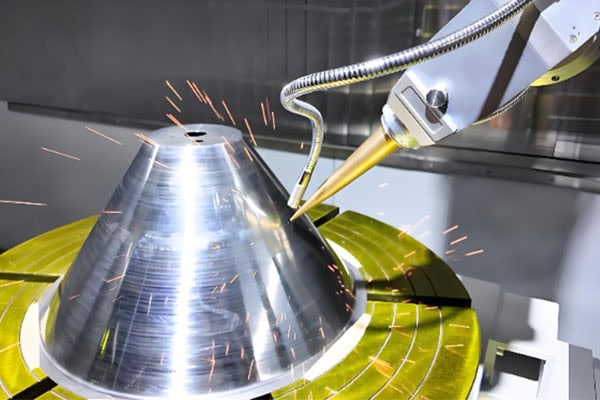
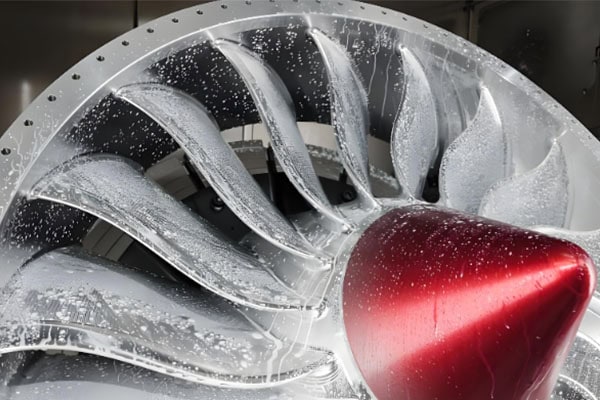
Aerospace components often feature large curvature variations, complex structures, thin walls, and lightweight designs. Some blades, flow channels, fuselage structural components, and engine parts also contain deep cavities, narrow slots, and variable cross-sections. When using traditional 3-axis machining, complex surfaces may be limited by tool interference, workholding constraints, and machining accessibility. Therefore, aerospace complex surface machining requires a combination of multi-axis CNC machining, optimized toolpath planning, and strict dimensional inspection to achieve a balance between structural complexity and machining accuracy.
Get 20% offf
Your First Order
Need custom metal and plastic parts?
Key Challenges of Aerospace Complex Surface Machining
Complex Surface Geometries
Aerospace components often use streamlined or freeform surface designs, such as impellers, blades, air intake structures, and complex housings. During machining, surface continuity must be maintained while minimizing tool marks and local over-cutting. At the same time, critical areas must meet the required dimensional and profile tolerances.
Deformation of Thin-Wall Structures
To reduce overall weight, many aerospace components use thin walls, thin ribs, and lightweight structures. Excessive or unstable cutting forces can cause vibration and deformation during machining. Therefore, machining parameters should be optimized according to the material, wall thickness, and component geometry, while suitable workholding methods can improve machining stability.
High Demand for Multi-Directional Machining
Complex surfaces often cannot be completely machined from a single direction. 5-axis CNC machining allows the tool orientation to change dynamically, enabling the cutter to follow complex surfaces more effectively. TiRapid lists 5 Axis CNC Machining among its core machining capabilities and provides machining solutions for complex geometries.
CNC Machining Solutions for Aerospace Complex Surfaces
Improving Surface Machinability with 5-Axis Machining
For aerospace components with multi-directional curved surfaces, 5-axis CNC machining can be used to change the tool orientation and reduce the need for repeated setups. For blades, curved housings, and complex structural components, 5-axis machining can help reduce inaccessible areas and improve surface continuity.
CAM Programming and Toolpath Optimization
Complex surface machining requires advanced CAM programming. Before machining, the 3D CAD model should be analyzed for curvature, stock allowance, tool accessibility, and potential interference. Appropriate toolpaths can then be developed for roughing, semi-finishing, and finishing.
The roughing stage focuses on removing most of the excess material. Semi-finishing helps establish a consistent remaining stock allowance, while finishing focuses on surface profile, dimensional accuracy, and surface quality. Optimizing step-over, cutting direction, and tool orientation can reduce unnecessary tool movements and repeated machining.
Matching Materials with Machining Parameters
Aerospace components commonly use materials such as aluminum alloys, titanium alloys, and stainless steel. These materials have different hardness, thermal conductivity, and cutting characteristics. Therefore, tool materials, spindle speed, feed rate, and cutting depth need to be selected according to the specific material.
Machining Component
Common Materials
Main Machining Challenges
Recommended Approach
Aerospace structural parts
Aluminum alloys
Thin walls, thin ribs, deformation
High-speed milling, 5-axis machining
Engine structural components
Titanium alloys
High strength, high cutting temperature
Multi-axis machining, parameter optimization
Blade components
Aluminum alloys, titanium alloys
Freeform surfaces, changing curvature
Simultaneous 5-axis machining
Complex housings
Aluminum alloys, titanium alloys
Deep cavities, complex surfaces
5-axis milling, multi-stage machining
Precision brackets
Aluminum alloys, stainless steel
Holes, curved surfaces, dimensional accuracy
CNC milling, precision inspection
Quality Control for Complex Surface Machining
Controlling Machining Allowances
Complex surface components require carefully controlled machining allowances. Excessive stock can increase cutting loads, while insufficient stock may affect finishing stability. Multi-stage machining helps create more stable conditions for the final finishing process.
Reducing Workholding Errors
For complex aerospace components, repeated setups can introduce errors when transferring machining datums. Multi-axis machining combined with an appropriate positioning strategy can reduce the number of setups and improve positional relationships between different surfaces.
Strengthening Dimensional and Surface Inspection
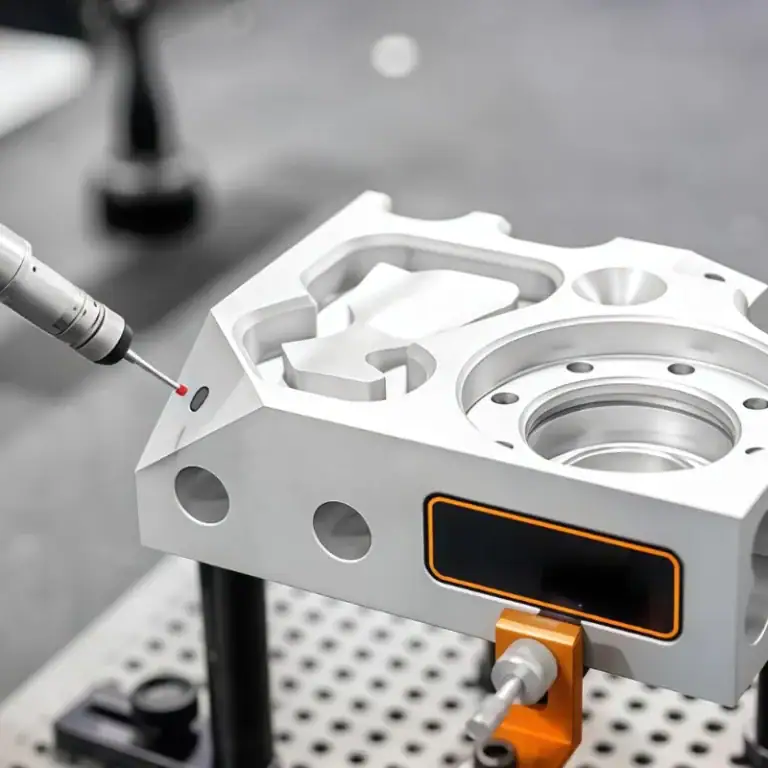
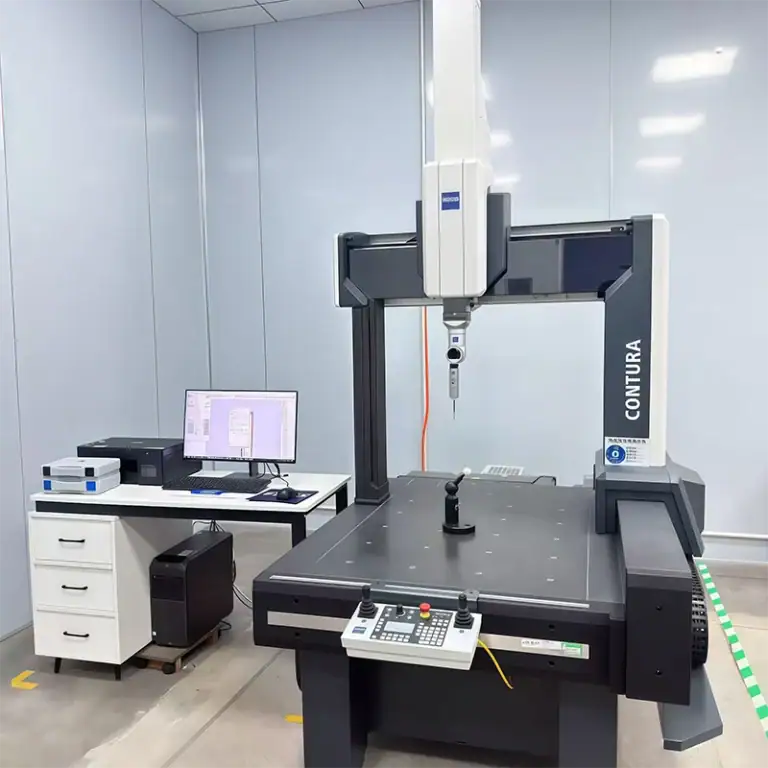
After machining, components should be inspected according to engineering drawings and 3D models. For complex surfaces, coordinate measuring machines (CMM) can be used to inspect profiles, hole positions, flatness, and critical dimensions. TiRapid also provides CMM inspection and manufacturing services covering both prototypes and production requirements.
Manufacturing Process for Aerospace Complex Components
Aerospace complex surface machining can follow a process such as “drawing analysis—DFM evaluation—material preparation—rough machining—semi-finishing—finishing—surface treatment—dimensional inspection.”
TiRapid supports CAD file submission, DFM analysis, CNC machining, surface finishing, and CMM inspection. These capabilities allow aerospace projects to receive integrated manufacturing support from prototype development to production.
To meet the manufacturing requirements of complex aerospace surfaces, thin-wall structures, and high-precision components, TiRapid can combine 5-axis CNC machining, precision milling, prototype manufacturing, low-volume production, and quality inspection according to the geometry and material of each component.
For aerospace components in the development stage, rapid CNC prototyping can help validate designs before production. For low-volume projects, the manufacturing process can be adjusted according to production quantities, component geometry, material characteristics, and required tolerances.
Complex surface machining is not simply a matter of increasing the number of machine axes. It requires integrated planning across materials, cutting tools, fixtures, CAM toolpaths, machining parameters, and inspection processes. With an optimized manufacturing strategy, aerospace complex surface components can be produced more consistently, providing reliable CNC machining support for aircraft, engines, and other aerospace equipment.
Author
Galen Director and Founder
Committed to ensuring we provide the best possible service in the manufacturing industry.
Limits, fits and tolerances define the acceptable dimensional variation and assembly relationships between mating mechanical components. Limits establish the maximum and minimum permitted sizes, tolerances define the allowable variation, and
Ejector pins are small mold components, but they play a major role in whether an injection molded part can leave the mold cleanly and consistently. After plastic cools around the
A machined housing can have a flat mounting face, a deep pocket, a bearing seat, and threaded holes. A shaft may need finished diameters, grooves, and an axial bore. Each
CNC plastic machining is a subtractive manufacturing process that uses computer-controlled cutting tools to produce precision components from engineering plastics. It is widely used for prototypes, custom housings, bushings, gears,
A flat mounting face, a deep pocket, and a curved mold surface call for different cutting approaches. Choosing a milling cutter starts with understanding the feature to be produced, then
Aluminum is a weakly paramagnetic metal, meaning it responds slightly to an external magnetic field but does not behave like iron or ordinary carbon steel. A typical refrigerator magnet will
Stiffness and strength are often treated as if they describe the same material behavior, but they answer different engineering questions. Stiffness tells you how much a material or part deforms
CNC machining is used to manufacture precise metal and plastic components for automotive, medical, aerospace, industrial equipment, and electronic products. It transforms raw material into functional parts through computer-controlled milling,
A shaft must enter its mating bore, a bearing must stay seated, and a cover must locate correctly on its housing. Each function permits some dimensional variation. The engineering task
SFM machining uses surface feet per minute to measure the cutting speed between a rotating tool and the workpiece. It helps machinists calculate suitable spindle speeds, control cutting conditions, and
CNC is one of the core technologies behind modern manufacturing. It allows machines to follow programmed instructions and produce parts with controlled dimensions, repeatable movements, and less dependence on manual
A machined housing can have correctly sized holes and still fail to assemble if those holes are in the wrong locations. Checking each diameter tells you only part of the