In CNC plastic machining quotations, the prices of common plastics such as ABS, PVC, and POM are relatively stable, while high-performance engineering plastics such as PEEK, PI, and PEI are more expensive, making material costs an important part of the quotation. At the same time, CNC machining does not calculate material costs simply based on the final product weight. Factors such as blank size, machining allowance, and material waste must also be considered.
What Percentage Do Material Costs Usually Account for in CNC Plastic Machining?
The total cost of CNC plastic machining usually consists of material costs, machining hours, equipment costs, tool wear, labor inspection, and post-processing expenses. The proportion of material costs is not fixed and will vary depending on part size, material price, and machining complexity.For ordinary plastic parts, material costs may only account for a small portion of the total quotation. However, for high-performance plastics or large-sized components, the proportion of material costs will increase significantly.
Material Costs of Ordinary Plastics Account for a Lower Proportion
Common engineering plastics include:ABS, POM, PVC, PP, PE.
The purchase prices of these materials are generally relatively stable and they are easy to obtain, so the cost of the materials themselves is usually not very high. However, this does not mean that the overall machining cost should be low simply because the material is inexpensive. During the machining process, the actual expenses are often not only related to materials but also include programming, fixture setup, cutting, inspection, and other procedures. Especially for small precision parts, the material usage is usually limited, while machining time and labor costs become more significant. Therefore, material costs generally account for a relatively small percentage of the total price. For example, a small precision POM component may only require several dozen yuan worth of material, but CNC machining still requires:
- Program preparation
- Workpiece clamping
- Tool machining
- Dimensional inspection
All these steps require time and labor investment, so the final machining cost is often higher than the material cost. For this type of part, material costs may usually account for around 10%–30% of the total cost. The exact percentage depends on whether the part structure is complex and how long the machining process takes.If the part is relatively simple, the material cost proportion may be even lower. If the part requires high precision and repeated adjustments, the proportion of material costs may also change accordingly.
High-Performance Plastic Material Costs Account for a Higher Proportion
Some industrial applications have higher material requirements, such as resistance to high temperatures, wear resistance, corrosion resistance, or long-term operation in special environments. In these cases, high-performance plastics are often used, including:
- PEEK
- PEI
- PPS
- PI
These materials provide characteristics such as high-temperature resistance, high strength, and chemical corrosion resistance, but their raw material prices are relatively high.When machining small precision parts, machining time may be similar to ordinary plastics, while material prices are significantly higher. As a result, material costs account for a larger proportion of the total quotation.
Part Size Affects the Proportion of Material Costs
The larger the part, the larger the required blank size and the greater the material consumption.Especially because CNC machining is a subtractive manufacturing process, materials are not directly formed into finished products. Instead, a relatively large blank is prepared first, and excess material is removed through cutting.Therefore, the larger the part size, the higher the material cost usually becomes.
Small-sized parts:
- Use less material
- Have lower blank costs
- Have a higher proportion of machining costs
Large-sized parts:
- Require larger blank purchase sizes
- Have significantly higher material weight
- Have an increased proportion of material costs
For example, a small plastic spacer may only require several dozen grams of material, while a large equipment protective cover may require machining from an entire plastic sheet, naturally increasing material expenses.Therefore, in CNC plastic machining quotations, the actual part dimensions must be

What Factors Affect Material Costs?
The proportion of material costs in the overall quotation is affected by multiple factors. Material type, material utilization rate, and purchasing method can all change the final cost. Even plastic materials with the same weight may have significant price differences due to differences in performance and machining requirements.
Plastic Material Type Affects Price
Different plastic materials have significant differences in performance, so their prices can also vary greatly. Ordinary plastics are suitable for general applications and are relatively easy to control in terms of cost, while some high-performance plastics provide stronger properties but also have significantly higher purchase costs.In many cases, whether the material selection is appropriate directly determines whether the final quotation is high or low. For example, some parts can actually be manufactured using ordinary engineering plastics, but if high-performance materials are selected from the beginning, material costs will naturally increase considerably.
Common situations include:
Ordinary engineering plastics: ABS, POM, PA
The price is relatively easier to control.
High-performance plastics: PEEK, PPS, PI
The price is significantly higher.
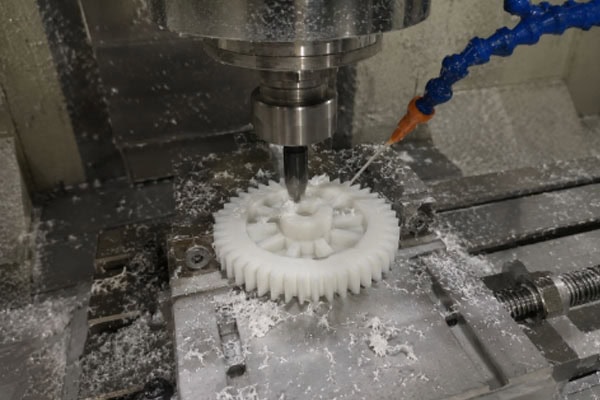
For example, POM is suitable for manufacturing mechanical parts such as gears and bushings, while PEEK is commonly used in semiconductor, medical, and aerospace applications. Although PEEK has higher machining costs, its high-temperature resistance and wear resistance allow it to meet the requirements of special environments. Therefore, companies usually select materials based on actual application requirements rather than simply considering the price.
Material Utilization Rate Affects Actual Costs
CNC machining is essentially a subtractive manufacturing process. This means a piece of material is prepared first, and then excess material is removed through cutting.Because of this process, the weight of the raw material and the final product weight are not the same.Many customers may think that if a part only weighs several hundred grams, the material cost should be similar. However, in reality, the material purchased at the beginning is often much larger than the final product because sufficient material must be reserved for clamping, machining allowance, and achieving final precision.As a result, remaining materials, scraps, and machining allowances become part of the overall cost.
Therefore:Raw material weight ≠ Product weight
For example:
The final product weight is 500 grams, but to ensure proper clamping and machining allowance, 1 kilogram or even more material may need to be purchased.
The excess material may become:
- Machining waste
- Cutting allowance
- Fixture holding areas
If the part structure is complex, such as having many grooves, holes, thin walls, or irregular shapes, material utilization will decrease further. This is because such parts require more cutting during machining, resulting in more waste. On the other hand, if the part structure is relatively regular and the blank size is selected appropriately, material waste can be reduced. In actual production, many projects achieve good cost control not because the material itself is cheaper, but because the design and blank selection are more reasonable, reducing unnecessary waste.
Purchasing Method Affects Material Costs
For the same type of plastic material, standard-size sheets, customized-size rods, and special-grade materials may all have significant price differences. Especially in small-batch machining, the purchase quantity is usually limited. Suppliers often do not provide very large discounts, so the unit material cost naturally becomes higher. On the other hand, for long-term and stable production projects, centralized purchasing can more easily reduce material unit prices.
For example:
- Standard-size sheets
- Customized-size rods
- Special-grade materials
All may have different prices.
If the purchase quantity is small, suppliers usually sell according to small-batch pricing, increasing the unit cost. For long-term production projects, centralized purchasing can reduce material prices and improve cost control capabilities.
How Can Material Costs Be Reduced in CNC Plastic Machining?
To reduce material costs, the most important approach is not simply searching for cheaper materials, but using materials more efficiently while meeting product requirements. In many cases, high costs are not caused by expensive materials themselves, but by unreasonable designs, unsuitable blank selection, or excessive machining allowances, which eventually lead to waste. With proper planning in the early stages, many material costs can actually be reduced.
Optimize Part Structural Design
The product design stage has a significant impact on material consumption. Many parts use much more material and require longer machining times because they are designed too thick or too complex from the beginning.On the contrary, if the machining method is considered during the design stage and the structure is made more reasonable, material consumption can be greatly reduced.
For example:
- Reduce excessively thick structures
- Optimize wall thickness
- Design mounting positions reasonably
- Reduce unnecessary machining areas
A more reasonable structure can not only reduce material consumption but also shorten machining time. For example, some parts do not actually need to be made extremely thick, but excessive allowance is added during design for safety reasons. As a result, more material is consumed and machining becomes more time-consuming. In addition, if mounting holes, reinforcing ribs, or chamfer positions are poorly designed, the amount of cutting required may also increase.
Select Material Specifications Properly
Whether the selected material specifications are appropriate directly affects material utilization. In many cases, the part itself may not be large, but if the purchased blank size is too large, a significant amount of material will be wasted. On the other hand, selecting materials that are closer to the final product dimensions can reduce cutting waste and improve material utilization. For example:If the part dimensions are close to a standard sheet size, cutting waste can be reduced.
During purchasing, companies can:
- Select materials close to the product size
- Reduce machining allowance
- Use standard-size materials
This can reduce material waste and improve cost control. For example, if some parts can be arranged efficiently on standard plastic sheets, there is no need to customize special blanks, resulting in higher material utilization. Similarly, the choice between rods and sheets should also depend on whether the material form matches the part shape. Convenience alone should not be the only consideration.Selecting suitable specifications not only saves materials but also reduces additional cutting and handling work, making the entire machining process smoother.
Select Suitable Materials According to Application Requirements
Higher material performance does not mean it is suitable for every product. Different products operate in different environments and have different requirements. If ordinary mechanical parts use extremely high-end materials, costs will increase significantly, and such performance may not even be necessary. The truly reasonable approach is to select materials based on actual applications. The highest-performance plastic is not always the most suitable choice for every product.
For example:Ordinary mechanical components can use POM to meet requirements, and PEEK may not be necessary.
Reasonable material selection can:
- Reduce raw material costs
- Reduce machining difficulty
- Improve production efficiency
Material selection should be determined based on working environment, service life, and performance requirements. For example, if a part is only used for ordinary transmission, support, or positioning purposes, materials such as POM and ABS are often sufficient. However, if the part needs to operate for a long time in high-temperature, highly corrosive, or high-wear environments, higher-performance materials should be considered.
The Relationship Between Material Costs and CNC Plastic Machining Quotations
The quotation for CNC plastic machining is usually not determined by material costs alone. Instead, the entire machining process must be considered. Material cost is only one part of the total price. Other factors that influence the final quotation include machining time, process complexity, precision requirements, production quantity, and other related factors.
Machining Costs Account for a Higher Proportion in Small-Batch Production
When the production quantity is relatively small, many fixed costs are difficult to distribute. For example, programming, machine setup, and first-piece inspection require similar preparation time whether producing 1 piece or 10 pieces. As a result, when these fixed costs are distributed among a small number of products, the machining cost per part becomes relatively high. Even if the material itself is inexpensive, the final total price may not necessarily be low.
When production quantities are small:
- Programming costs are fixed
- Machine setup costs are fixed
- Inspection costs are fixed
These costs need to be distributed among a limited number of products. Therefore, even if material prices are low, machining costs may still account for the majority of the total expense. For example, in a small-batch prototype project, the material cost may only represent a small portion of the total price. However, because the process requires repeated dimensional confirmation, tool path adjustments, and precision inspections, labor and machine time become significant. In such cases, the quotation customers see is not simply “how much the material costs,” but rather “how much the entire machining process costs.” Therefore, in small-batch machining, material cost is important, but it is usually not the most dominant factor.
Material Costs Have a Greater Impact in Batch Production
When production quantities increase, the situation gradually changes. Because fixed costs such as initial programming, machine setup, and inspection can be distributed among more products, the machining cost per individual part decreases. At this point, the proportion of material costs in the total cost becomes more noticeable. Especially as production volume increases, the amount of material purchased becomes larger, and material pricing and purchasing methods have a greater impact on overall costs. After production quantities increase, fixed machining costs are distributed, and the proportion of material costs gradually becomes higher.
For example:When producing large quantities of plastic parts, material purchasing costs may become a major area of cost control for companies. Through bulk purchasing and optimized material layout, the unit cost of products can be effectively reduced. For example, for the same batch of parts, if materials can be purchased together, cutting layouts can be optimized, and machining processes can be standardized, many unnecessary losses can be reduced.
Frequently Asked Questions
Does More Expensive Material Always Mean a Higher CNC Plastic Machining Price?
Not necessarily. Material price is only one of the factors affecting CNC machining costs. Some ordinary plastics may have lower material prices, but if the part structure is complex, precision requirements are high, or machining time is long, the overall cost may still be high. On the other hand, some high-performance plastics may have expensive raw materials, but if the part structure is simple and machining time is short, the final price may not increase significantly. Therefore, CNC plastic machining quotations need to consider multiple factors, including material, machining time, process requirements, and production quantity.
The final cost cannot be judged only based on the material unit price.
Conclusion
There is no fixed percentage for the proportion of material costs in CNC plastic machining. It changes depending on material type, part size, machining complexity, and material utilization rate. When processing ordinary engineering plastics, material costs usually account for only part of the total cost. However, for high-performance plastics such as PEEK and PI, the high material prices may make material costs represent a much larger portion of the quotation.
In other words, even for the same CNC plastic machining process, different materials, different parts, and different production quantities may result in completely different material cost proportions. Reducing costs does not mean simply choosing cheaper materials. Instead, companies should optimize designs, select appropriate material specifications, and improve material utilization while ensuring product performance requirements are met. Through reasonable planning and efficient material management, CNC plastic machining projects can achieve better cost control while maintaining quality and performance.