Nylon is a family of polyamide engineering plastics used in mechanical parts, automotive systems, electrical components, industrial equipment, medical products, consumer goods, and additive manufacturing. Its combination of strength, wear resistance, low friction, impact performance, and relatively low weight allows it to replace metal or other plastics in many functional applications.
This guide explains the main uses of nylon, the differences between common nylon grades, how the material performs in gears, bearings, housings, and structural components, which manufacturing processes are suitable, how nylon behaves during CNC machining, and what engineers should consider when controlling tolerances, moisture, wear, and long-term dimensional stability.
What Is Nylon and Why Is It Widely Used?
Nylon is a thermoplastic polyamide available in many formulations, including PA6, PA66, PA11, PA12, cast nylon, and fiber-reinforced grades. These materials share a polyamide structure but do not provide identical strength, moisture response, heat resistance, flexibility, or machining behavior.
Mechanical and Wear Properties
Nylon offers a useful balance of strength, toughness, impact resistance, and fatigue performance. It can withstand repeated mechanical loading better than many commodity plastics, making it suitable for moving parts, fasteners, brackets, guides, and components exposed to vibration or intermittent impact.
Its low-friction behavior is especially valuable in sliding or rotating assemblies. Nylon gears, bushings, wear pads, and rollers can operate with less noise than equivalent metal parts. In appropriate conditions, the material can also reduce lubrication requirements and protect mating components from abrasive metal-to-metal contact.
Performance depends on grade, temperature, moisture, load, and operating speed. Standard nylon may work well for moderate mechanical duty, while oil-filled, molybdenum-disulfide-modified, glass-filled, or cast grades may be selected when wear resistance, stiffness, dimensional control, or load capacity needs improvement.
Lightweight and Corrosion-Free Performance
Nylon is significantly lighter than steel, brass, and many other engineering metals. Replacing a metal component with nylon can reduce assembly weight, rotational inertia, handling effort, and operating noise. This is useful in conveyors, automation systems, vehicle components, packaging machines, and mobile equipment.
Unlike carbon steel, nylon does not rust when exposed to moisture. This makes it useful for guides, spacers, rollers, covers, and wear components used in humid production environments. Corrosion resistance may also reduce maintenance when the part does not need the stiffness or temperature capability of metal.
Nylon should not be treated as a direct metal replacement in every situation. Its lower stiffness, greater thermal expansion, moisture absorption, and susceptibility to creep must be considered. The design should be reviewed around the real load, temperature, environment, and expected service life.
Available Material Forms
Nylon is supplied as pellets for injection molding, powder or filament for additive manufacturing, and rods, tubes, plates, or cast blanks for CNC machining. The available stock form affects part size, material properties, machining allowance, lead time, and production economics.
Extruded nylon stock is widely used for smaller machined parts, while cast nylon is often selected for thick plates, large-diameter rods, rollers, pulleys, and heavy wear components. Cast production can provide larger stock sizes and may reduce internal stress compared with some extruded shapes.
Fiber, film, and molded forms support textiles, packaging, cable products, and high-volume components. Engineers should therefore choose not only the correct nylon grade but also the manufacturing form that provides the required geometry, consistency, tolerance, and production quantity.
Common Nylon Grades and Their Engineering Uses
The term nylon describes a family rather than one material. PA6, PA66, PA11, PA12, cast nylon, and reinforced grades differ in mechanical strength, stiffness, moisture sensitivity, chemical behavior, flexibility, and processability. Grade selection should match the working conditions of the part.
| Nylon Grade | Main Characteristics | Typical Engineering Uses |
| Nylon 6 / PA6 | Tough, wear-resistant, widely available and machinable | Gears, bushings, rollers, guides and general mechanical parts |
| Cast Nylon 6 | Available in large stock sizes with good wear behavior | Large pulleys, wheels, bearings, wear plates and crane pads |
| Nylon 66 / PA66 | Higher stiffness and heat capability than many PA6 grades | Fasteners, electrical parts, automotive components and structural parts |
| Nylon 11 / PA11 | Flexible, impact-resistant and lower in moisture uptake | Tubing, pneumatic lines, flexible parts and additive manufacturing |
| Nylon 12 / PA12 | Good dimensional stability and chemical resistance | Fuel lines, connectors, housings and 3D-printed components |
| Glass-Filled Nylon | Increased stiffness, strength and dimensional stability | Brackets, housings, structural parts and under-hood components |
| Oil-Filled or MoS₂ Nylon | Modified friction and wear performance | Bearings, wear pads, slides, gears and chain guides |
Nylon 6 and Cast Nylon
Nylon 6 is one of the most widely used nylon grades for mechanical and industrial components. It provides good toughness, wear resistance, impact performance, and machinability. Typical applications include gears, rollers, bushings, guide blocks, machine guards, and general replacement parts.
Cast nylon is based commonly on PA6 but is produced directly in larger shapes. This makes it practical for large wheels, thick wear plates, pulleys, crane pads, and components that would be inefficient to machine from smaller extruded stock. Modified cast grades may contain oil or solid lubricants.
PA6 absorbs moisture, which can change dimensions and mechanical behavior. For general wear parts, this may be acceptable or even improve toughness. For precision fits, the expected humidity and conditioning state should be considered before final tolerances and inspection criteria are established.
Nylon 66
Nylon 66 is often selected when higher stiffness, mechanical strength, or elevated-temperature performance is needed. It is commonly used for fasteners, bearing cages, structural brackets, electrical connectors, automotive parts, and molded components that must retain shape under greater mechanical load.
Compared with PA6, PA66 can provide a more rigid response, but it may also require different processing conditions. Injection molding temperature, drying, tool design, and shrinkage control must match the selected formulation. Glass reinforcement is frequently added when greater stiffness is required.
Machining PA66 requires the same attention to heat, sharp cutting tools, and clamping pressure as other nylon grades. Reinforced PA66 is more abrasive than unfilled nylon, so cutter material, tool wear, feed strategy, and edge quality become more important during precision production.
Nylon 11 and Nylon 12
PA11 and PA12 are used when flexibility, impact resistance, chemical resistance, or reduced moisture sensitivity is more important than maximum rigidity. They are common in flexible tubing, pneumatic systems, automotive fluid lines, cable protection, connectors, and additive-manufactured parts.
Their lower moisture response can make PA11 and PA12 more dimensionally predictable in changing environments than PA6 or PA66. This is valuable for components exposed to humidity, fluids, outdoor conditions, or applications where a small change in fit may affect assembly performance.
These grades are frequently associated with powder-bed 3D printing because they can produce durable functional prototypes and low-volume parts. The final selection between PA11 and PA12 should consider stiffness, flexibility, impact requirements, surface quality, processing route, and certification needs.
Reinforced and Modified Nylon
Glass-filled nylon improves stiffness, strength, dimensional stability, and resistance to deformation under load. It is commonly used for structural brackets, housings, automotive components, electrical supports, and parts that must maintain geometry better than unfilled nylon.
The reinforcement changes manufacturing behavior. Fiber-filled nylon is more abrasive to cutting tools and can produce rougher edges if the machining strategy is not controlled. Molded parts may also shrink differently along and across the fiber-flow direction, affecting warpage and dimensional consistency.
Oil-filled, lubricant-modified, and MoS₂-filled nylons are designed for sliding and wear applications. These grades can reduce friction or improve bearing performance, but the benefit depends on pressure, speed, mating material, surface finish, and operating temperature.
Uses of Nylon in Mechanical Components
Mechanical components are among the most important industrial uses of nylon. Its wear resistance, damping behavior, low weight, and ability to run against metal make it suitable for parts that rotate, slide, guide, support, or transfer moderate mechanical loads.
Gears and Sprockets
Nylon gears are used in appliances, office equipment, automation systems, automotive mechanisms, packaging machines, and light industrial drives. They operate more quietly than metal gears and can reduce vibration because the polymer absorbs impact between meshing teeth.
The material can also protect the mating gear by reducing harsh metal contact. Nylon is useful where moderate loads, controlled temperatures, and intermittent duty are expected. Molded gears support high-volume production, while CNC-machined gears are practical for prototypes, replacements, and low-volume custom designs.
Gear design must account for tooth deflection, heat, moisture, creep, and dimensional growth. Nylon should not be selected only because it has low friction. Tooth geometry, transmitted torque, rotational speed, lubrication, backlash, and operating temperature must be reviewed together.
Bearings and Bushings
Nylon bearings and bushings support shafts, pivots, rollers, and sliding assemblies where low noise and corrosion resistance are important. They can reduce the need for external lubrication and prevent direct contact between a metal shaft and a metal housing.
These parts are used in conveyors, agricultural machinery, material-handling equipment, appliances, packaging systems, and general industrial mechanisms. Modified nylon grades may improve wear behavior when the bearing operates under repeated motion or moderate load.
Bearing performance depends on pressure and surface speed, often considered together as a pressure-velocity condition. A nylon bushing that works well at low speed may generate excessive heat at higher speed. Clearance, shaft finish, alignment, and operating temperature should be evaluated before production.
Rollers, Pulleys, and Wheels
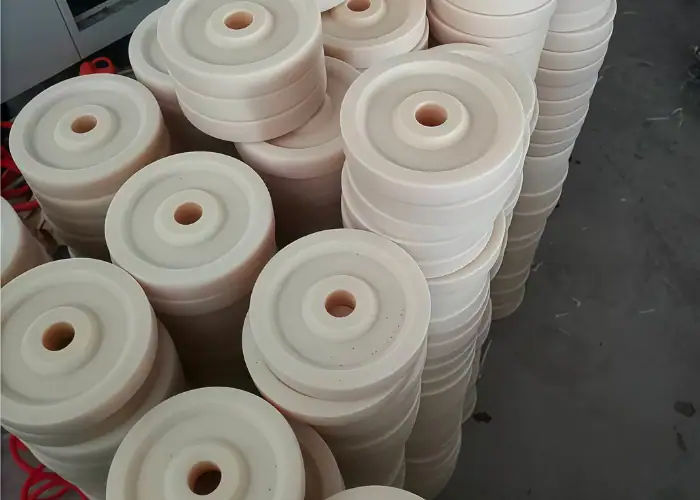
Nylon rollers and wheels are used in conveyor systems, lifting equipment, doors, guides, handling machines, and manufacturing lines. Their lower weight reduces rotational mass, while their damping behavior can make equipment quieter than equivalent steel components.
Large cast nylon blanks are particularly useful for heavy rollers and pulleys. The component can be machined with grooves, bearing bores, flanges, keyways, and mounting features. This allows a custom geometry to be produced without casting or machining a heavy metal part.
The design must provide enough wall thickness around hubs and bores. Press fits, keys, bearings, and fasteners can create local stress in the plastic. Sharp internal corners should be avoided, and the assembly method should distribute force instead of concentrating it in a thin section.
Wear Pads, Guides, and Slide Blocks
Nylon wear pads are installed between moving machine surfaces to reduce friction, noise, and damage. Common uses include telescoping equipment, guide rails, lifting systems, chain tracks, vehicle mechanisms, and industrial machines with repeated sliding motion.
A replaceable nylon pad can act as a sacrificial part that protects a more expensive steel structure. When wear reaches the allowable limit, the pad can be replaced without rebuilding the full assembly. CNC machining allows holes, slots, pockets, and mounting surfaces to match existing equipment.
Wear rate depends on load, motion, contamination, surface condition, and temperature. Dust or metal particles can become embedded in the nylon and increase abrasion. Material grade and clearance should therefore be chosen around the actual operating environment rather than nominal load alone.
Uses of Nylon Across Major Industries
Nylon appears across many industries, but its role differs by application. In one product it may serve as a low-friction wear surface, while in another it functions as an electrical insulator, lightweight bracket, flexible tube, molded housing, or vibration-damping component.
Automotive
Automotive uses of nylon include clips, cable ties, connectors, bearing cages, gears, bushings, air-intake components, ducts, covers, fluid lines, and under-hood brackets. The material helps reduce vehicle weight while providing resistance to vibration, wear, oils, and selected chemicals.
Glass-filled PA6 and PA66 are often used for structural molded components that need greater stiffness. PA11 and PA12 may be selected for flexible tubing or fluid-handling applications where chemical resistance and reduced moisture sensitivity are important.
Automotive selection requires more than general material strength. Temperature cycles, fuel or lubricant exposure, vibration, UV exposure, flame requirements, and long-term creep must be considered. The selected grade should be validated for the exact vehicle environment.
Industrial Equipment
Industrial equipment uses nylon for gears, sprockets, rollers, wear strips, bushings, pulleys, spacers, jigs, fixtures, seals, and replacement components. These applications take advantage of low friction, corrosion resistance, damping, and the ability to machine custom parts from stock.
Nylon components can reduce noise in conveyor, packaging, food-processing, textile, and material-handling equipment. A machined guide or wear strip may also prevent scratching on products moving through a production line.
Industrial machinery often operates under variable loads and contaminated conditions. The engineering review should include dust, chips, cleaning chemicals, temperature, impact, and maintenance intervals. A grade that works in a clean laboratory may behave differently in a heavy manufacturing environment.
Medical
Selected nylon grades are used in sutures, catheter-related components, device housings, instrument parts, prosthetic supports, and disposable medical products. The material offers a useful balance of strength, flexibility, wear performance, and manufacturing versatility.
Medical use requires grade-specific validation. General industrial nylon should not automatically be considered suitable for body contact, sterilization, or regulated devices. Biocompatibility, traceability, cleaning method, sterilization process, and material documentation may all affect selection.
For prototypes and equipment components that do not contact patients, CNC-machined or 3D-printed nylon can support fit and functional testing. Production decisions should still distinguish between a visual prototype, a test fixture, and a regulated final-use medical component.
Aerospace
Aerospace applications may use nylon for cable supports, ducting, housings, lightweight brackets, spacers, clips, protective components, and non-structural interior parts. Low weight and vibration damping can provide advantages where a metal component would add unnecessary mass.
The material is not normally selected for primary high-temperature or high-load structures. Service temperature, flammability, smoke requirements, moisture, and long-term environmental exposure may limit the use of standard grades.
Reinforced or certified formulations can expand the application range, but the final decision must be based on aerospace specifications. Traceability and process control are as important as nominal material properties when the part is used in a controlled aircraft system.
Automation
Automation systems use nylon in grippers, locating blocks, sensor mounts, guides, rollers, cable-management components, fixtures, and protective covers. The material can reduce moving mass and prevent machined workpieces from being scratched during handling.
Custom CNC-machined nylon parts are particularly useful for low-volume automation equipment. Engineers can adjust geometry without purchasing an injection mold, making it easier to refine a fixture, end-of-arm tool, guide rail, or machine interface during commissioning.
Dimensional stability should be reviewed when the nylon part controls precise positioning. Moisture absorption, clamping force, and temperature can change a critical dimension. Metal inserts or alternative plastics may be needed around highly loaded or precision locating features.
Electronics
Nylon is used for connectors, cable glands, terminal components, coil forms, switches, circuit supports, fasteners, spacers, and insulating housings. Its electrical insulation and ability to be molded into small detailed shapes make it useful for high-volume electrical production.
Flame-retardant and reinforced grades are available for applications that need greater stiffness or specific fire performance. The exact grade should match the applicable electrical standard, operating voltage, heat exposure, and environmental condition.
Moisture can affect electrical and dimensional properties, so material conditioning should be considered. A connector that operates in a controlled indoor environment may require a different grade from one exposed to outdoor humidity, heat, or automotive fluids.
Robotics
Robotic systems use nylon for lightweight covers, cable guides, bushings, custom gripper fingers, gears, spacers, sensor brackets, and low-friction interfaces. Reducing component weight can lower actuator load and improve the responsiveness of moving assemblies.
Machined nylon can also protect delicate products during robotic handling. A polymer jaw or contact pad is less likely to mark an aluminum, glass, painted, or polished surface than a bare metal gripper.
Repeated motion introduces fatigue and wear considerations. The design should distribute load, avoid thin unsupported sections, and provide suitable clearance. Where precise stiffness is required, glass-filled nylon or a metal-supported nylon component may be more appropriate.
Consumer Products
Nylon is found in kitchen tools, sports equipment, luggage components, toothbrush bristles, power-tool housings, fasteners, appliance mechanisms, and outdoor products. Its toughness and fatigue resistance support parts exposed to repeated use.
Injection molding is commonly used for high-volume consumer components because nylon can reproduce detailed ribs, clips, snap fits, and textured surfaces. Colorants and fillers allow the manufacturer to adjust appearance and performance.
Consumer applications still require environment-specific selection. Food contact, dishwasher exposure, outdoor UV, cleaning chemicals, impact, and repeated flexing can affect material choice. A suitable grade must meet both functional and regulatory requirements.
How Nylon Parts Are Manufactured?
Nylon can be injection molded, extruded, cast, CNC machined, or additively manufactured. Each process creates different mechanical behavior, surface quality, dimensional capability, tooling cost, and production economics.
| Manufacturing Process | Best Suited For | Main Engineering Consideration |
| Injection Molding | Detailed parts and medium-to-high production volumes | Drying, shrinkage, cooling and mold design |
| CNC Machining | Prototypes, replacement parts and low-volume precision components | Heat, workholding, moisture and dimensional stability |
| Casting | Large stock shapes, wheels, pulleys and wear components | Internal stress, machining allowance and material consistency |
| Extrusion | Rods, tubes, sheets and continuous profiles | Directional properties and stock-size limitations |
| 3D Printing | Complex prototypes and low-volume custom parts | Surface texture, anisotropy and process-specific accuracy |
Injection Molding
Injection molding is widely used for nylon housings, clips, gears, connectors, brackets, fasteners, and automotive components. It supports detailed geometry and integrates ribs, bosses, snap fits, and mounting features into one molded part.
Nylon resin normally requires controlled drying before molding because moisture can affect processing quality. Tool design must also address material flow, shrinkage, cooling, venting, gate location, and ejection. Reinforced grades may create additional wear on mold components.
Injection molding is economical when production volume justifies the mold. Design changes become more expensive after tooling, so wall thickness, draft, undercuts, sink risk, fiber orientation, and tolerance requirements should be reviewed before mold manufacturing.
CNC Machining
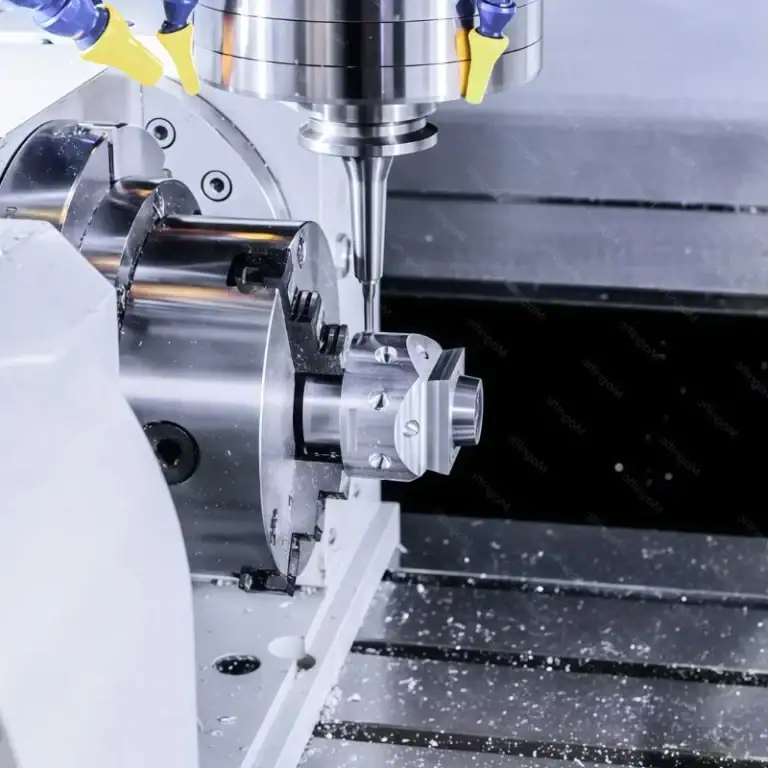
CNC machining produces nylon parts directly from rod, plate, tube, or cast stock. It is suitable for prototypes, replacement components, custom fixtures, large rollers, low-volume parts, and designs that may change before production is finalized.
Milling and turning can create accurate bores, grooves, pockets, threads, flanges, and complex profiles. CNC machining avoids injection mold cost and allows individual dimensions to be adjusted quickly, which is valuable for maintenance and engineering development.
The material is softer and more flexible than metal, so cutting strategy must prevent heat, burrs, deflection, and clamping distortion. Dimensional requirements should also consider moisture conditioning before the part is inspected or installed.
Casting and Extrusion
Cast nylon is often used for large stock shapes and heavy wear components. The casting process can produce thick plates, large rods, rings, and near-net shapes that would be difficult or wasteful to manufacture by extrusion.
Extruded nylon is commonly available as rod, sheet, and tube. It is practical for small and medium machined components, but internal stress and directional behavior may become important when a large amount of material is removed from one side.
Stock selection affects machining stability. A part cut from oversized stock may move as residual stress is released. Balanced roughing, intermediate relaxation, and a final finishing operation can improve dimensional consistency on critical components.
Additive Manufacturing
Nylon is widely used in selective laser sintering, multi-jet fusion, and filament-based 3D printing. PA11 and PA12 are common for functional prototypes, housings, ducts, fixtures, and low-volume parts with complex internal or organic geometry.
Additive manufacturing allows features that may be difficult to machine, including internal channels, lattice structures, and consolidated assemblies. It also avoids dedicated tooling, which supports rapid design iteration.
Printed nylon does not always match machined or molded nylon in surface finish, directional strength, porosity, or tolerance. Engineers should select the process based on the purpose of the part rather than assuming all nylon components behave identically.
CNC Machining Behavior of Nylon
Nylon is considered machinable, but it does not behave like aluminum or steel. Its lower stiffness, lower thermal conductivity, high thermal expansion, and moisture response require a cutting strategy designed specifically for engineering plastics.
Heat and Chip Control
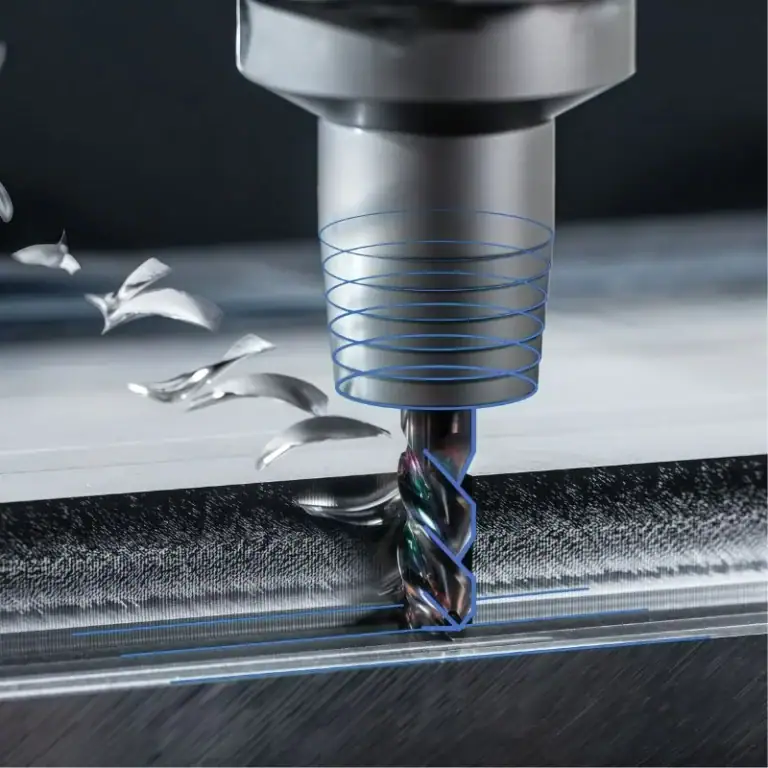
Heat can soften nylon near the cutting edge, causing smearing, poor finish, dimensional growth, or chips that wrap around the tool. Sharp cutters and positive cutting geometry help shear the material cleanly instead of pushing or rubbing it.
Feeds should be high enough to create a real chip, while cutting speed and tool engagement should avoid excessive heat. Air blast or a compatible coolant may assist chip evacuation, but the fluid should not create contamination or unwanted moisture absorption.
Deep pockets and drilling operations require particular attention because chips can become trapped. Peck drilling, polished flutes, suitable point geometry, and adequate clearance help prevent heat buildup and oversized or damaged holes.
Workholding and Part Deformation
Nylon can deform under chuck, vise, or clamp pressure. A part may measure correctly while clamped and move after it is released. Thin walls, rings, sleeves, and large flat plates are especially sensitive to workholding force.
Soft jaws, broad contact surfaces, vacuum fixtures, and controlled clamping pressure can reduce distortion. The workholding system should secure the stock without creating local compression that changes the final geometry.
The machining sequence should preserve stiffness for as long as possible. Roughing both sides in a balanced pattern, leaving finishing allowance, and completing critical surfaces after stress relief can reduce warpage in thin or asymmetrical components.
Moisture and Dimensional Stability
PA6 and PA66 absorb moisture from the environment. As moisture content changes, the part can change size and become more flexible. This may affect bores, press fits, flatness, threads, and assemblies with tight clearances.
Inspection should therefore consider the material’s conditioning state. A dry-machined component measured immediately after production may not have the same dimensions after exposure to normal humidity.
For moisture-sensitive precision parts, engineers may choose a lower-absorption nylon grade, increase clearance, condition the material before final machining, or select Delrin, PEEK, or another plastic with better dimensional stability.
Nylon Machining Tolerances and Quality Control
Nylon parts can be machined accurately, but tolerance capability depends on grade, stock size, geometry, moisture, temperature, and workholding. The drawing should separate truly critical dimensions from general features so the process remains practical.
Dimensional Accuracy
Small, rigid nylon components are generally easier to control than large plates, thin rings, or long shafts. Large material removal, thin sections, and asymmetrical geometry increase the risk of movement during and after machining.
Critical bores, bearing seats, and mating surfaces may require staged machining. The component can be rough-machined, allowed to stabilize, and then returned for finishing. This reduces the effect of released internal stress.
Tolerance should reflect operating conditions. A close fit measured in a dry inspection room may tighten after moisture absorption or temperature change. Functional clearance should account for the full service environment.
Surface Finish and Edge Quality
Sharp tools can produce clean surfaces on unfilled nylon. A dull cutter may rub and create fuzzy edges, melted material, or inconsistent gloss. Tool nose radius, feed, cutting direction, and support all influence the final finish.
Glass-filled nylon is more abrasive and may show exposed fibers at machined edges. It can also wear tools more quickly, causing dimensions and surface quality to drift during production.
Deburring should be controlled because aggressive scraping or sanding can round critical edges. Fine knives, controlled chamfers, or light finishing passes are often more suitable than heavy manual removal.
Inspection and Conditioning
CMMs, calipers, micrometers, optical systems, gauges, and functional fixtures can inspect machined nylon components. The chosen method should avoid excessive contact force on flexible features.
Temperature and humidity should be recorded when dimensions are highly sensitive. Conditioning the part before final inspection can help align the measurement state with the expected service condition.
Functional gauges are useful for gears, bushings, guides, and assembly interfaces. They confirm whether dimensional variation affects real use rather than evaluating only isolated measurements.
Nylon vs Delrin, PEEK, and Metal
Material selection often involves comparing nylon with Delrin, PEEK, aluminum, or steel. Nylon is attractive for wear, weight, damping, and cost, but another material may be better when dimensional stability, temperature, stiffness, or heavy load dominates.
| Comparison | Nylon Advantage | Alternative Advantage |
| Nylon vs Delrin | Better toughness and wider wear-grade options | Delrin generally provides better moisture stability and crisp machining |
| Nylon vs PEEK | Lower material cost and broad availability | PEEK supports higher temperature and more demanding chemical service |
| Nylon vs Aluminum | Lower weight, noise and corrosion risk | Aluminum provides greater stiffness and dimensional stability |
| Nylon vs Steel | Lower mass and reduced metal-to-metal wear | Steel provides much higher strength, rigidity and load capacity |
Nylon vs Delrin
Nylon is often selected for wear parts, gears, rollers, and components that benefit from toughness and impact resistance. Modified grades provide options for lubrication, wear, and large cast stock.
Delrin, or acetal, usually absorbs less moisture and maintains dimensions more consistently. It also machines with crisp edges, making it suitable for precision components, valve parts, small gears, and close-fitting assemblies.
The choice depends on environment and function. Nylon may be stronger in abrasive or impact-related applications, while Delrin may be more predictable for tight tolerances in changing humidity.
Nylon vs PEEK
Nylon is a practical engineering plastic for moderate temperature, wear, and structural requirements. It is far more economical than PEEK and is available in many stock forms and modified grades.
PEEK is selected for higher temperatures, aggressive chemicals, demanding wear, and applications requiring high-performance material documentation. It also offers better dimensional stability in many environments.
Using PEEK where nylon is sufficient can increase cost unnecessarily. Using nylon where temperature or chemical exposure exceeds its capability can lead to early failure. Service conditions should drive the decision.
Nylon vs Aluminum and Steel
Nylon reduces weight, noise, corrosion, and the need for lubrication in suitable mechanical applications. It can also protect mating surfaces and simplify replacement wear components.
Aluminum and steel provide much greater stiffness and resist creep under sustained load. They are more suitable for structural parts, threaded joints, precise shafts, high temperatures, and heavily loaded components.
Hybrid designs often provide the best result. A nylon gear, bushing, roller, or wear pad can operate around a metal shaft, hub, insert, or structural frame, allowing each material to perform the function it handles best.
Common Nylon Failure Risks
Nylon components usually fail because the selected grade, design, or environment does not match the application. Understanding the likely failure mode helps engineers determine whether the solution is a stronger grade, different geometry, increased clearance, or another material.
Creep and Permanent Deformation
Creep is the gradual deformation of nylon under sustained load. It can affect compressed spacers, press fits, structural brackets, threaded joints, and bearings exposed to continuous pressure.
Higher temperature increases the risk. A component may initially hold alignment but lose preload or change shape during long-term operation.
The design should reduce constant stress and distribute load over a larger area. Reinforced nylon, metal inserts, or a more rigid material may be required for highly loaded interfaces.
Wear and Overheating
Sliding nylon components generate heat through friction. If load, speed, or lubrication exceeds the material’s capability, the surface can soften, deform, or wear rapidly.
Poor alignment and rough mating surfaces concentrate contact pressure. Abrasive contamination can also increase wear by becoming trapped between the nylon and metal surface.
A wear-grade nylon, improved surface finish, larger bearing area, reduced speed, or better lubrication may solve the problem. Testing should reproduce the actual duty cycle.
Moisture-Related Dimensional Change
Moisture absorption can enlarge PA6 and PA66 components and change their stiffness. Tight bores, close-running gears, and precision guides may bind after environmental exposure.
The risk is highest when parts are machined dry and installed in humid or wet conditions. A dimension that passed inspection may move after conditioning.
Designers can add clearance, condition the part before finishing, use PA11 or PA12, or select a lower-absorption material when dimensional consistency is more important than nylon’s other advantages.
Chemical and Temperature Exposure
Nylon resists many oils and industrial chemicals, but compatibility depends on grade, concentration, temperature, and exposure time. Strong acids or other aggressive substances may degrade performance.
Elevated temperature reduces stiffness and increases creep. Short heat exposure and continuous operating temperature should not be treated as the same requirement.
Chemical resistance charts and material data should be reviewed for the selected grade. When the environment is uncertain, representative testing can reduce the risk of unexpected swelling, cracking, or loss of strength.
FAQs
Which nylon grade is best for CNC-machined parts?
PA6 and cast nylon are common for general CNC-machined gears, rollers, bushings, and wear parts. PA66 can provide greater stiffness, while PA11 or PA12 may be better when lower moisture absorption is important. The best grade depends on load, tolerance, humidity, wear, and operating temperature.
Can nylon hold tight machining tolerances?
Nylon can hold controlled tolerances when the part is rigid, the stock is stable, and machining heat and clamping pressure are managed. However, moisture absorption and thermal expansion can change dimensions after machining. Tight-tolerance designs should define the inspection condition and expected service environment.
Is nylon suitable for press-fit bearings and metal inserts?
Nylon can be used with press fits and inserts, but interference must be controlled to avoid excessive stress and long-term creep. Metal inserts, compression limiters, shoulders, or mechanical retention may provide more reliable load transfer for assemblies exposed to repeated tightening or sustained pressure.
When should nylon be replaced with Delrin or PEEK?
Delrin is often better when low moisture absorption, dimensional stability, and crisp precision machining are priorities. PEEK is better for high temperature, aggressive chemicals, or demanding performance requirements. Nylon remains practical when wear resistance, toughness, noise reduction, and cost are the main concerns.
Conclusion
Nylon is used across mechanical, automotive, industrial, medical, aerospace, automation, electronics, robotics, and consumer applications because it combines toughness, wear resistance, low friction, damping, and low weight. The correct choice depends on grade, manufacturing route, load, moisture, temperature, tolerance, and long-term service conditions rather than the general properties of nylon alone.
At TiRapid, we provide precision CNC machining services for custom nylon and engineering plastic parts, helping customers control material selection, machining stability, dimensional accuracy, surface quality, and functional performance for demanding applications.