Metalloids are elements with properties between metals and nonmetals. They are important because they combine useful features such as metallic appearance, brittleness, moderate conductivity, chemical flexibility, and semiconductor behavior.
This guide explains the general properties of metalloids, their physical and chemical behavior, common examples, and practical uses in modern industries.
What Are Metalloids?
Metalloids are chemical elements that show both metallic and nonmetallic properties. They are not fully metals, but they are also not typical nonmetals, which makes them useful in applications where intermediate material behavior is required.
Metalloids on the Periodic Table
Metalloids on the periodic table are usually found along the zigzag line between metals and nonmetals. This position explains why their behavior is often described as intermediate or transitional.
The properties of metalloids on the periodic table are closely related to their electron structure. Elements on one side of the line are mostly metals, while elements on the other side are mostly nonmetals. Metalloids sit near this boundary and therefore show a combination of both types of behavior.
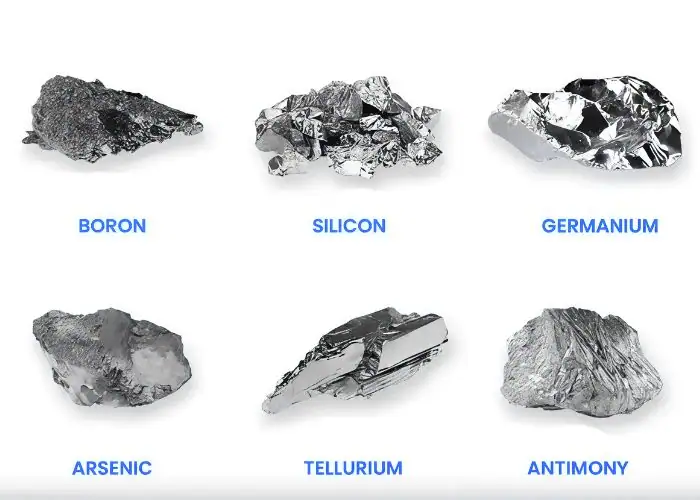
The commonly recognized metalloids include boron, silicon, germanium, arsenic, antimony, and tellurium. Some sources also include polonium and astatine, depending on how strictly the metalloid category is defined.
Common Metalloid Elements
Common metalloid elements include boron, silicon, germanium, arsenic, antimony, and tellurium. These elements are the most frequently discussed because their properties and applications are well established.
Silicon is the most widely known metalloid because it is used in semiconductors, solar cells, and electronic components. Boron is valued in glass, ceramics, abrasives, and high-strength materials. Germanium is used in fiber optics, infrared optics, and specialized electronics.
Arsenic, antimony, and tellurium also have industrial value, but they require careful handling because some compounds can be toxic or environmentally sensitive. In manufacturing, these elements are often used in controlled forms, alloys, additives, or specialized electronic materials.
What Distinguishes Metalloids from Metals and Nonmetals?
Metalloids are distinguished from metals and nonmetals by their mixed properties. They may look metallic, but they are usually brittle and have lower electrical conductivity than metals.
Differences Between Metals, Nonmetals, and Metalloids
The main difference between metals, nonmetals, and metalloids is how they behave physically, chemically, and electrically. Metals usually conduct heat and electricity well, nonmetals usually do not, and metalloids show intermediate behavior.
Metals are often ductile and malleable, which means they can be drawn into wires or shaped into sheets. Metalloids are usually brittle, so they are not ideal for structural forming or heavy load-bearing components.
Chemically, metals tend to lose electrons and form positive ions, while nonmetals tend to gain or share electrons. Metalloids often form covalent bonds and may show variable oxidation states, depending on the element and the reaction conditions.
Why Metalloids Have Intermediate Properties
Metalloids have intermediate properties because their atomic structures place them between metals and nonmetals. Their valence electrons allow them to behave in different ways depending on bonding, temperature, purity, and surrounding elements.
This is why metalloids properties can vary more than many people expect. Silicon can behave like an insulator in pure form but become more conductive when doped with selected elements. Antimony and tellurium can improve alloy performance or support specialized electrical behavior.
For engineers and manufacturers, this means metalloids should not be judged only by one simple label. Their actual performance depends on grade, purity, compound form, processing method, and final application.
Main Properties of Metalloids
The main properties of metalloids include solid state, metallic luster, brittleness, variable conductivity, covalent bonding, intermediate electronegativity, and useful chemical behavior. These common properties of metalloids explain why they are used in electronics, alloys, glass, ceramics, and advanced materials.
Solid State at Room Temperature
Metalloids are generally solid at room temperature. This makes them different from some nonmetals, which may exist as gases or liquids under normal conditions.
Their solid form allows them to be used in wafers, powders, compounds, alloying additions, ceramics, glasses, and engineered material systems. Silicon wafers, for example, are a major foundation of modern semiconductor manufacturing.
However, being solid does not mean metalloids behave like structural metals. Many metalloids are brittle, so their use must be based on function rather than traditional metal-like toughness or formability.
Metallic Luster
Metalloids often have a metallic luster, which means they can appear shiny like metals. This appearance is one of the easiest visual clues for identifying many metalloids.
The metallic look can be misleading because it does not mean the material behaves like a true metal. A metalloid may look shiny but still crack or break easily under impact or bending.
For manufacturing, appearance alone is not enough for material selection. Engineers must also consider conductivity, brittleness, chemical behavior, safety, and processing requirements.
Brittleness
Metalloids are usually brittle rather than malleable. They tend to break, crack, or fracture instead of bending smoothly like many metals.
This property limits their use in structural parts that require deformation, forming, or high impact resistance. A metalloid is usually not selected to replace steel, aluminum, or titanium in heavy-duty mechanical components.
However, brittleness does not make metalloids unimportant. Many high-performance materials are brittle but valuable because they provide special electrical, thermal, optical, or chemical properties.
Variable Electrical Conductivity
Metalloids have variable electrical conductivity. They usually conduct electricity better than nonmetals but not as well as true metals.
This is one of the most useful properties of metalloids. Silicon and germanium are well-known semiconductor materials because their conductivity can be controlled through doping, temperature, and material purity.
In electronics, controlled conductivity is often more valuable than maximum conductivity. This is why metalloids are essential for transistors, diodes, integrated circuits, sensors, and solar cells.
Thermal Conductivity
Metalloids usually have moderate thermal conductivity. They can transfer heat better than many nonmetals, but they are usually not as thermally conductive as common metals.
Thermal behavior matters in electronics, energy systems, and high-temperature applications. Silicon, for example, must manage both electrical function and heat during device operation.
Different metalloids can behave very differently. Some are useful in thermal management or thermoelectric devices, while others are more valuable for chemical or optical performance.
Intermediate Ionization Energy and Electronegativity
Metalloids usually have ionization energy and electronegativity values between metals and nonmetals. This intermediate behavior supports their mixed chemical and electrical properties.
Ionization energy affects how easily an atom loses electrons. Electronegativity affects how strongly an atom attracts electrons in chemical bonding. Since metalloids fall between metals and nonmetals, they can form different types of compounds.
This explains why metalloids are chemically flexible. They can interact with metals, nonmetals, and other elements in ways that support alloys, semiconductors, ceramics, and specialty compounds.
Covalent Bonding Behavior
Metalloids commonly form covalent bonds. This means they often share electrons with other atoms instead of simply losing or gaining electrons.
Covalent bonding is important in materials such as silicon dioxide, boron compounds, germanium compounds, and many semiconductor structures. These bonds can create stable, hard, heat-resistant, or electrically useful materials.
This property also helps explain why metalloids behave more like nonmetals in some chemical reactions, even though they may look like metals on the surface.
Variable Chemical Reactivity
Metalloids show variable chemical reactivity. Some react more easily with metals, nonmetals, halogens, or oxygen, while others are more stable under normal conditions.
The chemical properties of metalloids depend on the specific element and compound form. Boron, silicon, arsenic, antimony, and tellurium do not behave identically, even though they are grouped as metalloids.
In industrial use, this means each metalloid must be evaluated separately. A material that works well in electronics may not be suitable for direct structural use or uncontrolled chemical exposure.
Amphoteric Oxides
Some metalloids can form amphoteric oxides. Amphoteric oxides can react with both acids and bases, depending on the chemical environment.
This behavior is useful because it shows the intermediate nature of metalloids. They do not behave exactly like typical metal oxides or typical nonmetal oxides.
In practical applications, oxide behavior can affect surface chemistry, processing, compatibility, and material performance in chemical, ceramic, and electronic systems.
Melting and Boiling Points
Metalloids often have relatively high melting and boiling points, but the exact values vary by element. This helps some metalloids perform well in heat-related or high-stability applications.
Boron and silicon, for example, are known for high-temperature stability compared with many common materials. Tellurium and antimony have different thermal behavior and are used in more specialized applications.
For engineers, melting point alone is not enough to choose a material. Thermal expansion, brittleness, conductivity, oxidation behavior, and processing method must also be considered.
Physical Properties of Metalloids
The physical properties of metalloids include solid form, metallic appearance, brittleness, and intermediate electrical and thermal conductivity. These properties describe how metalloids look, feel, conduct, break, and respond to physical conditions.
Appearance and Structure
Metalloids often appear shiny, gray, or metallic, but their internal structure is not the same as typical metals. Their bonding and crystal structures contribute to their brittle and semiconductor-like behavior.
This explains why a metalloid can look like a metal but behave very differently during machining, forming, or impact. Visual inspection is useful, but it cannot replace material data.
In manufacturing, structure matters because it affects cutting behavior, fracture risk, surface finish, and long-term stability. Brittle metalloid materials may require controlled processing instead of aggressive forming.
Brittleness vs Malleability
Metalloids are generally brittle, not malleable. They are more likely to fracture than bend when mechanical force is applied.
This is an important difference from metals. Aluminum, copper, and many steels can be formed, rolled, drawn, or machined into load-bearing parts. Metalloids are usually used for functional properties rather than ductile mechanical performance.
When metalloid-containing materials are used in manufacturing, engineers often use them as wafers, additives, compounds, ceramics, or alloying elements instead of relying on them as fully structural materials.
Electrical and Thermal Behavior
Metalloids have intermediate electrical and thermal behavior. They can conduct electricity and heat, but usually not as strongly as metals.
This intermediate behavior is exactly what makes many metalloids valuable. In semiconductors, the ability to control electrical flow is more useful than simply conducting electricity as much as possible.
Thermal behavior also matters in advanced applications. Electronic components, optical devices, solar cells, and thermoelectric materials all require careful control of heat and electrical performance.
Chemical Properties of Metalloids
The chemical properties of metalloids include covalent bonding, variable oxidation states, intermediate electronegativity, and reactions with both metals and nonmetals. These properties explain how metalloids form compounds and behave in different chemical environments.
Oxidation States
Metalloids can show variable oxidation states. This means they may combine with other elements in more than one chemical form.
Variable oxidation states are useful because they allow metalloids to form different compounds with different properties. Arsenic, antimony, and tellurium, for example, can appear in multiple oxidation states depending on the chemical system.
In manufacturing and material design, oxidation state can influence toxicity, stability, corrosion behavior, electrical performance, and compatibility with other materials.
Covalent Bond Formation
Metalloids often form covalent bonds by sharing electrons with other atoms. This is one of their most important nonmetal-like properties.
Covalent bonding helps create stable compounds such as silicon dioxide and boron-based materials. It also supports semiconductor structures, ceramic materials, and specialty chemical compounds.
This behavior makes metalloids useful in high-performance applications where simple metallic bonding is not enough to provide the required electrical, thermal, or chemical properties.
Reactivity with Other Elements
Metalloids can react with both metals and nonmetals. Their reactivity depends on the element, purity, temperature, and surrounding chemical environment.
With metals, some metalloids can form alloys or intermetallic compounds. With nonmetals, they often form covalent compounds. This flexibility is one reason they are valuable in metallurgy, electronics, and chemical processing.
However, reactivity must be controlled. Some metalloid compounds can be toxic, unstable, or environmentally sensitive, so safe handling and correct material selection are important.
Acidic, Basic, and Amphoteric Behavior
Some metalloid oxides can show acidic, basic, or amphoteric behavior. This means their chemical response may change depending on whether they are exposed to acids or bases.
This property reflects the intermediate nature of metalloids. Metal oxides are often basic, while nonmetal oxides are often acidic. Metalloid oxides may sit between these patterns.
For industrial applications, oxide behavior can affect surface treatment, chemical compatibility, glass production, ceramics, and electronic material processing.
Common Metalloids and Their Applications
Common metalloids are used in applications such as semiconductors, solar cells, glass, ceramics, alloys, flame retardants, optics, and specialty chemicals. Each metalloid has different strengths and limitations.
Boron
Boron is a metalloid used in glass, ceramics, abrasives, detergents, composites, and high-performance materials. It is valued for hardness, heat resistance, and its ability to improve material performance in selected systems.
Boron compounds are often used in borosilicate glass, which has good thermal shock resistance. Boron is also important in fiberglass, ceramics, and some advanced aerospace or defense-related materials.
In manufacturing, boron is usually used in compound or additive form rather than as a simple standalone structural material.
Silicon
Silicon is the most widely used metalloid in modern technology. It is essential for semiconductors, solar cells, microchips, sensors, and many electronic devices.
Pure silicon has limited conductivity, but its electrical behavior can be controlled through doping. This makes it one of the most important materials in electronics manufacturing.
Silicon is also widely used in glass, ceramics, silicones, and construction-related materials. Its combination of abundance, stability, and electronic usefulness makes it one of the most valuable metalloids.
Germanium
Germanium is a metalloid used in fiber optics, infrared optics, semiconductors, and specialized electronic applications. It is valued for optical and electrical properties rather than structural strength.
Germanium can transmit infrared light, making it useful in infrared lenses, sensors, and thermal imaging systems. It can also be used in high-efficiency solar cells and semiconductor devices.
Because germanium is less common and more specialized than silicon, it is usually selected when its unique optical or electronic performance justifies the cost.
Arsenic
Arsenic is a metalloid used in some semiconductor compounds and specialized alloys, but it requires careful safety control. Many arsenic compounds are toxic, so its use must be strictly managed.
One important application is gallium arsenide, a compound semiconductor used in high-speed electronics, LEDs, laser diodes, and certain solar cells. In these applications, arsenic is not used casually but as part of a controlled engineered material.
For general manufacturing, arsenic is not a common material choice unless the application specifically requires its chemical or electronic behavior.
Antimony
Antimony is a metalloid used in flame retardants, lead alloys, batteries, and some electronic materials. It is valued because it can improve safety, hardness, and performance in selected systems.
Antimony compounds are widely used in flame-retardant formulations for plastics, textiles, coatings, and electrical materials. In alloys, antimony can improve hardness and strength.
Like arsenic, antimony must be used responsibly because certain compounds can create health or environmental concerns. Proper material handling and compliance are important.
Tellurium
Tellurium is a metalloid used in thermoelectric devices, solar cells, steel alloys, and specialty electronic materials. It is valued for its electrical, thermal, and alloying behavior.
Tellurium can improve machinability in some metal alloys and is used in cadmium telluride solar cells. It also plays a role in thermoelectric materials that convert heat differences into electrical energy.
Because tellurium is relatively rare, it is usually used in targeted applications where its performance benefits are important.
Applications of Metalloids in Industry
Metalloids are used in industry because their mixed properties support electronic, thermal, optical, chemical, and material performance. They are especially valuable where metals or nonmetals alone cannot provide the right balance.
Electronics and Semiconductors
Metalloids are important in electronics and semiconductors because their conductivity can be controlled. Silicon and germanium are the best-known examples.
Semiconductors need materials that can switch, regulate, or control electrical current. Metals conduct too easily, while many nonmetals conduct too poorly. Metalloids provide the useful middle ground.
This is why silicon is used in microchips, transistors, diodes, sensors, solar cells, and integrated circuits. Without metalloid-based semiconductors, modern electronics would not function in the same way.
Solar Cells and Renewable Energy
Metalloids are used in solar cells and renewable energy because they can help convert light or heat into electrical energy. Silicon is the dominant material in many photovoltaic cells.
The semiconductor behavior of silicon allows solar panels to generate electricity from sunlight. Tellurium is also important in cadmium telluride solar cells, while germanium can be used in high-efficiency solar technologies.
As renewable energy expands, metalloid materials will continue to support solar power, power electronics, battery systems, and energy conversion technologies.
Alloy Production
Metalloids are used in alloy production because they can improve hardness, strength, corrosion behavior, or machinability. Even small additions can change the performance of a metal system.
Boron can improve hardenability in steel. Antimony can improve hardness in lead alloys. Tellurium can improve machinability in copper and steel alloys.
However, metalloid additions must be controlled carefully. Too much of the wrong element can increase brittleness, reduce ductility, or create processing problems.
Glass and Ceramics
Metalloids are used in glass and ceramics because they can improve heat resistance, hardness, chemical stability, and optical properties. Boron and silicon are especially important in this area.
Silicon dioxide is the foundation of many glass and ceramic materials. Boron compounds are used in borosilicate glass, which resists thermal shock better than ordinary glass.
These materials are used in laboratory glassware, cookware, electronics, optics, insulation, and industrial components that need stable performance under heat or chemical exposure.
Flame Retardants
Metalloids are used in flame retardants because some compounds can help reduce flammability in plastics, textiles, coatings, and electrical materials. Antimony compounds are common examples.
In many flame-retardant systems, antimony compounds work together with halogenated materials to slow flame spread. This can improve safety in wiring, enclosures, building products, and industrial equipment.
Flame-retardant use must balance performance, safety, environmental rules, and regulatory compliance. The exact compound and application matter more than the element name alone.
Optoelectronics
Metalloids are used in optoelectronics because they can interact with light and electricity in useful ways. Germanium, silicon, and arsenic-based compounds are important examples.
Optoelectronic applications include infrared optics, LEDs, laser diodes, photodetectors, fiber optics, and imaging systems. These applications require precise control of optical and electrical behavior.
Metalloids are valuable because they can support both signal transmission and electronic control in advanced devices.
Chemical Industry
Metalloids are used in the chemical industry as compounds, catalysts, additives, and functional materials. Their chemical flexibility allows them to support many specialized reactions and products.
Boron compounds, silicon compounds, arsenic compounds, antimony compounds, and tellurium compounds all have specific chemical roles. Some are used in detergents, coatings, ceramics, medicines, agriculture, or industrial processing.
Because some metalloid compounds can be hazardous, chemical use requires proper safety controls, environmental management, and regulatory review.
Why Metalloid Properties Matter in Manufacturing
Metalloid properties matter in manufacturing because they help create materials and components with controlled electrical, thermal, chemical, optical, and mechanical behavior. They are not only academic elements,they directly affect product performance.

Role in High-Performance Materials
Metalloids play a role in high-performance materials by improving hardness, stability, heat resistance, electronic behavior, or chemical performance. They often act as functional elements inside a larger material system instead of being used alone as pure structural materials.
For example, boron can improve glass and composite performance. Silicon enables semiconductor devices and silicone-based materials. Antimony supports flame retardancy and alloy hardness. When metalloids are added to metals, such as silicon-aluminum alloys or antimony-containing alloys, the final material can gain better strength, wear resistance, castability, or functional performance while still being suitable for common machining processes.
In high-performance manufacturing, metalloid-containing alloys are often processed by CNC milling, CNC turning, drilling, grinding, and other precision machining methods. Compared with pure brittle metalloids, these alloys usually have improved plasticity and machinability after being combined with metal elements. This makes them more practical for industrial parts, electronic housings, automotive components, tooling-related parts, and custom CNC machined components.
These materials must still be selected based on real operating conditions, including temperature, stress, chemical exposure, electrical requirements, dimensional tolerance, surface finish, and safety standards. For CNC machining projects, engineers should also consider tool wear, chip control, cutting parameters, and whether the metalloid-containing alloy behaves more like a standard metal alloy or a brittle functional material.
Benefits for Electronics and Advanced Components
Metalloids benefit electronics and advanced components because they allow engineers to control conductivity, signal behavior, thermal response, and optical performance. This makes them essential in modern technology.
Silicon is the clearest example. Its semiconductor behavior supports microprocessors, memory chips, sensors, and power electronics. Germanium supports infrared optics and fiber optic systems.
As components become smaller, faster, and more energy efficient, metalloid-based materials remain important for precision, performance, and reliability.
Limitations in Structural Applications
Metalloids are limited in structural applications because they are usually brittle and not as ductile as metals. They are not normally used as direct replacements for steel, aluminum, or titanium in load-bearing parts.
This does not mean metalloids lack manufacturing value. Instead, it means they are usually used where functional performance is more important than toughness or ductility.
For structural design, engineers often use metalloids as alloying additions, coatings, compounds, or ceramic-related materials rather than relying on them as pure structural elements.
Environmental and Safety Considerations of Metalloids
Environmental and safety considerations are important because some metalloids and metalloid compounds can be toxic, persistent, or difficult to manage. The risk depends on the element, compound form, exposure level, and application.
Soil and Water Contamination
Some metalloids can contribute to soil and water contamination when released from mining, industrial waste, agriculture, or improper disposal. Arsenic is one of the most well-known concerns.
Contamination can affect drinking water, crops, ecosystems, and long-term public health. This is why metalloid-containing waste streams must be controlled.
Manufacturers should manage raw materials, process residues, wastewater, and end-of-life products responsibly when hazardous metalloids are involved.
Human Health Risks
Some metalloids can create human health risks depending on exposure form and concentration. Arsenic and certain antimony compounds require particular care.
Health risks may come from inhalation, ingestion, skin contact, dust, fumes, or contaminated water. These risks are strongly connected to compound chemistry, not just the element name.
Safe manufacturing requires proper material safety data, personal protective equipment, ventilation, exposure monitoring, and waste management.
Handling and Application Challenges
Handling and application challenges arise because metalloids can be brittle, reactive, toxic, rare, or difficult to process. These challenges must be considered early in design and sourcing.
A material may be technically suitable but difficult to machine, expensive to procure, or restricted by safety rules. This can affect cost, lead time, and supplier selection.
The best approach is to confirm the material form, grade, process route, safety requirements, and application environment before production.
Future Uses of Metalloids in Emerging Technologies
Future uses of metalloids will continue to grow in semiconductors, renewable energy, smart materials, optics, and advanced manufacturing. Their intermediate properties make them valuable for new technologies.
Advanced Semiconductors
Metalloids will remain important in advanced semiconductors because they help control electron flow in electronic devices. Silicon will continue to dominate many applications, while germanium and compound semiconductors will support specialized performance.
Advanced chips require precise control of purity, doping, and crystal quality. Small changes in material behavior can affect speed, power use, and reliability.
As electronics become more complex, metalloid-based materials will continue to support computing, communications, sensors, and power devices.
Renewable Energy Materials
Metalloids will support renewable energy materials through solar cells, thermoelectric devices, power electronics, and energy conversion systems. Silicon, tellurium, and germanium are important in this field.
Renewable energy systems need materials that can manage electricity, heat, light, and long-term outdoor exposure. Metalloid properties are well suited to many of these requirements.
Future development may focus on higher efficiency, lower material waste, improved recycling, and more stable supply chains.
New Functional Materials
Metalloids will help create new functional materials with controlled electrical, thermal, optical, and chemical behavior. These materials may support sensors, coatings, smart devices, and advanced manufacturing systems.
Functional materials are designed for performance, not just strength. They may respond to heat, light, electricity, pressure, or chemical exposure.
Because metalloids can behave between metals and nonmetals, they are useful building blocks for materials that need balanced or tunable properties.
FAQs
What Are The Properties Of Metals Nonmetals And Metalloids?
Metals are shiny, malleable, ductile, and good conductors of heat and electricity. Nonmetals are usually dull, brittle, and poor conductors. Metalloids have properties between metals and nonmetals, such as metallic luster, brittleness, and moderate conductivity, making them useful in electronic and industrial materials.
What Are Physical Properties Of Metalloids?
Metalloids are usually solid at room temperature and often have a shiny, metal-like appearance. However, they are brittle rather than malleable. Their electrical and thermal conductivity is moderate, which means they conduct better than nonmetals but not as well as true metals.
What Property Is Unique To Metalloids?
The most unique property of metalloids is their semiconductor behavior. They can conduct electricity better than nonmetals but less effectively than metals. Their conductivity can also be adjusted by temperature, purity, or doping, which makes them important for chips, sensors, and solar cells.
What Are The 7 Elements Of Metalloids?
The 7 commonly recognized metalloids are boron, silicon, germanium, arsenic, antimony, tellurium, and polonium. These elements are located near the zigzag line on the periodic table. Among them, silicon is the most widely used in semiconductors, solar panels, glass, and ceramics.
Conclusion
Metalloids are important because they combine metal-like and nonmetal-like properties in one group of elements. Their solid form, metallic luster, brittleness, intermediate conductivity, covalent bonding, and variable chemical behavior make them valuable in electronics, solar cells, glass, ceramics, alloys, flame retardants, optics, and advanced materials. Understanding the properties of metalloids helps engineers choose the right material for functional performance, not just basic strength.
At TiRapid, we provide precision CNC machining services for custom metal and plastic components used in industrial, electronic, automotive, medical, and advanced manufacturing applications. If your project requires material selection support, tight-tolerance machining, functional prototypes, or low-volume production, our team can help turn your design into reliable, production-ready parts.