PEI vs PEEK is a common material comparison in high-performance plastic selection because both materials are used in demanding engineering applications. PEI is often selected for electrical insulation, flame resistance, dimensional stability, and cost control, while PEEK is chosen for higher heat resistance, stronger chemical stability, better wear performance, and more demanding mechanical environments.
In this guide, we compare PEI vs PEEK by material structure, properties, advantages, limitations, grades, and applications to help you choose the right high-performance plastic for your project.
What Is PEI Material?
PEI, or polyetherimide, is a high-performance amorphous thermoplastic known for good heat resistance, excellent electrical insulation, flame retardancy, dimensional stability, and strong rigidity. It is widely used in aerospace interiors, electrical systems, semiconductor fixtures, medical equipment, automotive electronics, and industrial components.
Compared with common engineering plastics such as ABS, nylon, POM, or PC, PEI provides higher temperature resistance and better long-term dimensional stability. Compared with PEEK, PEI is usually more cost-effective and easier to process, making it a practical choice when the application needs high engineering performance but does not require the extreme chemical or wear resistance of PEEK.
For many engineering projects, PEI is useful when the part needs:
- Good thermal stability
- Electrical insulation
- Flame retardancy
- Dimensional stability
- Lower cost than PEEK
- Reliable CNC machining or molding performance
Chemical Structure and Material Characteristics of PEI
PEI is an amorphous thermoplastic, which means its polymer structure does not form a highly crystalline phase like PEEK. This gives PEI predictable shrinkage, good dimensional consistency, and stable processing behavior during CNC machining, injection molding, and 3D printing.
Its amorphous structure also helps PEI maintain tight dimensional control in precision components. This is useful for electrical insulators, semiconductor fixtures, high-temperature brackets, and aerospace interior parts where stable geometry is more important than sliding wear resistance.
However, because PEI is amorphous, its chemical resistance and wear resistance are generally lower than semi-crystalline materials such as PEEK. This means PEI works well in heat, flame, and insulation applications, but may not be the best choice for aggressive chemical exposure or high-friction moving parts.
| Material Characteristic | PEI Performance Meaning |
| Polymer structure | Amorphous thermoplastic |
| Processing behavior | Predictable and stable |
| Dimensional stability | Good for precision parts |
| Electrical insulation | Strong performance |
| Chemical resistance | Good, but lower than PEEK |
| Wear resistance | Moderate |
Key Properties of PEI
PEI provides a strong combination of heat resistance, flame resistance, rigidity, and electrical insulation. This makes it useful for engineering parts that need more performance than common plastics but do not require the highest performance level of PEEK.
PEI can usually operate continuously around 170–180°C, depending on grade and application conditions. It also has natural flame-retardant behavior and is commonly available in grades that meet UL94 V-0 requirements.
| Property | PEI Typical Performance |
| Continuous use temperature | Around 170–180°C |
| Tensile strength | About 95–120 MPa |
| Elastic modulus | Around 3.0–3.3 GPa |
| Flame rating | Often UL94 V-0 |
| Electrical insulation | Excellent |
| Moisture absorption | Low to moderate |
| Machinability | Good |
| Chemical resistance | Moderate to good |
For CNC machining, PEI generally offers good dimensional stability and smoother processing than many reinforced high-performance plastics. Stable clamping, sharp tools, and controlled cutting parameters are still important, especially for thin walls, flatness requirements, and tight-tolerance insulating parts.
Advantages and Limitations of PEI
The biggest advantage of PEI is its balance between performance and cost. It provides strong heat resistance, electrical insulation, flame retardancy, and dimensional stability at a lower cost than PEEK. For many aerospace interior parts, electrical housings, and semiconductor fixtures, PEI can meet the engineering requirement without using a more expensive material.
PEI is also easier to process than PEEK in many cases. It usually causes less tool wear during machining and requires less demanding molding or printing conditions. This can reduce production difficulty and improve manufacturing efficiency.
However, PEI also has limitations. It is less resistant to aggressive chemicals, long-term sliding wear, repeated friction, and extreme high-temperature environments than PEEK. If a part must work in fuel, steam, strong solvents, chemical processing systems, or high-load wear conditions, PEEK is usually safer.
| Factor | PEI Advantage | PEI Limitation |
| Cost | Lower than PEEK | Higher than common plastics |
| Heat resistance | Good | Lower than PEEK |
| Electrical insulation | Excellent | Not the only selection factor |
| Chemical resistance | Good in normal conditions | Limited in aggressive environments |
| Wear resistance | Acceptable for static parts | Not ideal for severe sliding wear |
| Machining | Easier than PEEK | Still needs controlled cutting |
Common PEI Grades and ULTEM Materials
PEI is available in different forms and grades depending on the manufacturing process and performance requirement. ULTEM is the most recognized PEI brand family and is widely used for high-performance industrial applications.
Common PEI material forms include PEI sheet, PEI rod, ULTEM 1000, glass-filled PEI, PEI filament, injection molding grades, and medical-related PEI grades. Unfilled PEI is commonly used for electrical insulation and precision machined components, while glass-filled PEI is chosen when stiffness, strength, and dimensional stability need to be improved.
The correct PEI grade should be selected based on operating temperature, mechanical load, flame rating, electrical insulation requirements, machining tolerance, and production method. For example, PEI filament may be suitable for industrial 3D printing prototypes, while PEI rod or sheet is better for CNC machined insulating fixtures and precision plates.
What Is PEEK Material?
PEEK, or polyether ether ketone, is a semi-crystalline high-performance thermoplastic known for excellent heat resistance, chemical resistance, mechanical strength, fatigue resistance, wear performance, and dimensional stability. It is one of the highest-performing engineering plastics used in precision manufacturing.
Compared with PEI, PEEK provides stronger performance in extreme environments. It is more expensive and usually requires more careful processing, but it is often the better material when the part must withstand high temperature, aggressive chemicals, repeated friction, mechanical stress, or long service life requirements.
For many engineering projects, PEEK is useful when the part needs:
- Extremely high heat resistance
- Strong chemical resistance
- Excellent wear and friction performance
- Long-term mechanical stability
- Low moisture absorption
- High fatigue resistance
- Reliable performance in harsh environments
Chemical Structure and Material Characteristics of PEEK
PEEK is a semi-crystalline thermoplastic. This structure gives it excellent resistance to chemicals, wear, fatigue, and high temperatures. Compared with PEI, PEEK generally performs better in dynamic mechanical systems and harsh operating environments.
Its semi-crystalline structure helps the material resist deformation under heat and load. It also improves hydrolysis resistance, making PEEK suitable for hot water, steam, and sterilization environments. This is one reason PEEK is widely used in medical devices, semiconductor equipment, and industrial pump or valve systems.
However, PEEK’s high performance also makes it more demanding to manufacture. It may require higher processing temperatures, better tooling, more stable machining parameters, and careful stress control for tight-tolerance parts.
| Material Characteristic | PEEK Performance Meaning |
| Polymer structure | Semi-crystalline thermoplastic |
| Heat resistance | Excellent |
| Chemical resistance | Excellent |
| Wear resistance | Excellent |
| Fatigue resistance | Strong |
| Moisture absorption | Very low |
| Processing difficulty | Higher than PEI |
Key Properties of PEEK
PEEK is selected when the part must perform reliably in demanding environments. It is commonly used when standard plastics, and even many high-performance plastics, cannot provide enough thermal, chemical, or mechanical performance.
PEEK can usually operate continuously around 250–260°C, depending on grade and working conditions. It also has excellent chemical resistance and can withstand many fuels, oils, solvents, steam, and aggressive industrial fluids.
| Property | PEEK Typical Performance |
| Continuous use temperature | Around 250–260°C |
| Short-term heat resistance | Above 300°C |
| Tensile strength | About 90–110 MPa |
| Chemical resistance | Excellent |
| Wear resistance | Excellent |
| Fatigue resistance | Excellent |
| Moisture absorption | Very low |
| Machinability | Good with proper tooling |
PEEK is especially valuable for parts that must work under heat, pressure, friction, or chemical exposure. It is also widely used where dimensional stability and long-term reliability are more important than material cost.
Advantages and Limitations of PEEK
The biggest advantage of PEEK is its overall performance. It combines heat resistance, chemical resistance, wear resistance, and mechanical durability in one material. For demanding projects, this makes PEEK one of the most reliable plastic options.
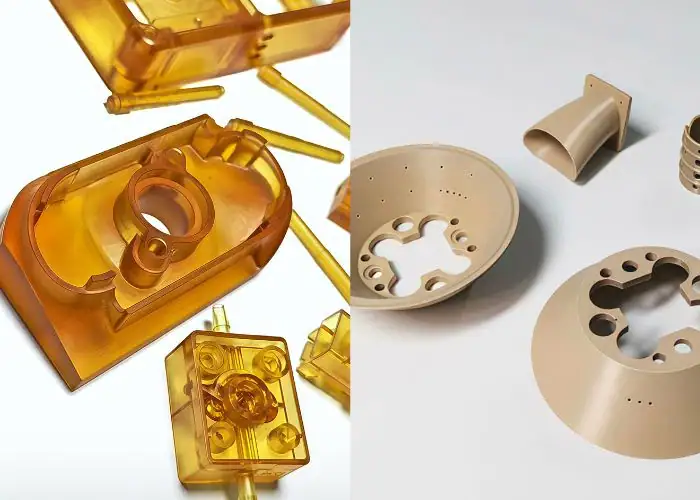
PEEK can replace metal in some applications where corrosion resistance, weight reduction, and long service life are important. It is commonly used for bearings, bushings, seals, valve seats, medical implants, aerospace brackets, and semiconductor components.
The main limitation of PEEK is cost. It is much more expensive than PEI and most engineering plastics. It also has higher machining and processing costs, especially when using reinforced grades. Carbon-filled or glass-filled PEEK can increase tool wear and may require optimized cutting strategies.
| Factor | PEEK Advantage | PEEK Limitation |
| Heat resistance | Excellent | Requires high processing temperature |
| Chemical resistance | Very strong | Higher material cost |
| Wear resistance | Excellent | Reinforced grades increase tool wear |
| Mechanical performance | Reliable under stress | May be over-specified for simple parts |
| Medical use | Suitable for selected grades | Certification must be confirmed |
| Cost | Long-term value in harsh use | High upfront cost |
Common PEEK Grades and Reinforced Materials
PEEK is available in several grades designed for different mechanical, thermal, wear, and regulatory requirements. Unfilled PEEK is commonly used for general high-performance parts, while reinforced grades improve stiffness, wear resistance, and dimensional stability.
Common PEEK material types include unfilled PEEK, glass-filled PEEK, carbon-filled PEEK, bearing-grade PEEK, medical-grade PEEK, tribological PEEK, PEEK sheet and rod, and industrial PEEK filament.
Glass-filled PEEK is often used when higher rigidity and dimensional stability are needed. Carbon-filled PEEK is selected for high stiffness, wear resistance, and lower thermal expansion. Bearing-grade PEEK may include fillers such as PTFE, graphite, or carbon to improve friction performance.
For medical or implant-related applications, material certification must be confirmed before production. Not every PEEK grade is suitable for medical use, even if the base material has strong biocompatibility potential.
PEI vs PEEK: Key Material Properties Comparison
PEI and PEEK differ mainly in heat resistance, chemical stability, wear behavior, cost, and long-term performance. PEI is usually better when insulation, flame resistance, dimensional stability, and cost efficiency are the main priorities. PEEK is usually better when extreme heat, chemical resistance, friction, and long service life are more important.
The practical rule is simple: choose PEI when the part needs stable engineering performance at a controlled cost, choose PEEK when the part must survive harsh service conditions.
| Property | PEI | PEEK |
| Structure | Amorphous | Semi-crystalline |
| Heat resistance | High | Very high |
| Chemical resistance | Moderate to good | Excellent |
| Wear resistance | Moderate | Excellent |
| Electrical insulation | Excellent | Excellent |
| Flame resistance | Excellent | Excellent |
| Machinability | Easier | More demanding |
| Cost | Lower | Much higher |
| Best use | Insulation and structural parts | Harsh and high-performance parts |
Mechanical Strength and Stiffness
PEI and PEEK both provide strong mechanical properties compared with standard engineering plastics. PEI has high rigidity and is suitable for structural parts that need stiffness and dimensional stability. PEEK offers better toughness, fatigue resistance, and long-term strength retention under more demanding conditions.
For static parts such as electrical housings, insulating blocks, and brackets, PEI can be a very practical option. For moving parts, load-bearing components, or assemblies exposed to repeated stress, PEEK is usually more reliable.
Heat Resistance and Continuous Operating Temperature
PEEK has better heat resistance than PEI. PEI can usually operate around 170–180°C, while PEEK can usually operate around 250–260°C. This difference becomes important when parts are used near engines, hot fluid systems, semiconductor equipment, or high-temperature industrial machinery.
PEI is suitable for elevated-temperature electrical and structural applications. PEEK is better for extreme heat environments where mechanical performance must remain stable for long service periods.
Chemical Resistance and Environmental Stability
PEEK offers stronger chemical resistance than PEI. PEI performs well in many normal industrial environments, but aggressive chemicals, strong solvents, or long-term exposure to harsh fluids may reduce its performance.
PEEK is more suitable for chemical processing, oil and gas systems, steam exposure, sterilization cycles, and semiconductor fluid-handling parts. If chemical exposure is a major risk, PEEK is usually the safer material.
Wear Resistance and Friction Performance
PEEK performs much better than PEI in sliding, friction, and wear applications. PEI can be used for static or low-friction parts, but it is not usually the first choice for bearings, bushings, seals, or moving assemblies.
PEEK, especially bearing-grade or carbon-filled grades, is commonly used in mechanical systems where long-term wear resistance is important. This makes it more suitable for pumps, valves, sliding parts, and high-load moving components.
What Are the Differences in Processing Methods Between PEI and PEEK?
PEI and PEEK can both be CNC machined, injection molded, and 3D printed, but their processing behavior is different. PEI is generally easier and more cost-effective to process, while PEEK requires tighter temperature control, more advanced equipment, and more careful machining strategies.
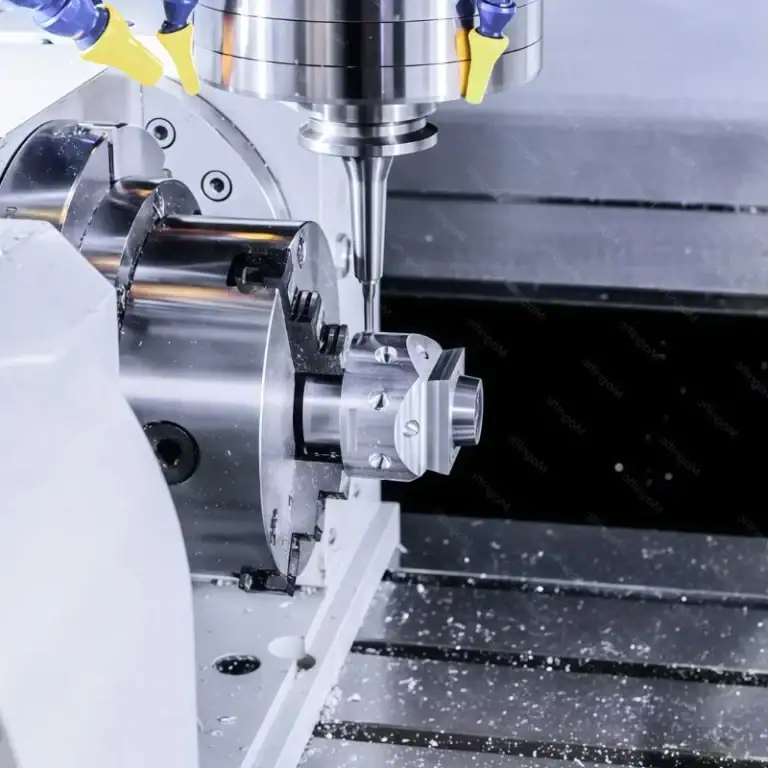
For complex parts, 5-axis CNC machining can reduce repeated setups and improve access to angled surfaces, deep cavities, and compound geometries. PEI is relatively stable and easier to machine in a single setup, while PEEK requires stricter control of cutting heat, tool sharpness, clamping force, and material stress to maintain dimensional accuracy.
For manufacturing decisions, processing cost can be just as important as material cost. A material that is cheaper per kilogram may still become expensive if it causes high scrap rates, tool wear, dimensional instability, or longer machining cycles.
| Manufacturing Factor | PEI | PEEK |
|---|---|---|
| CNC machining | Easier | More demanding |
| 5-axis machining | Easier to control for complex geometries | Requires careful heat, toolpath, and stress control |
| Tool wear | Lower | Higher |
| Injection molding | Easier than PEEK | Requires high-temperature control |
| 3D printing | More accessible | Requires an industrial printer |
| Surface finish | Good | Excellent with the proper process |
| Production cost | Lower | Higher |
CNC Machinability Comparison
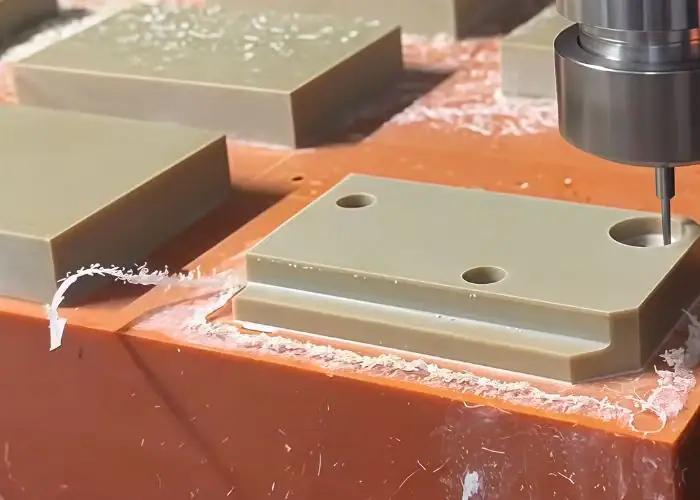
PEI is usually easier to machine than PEEK because it has lower tool wear, more predictable cutting behavior, and a more stable response during standard CNC milling or turning. For parts such as electrical insulators, semiconductor fixtures, brackets, housings, and precision plates, PEI can often achieve good dimensional accuracy and surface quality with conventional carbide tools.
PEI also tends to be more forgiving during machining. As long as the part is properly clamped and the cutting parameters are controlled, it can maintain stable dimensions without excessive burrs or tool damage. This makes PEI practical for small-batch production, prototype machining, and custom parts that require good tolerance control but do not face extreme wear or chemical exposure.
PEEK can also be CNC machined very well, but it requires stricter process control. Because PEEK has higher toughness, better wear resistance, and stronger heat resistance, cutting tools must stay sharp, cutting heat must be managed carefully, and the machining sequence should be planned to avoid internal stress or deformation. For reinforced PEEK grades, such as glass-filled or carbon-filled PEEK, tool wear can increase significantly, so carbide, diamond-coated, or PCD tools may be needed for stable production.
For tight-tolerance PEEK parts, fixturing and stress control are especially important. If too much material is removed in one pass, or if the part is clamped unevenly, the final dimensions may shift after machining. For high-precision PEEK components used in aerospace, medical, or semiconductor applications, rough machining, stress relief, and finishing passes are often planned separately.
| Machining Factor | PEI | PEEK |
| Machining difficulty | Easier | More demanding |
| Tool wear | Lower | Higher, especially reinforced grades |
| Cutting stability | Good | Requires better heat control |
| Surface finish | Good | Excellent with correct process |
| Best for | Insulators, fixtures, housings | Seals, bearings, medical parts |
| Cost impact | Lower | Higher |
Injection Molding and Processing Temperature
Both PEI and PEEK can be injection molded, but their processing requirements are different. PEI generally has a more manageable molding window, making it easier to use for many industrial molded components. It is commonly molded into electrical housings, connectors, brackets, medical equipment parts, and aerospace interior components.
PEI molding still requires proper drying, melt temperature control, and mold temperature control. If moisture is not removed before molding, defects such as bubbles, silver streaks, or weak surface areas may appear. However, compared with PEEK, PEI is usually easier to process and more suitable for medium-to-high-volume molded parts where cost and production efficiency matter.
PEEK injection molding is more demanding because it requires higher melt temperature, higher mold temperature, and more careful crystallization control. If cooling is uneven or the mold temperature is not stable, the final part may have inconsistent crystallinity, internal stress, warpage, or reduced mechanical performance. This is especially important for high-performance parts used in medical, aerospace, oil and gas, or semiconductor environments.
In general, PEI is more practical for flame-retardant and electrical insulation molded parts, while PEEK is better for molded components that must withstand extreme heat, chemicals, wear, or repeated mechanical stress.
| Processing Item | PEI | PEEK |
| Processing difficulty | Moderate | High |
| Melt temperature | Lower than PEEK | Higher |
| Mold temperature control | Important | Very critical |
| Drying before molding | Required | Required |
| Shrinkage control | More predictable | Depends on crystallization |
| Typical molded parts | Connectors, housings, brackets | Seals, valve parts, medical parts |
What Are The Cost Differences Between PEI VS PEEK?
PEI is usually much more cost-effective than PEEK. This is one of the main reasons engineers compare the two materials during early design. If PEI can meet the working requirements, it can reduce both raw material cost and processing cost.
PEEK is more expensive, but its long-term value can be higher in harsh environments. If a part fails early due to heat, chemical attack, or wear, the cost of replacement, downtime, and risk may be much higher than the initial material savings.
| Cost Factor | PEI | PEEK |
| Raw material cost | Lower | Much higher |
| Machining cost | Lower | Higher |
| Tool wear cost | Lower | Higher |
| Processing difficulty | Moderate | High |
| Long-term value | Good in normal conditions | Better in harsh conditions |
Choose PEI when the application needs heat resistance, insulation, and flame resistance, but the environment is not extremely aggressive. Choose PEEK when failure risk is high and the part must survive heat, chemicals, friction, or repeated stress.
What Are The Applications Of PEI vs PEEK In Various Industries?
PEI and PEEK are used across many of the same industries, but they usually serve different roles. PEI is commonly used in electrical, structural, and flame-retardant parts, while PEEK is used in high-load, high-wear, high-temperature, and chemically aggressive applications.
| Industry | PEI Applications | PEEK Applications |
| Aerospace | Interior panels, connectors, brackets | Structural brackets, seals, high-temp parts |
| Medical | Device housings, handles, sterilizable parts | Implants, surgical tools, precision components |
| Electronics | Connectors, insulators, housings | High-temp insulation, semiconductor parts |
| Automotive | Lighting parts, EV electrical parts | Engine parts, seals, bearings |
| Industrial | Fixtures, insulators, structural parts | Pumps, valves, bushings, wear parts |
PEI is often used when compliance, electrical safety, flame resistance, and cost are important. PEEK is preferred when durability, chemical resistance, and service life are more critical.
How to Choose Between PEI and PEEK?
The choice between PEI and PEEK should be based on real operating conditions, not only material reputation. PEEK is stronger in extreme environments, but PEI may be the smarter choice when the application does not need PEEK-level performance.
Choose PEI when the project needs electrical insulation, flame resistance, dimensional stability, and controlled cost. Choose PEEK when the part must withstand extreme temperature, aggressive chemicals, heavy wear, repeated mechanical load, or sterilization cycles.
| Requirement | Recommended Material |
| Lower cost | PEI |
| Better electrical insulation at controlled cost | PEI |
| Flame-retardant structural part | PEI |
| Extreme heat resistance | PEEK |
| Chemical resistance | PEEK |
| Wear resistance | PEEK |
| Medical implant-grade application | PEEK grade with certification |
| Industrial 3D printing with easier processing | PEI |
| High-performance 3D printing | PEEK |
Common selection mistakes include choosing PEEK only because it is the higher-performance material, or choosing PEI only because it is cheaper. The better choice depends on whether the part needs extreme performance or balanced performance.
FAQs
Why Is PEI Plastic So Expensive?
PEI plastic is expensive because it needs complex synthesis, high-temperature processing, and strict quality control. In my experience, PEI can cost several times more than ABS or POM, but its heat resistance, UL94 V-0 flame rating, and electrical insulation make it valuable for aerospace, electronics, and medical parts.
Is PEEK The Same As Ultem?
No, PEEK is not the same as ULTEM. ULTEM is a PEI material, while PEEK is a semi-crystalline high-performance plastic. In my projects, ULTEM is better for insulation and flame-retardant parts, while PEEK is better for high-load, high-temperature, and chemical-resistant components.
How Many Times More Expensive Is PEEK Than Ultem?
PEEK is usually about 2–5 times more expensive than ULTEM, depending on grade and certification. In my machining projects, PEI is often used when cost control matters, while PEEK is selected when the part needs stronger chemical resistance, wear resistance, or long-term heat stability.
Is PEEK The Strongest Plastic?
PEEK is one of the strongest engineering plastics, but not always the strongest in every single property. In my experience, its value comes from the balance of strength, heat resistance, chemical resistance, wear resistance, and fatigue performance, especially in aerospace, medical, and industrial applications.
Conclusion
PEI and PEEK are both valuable high-performance engineering plastics, but they are not designed for the same manufacturing priorities. PEI is better for electrical insulation, flame resistance, dimensional stability, and cost-controlled engineering applications. PEEK is better for extreme heat, aggressive chemicals, sliding wear, fatigue resistance, and long-term reliability in demanding environments.
At TiRapid, we provide precision CNC machining and manufacturing services for custom high-performance plastic parts, including PEI, PEEK, and other engineering materials. Share your drawing or material requirements to get a tailored manufacturing solution for your project.