PEEK and PMMA are both engineering plastics, but they are used for very different purposes. PEEK is known for its high strength, heat resistance, chemical resistance, and long-term durability, while PMMA is valued for its excellent transparency, smooth appearance, lower cost, and good optical performance.
Understanding peek vs pmma helps engineers and buyers choose the right material based on real part requirements. In this article, we will compare their properties, advantages, limitations, machining performance, and common applications, so you can decide which plastic is more suitable for your project.
What Is PEEK?
PEEK, or polyether ether ketone, is a high-performance engineering thermoplastic used for parts that need strength, heat resistance, chemical resistance, and long-term dimensional stability. Compared with common plastics such as PMMA, ABS, or Nylon, PEEK material is designed for more demanding working environments.
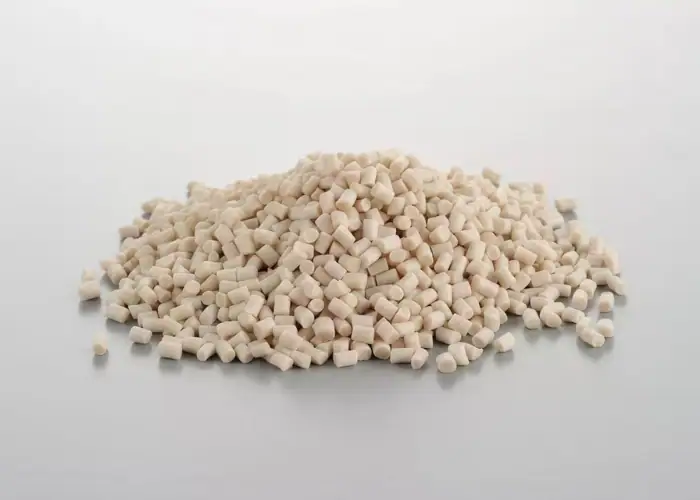
One of the main reasons engineers choose PEEK is its ability to maintain mechanical performance under heat and load. It can be used in applications where standard plastics may soften, deform, or lose strength. This makes it suitable for precision parts, structural components, insulation parts, wear-resistant parts, and high-performance CNC machined components.
PEEK also has strong chemical resistance and good fatigue performance. It can withstand many oils, fuels, solvents, and industrial fluids, which is why it is often used in medical, aerospace, automotive, electronics, and industrial equipment applications. In peek vs pmma comparison, PEEK is usually the stronger and more durable choice when mechanical performance matters more than transparency.
However, PEEK is not always necessary for every project. It is more expensive than many plastics and requires careful machining control. For parts that mainly need optical clarity, smooth appearance, or lower cost, PMMA may be a more practical choice.
What Is PMMA?
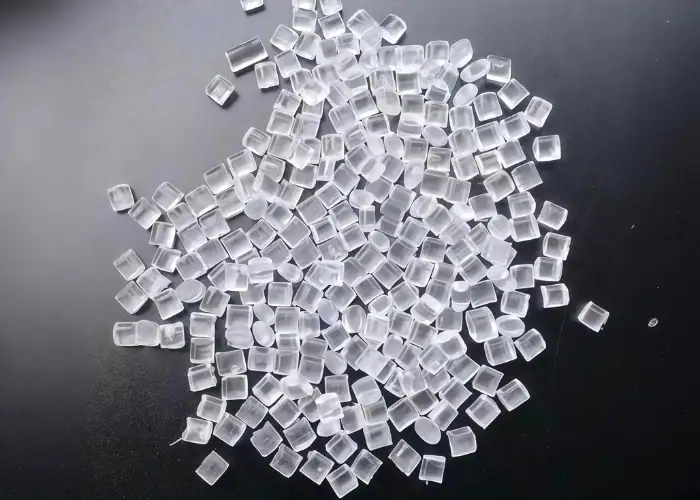
PMMA, or polymethyl methacrylate, is a transparent thermoplastic commonly known as acrylic. It is widely used when a part needs high optical clarity, smooth surface appearance, light weight, and good weather resistance. Compared with PEEK, PMMA material is not designed for extreme strength or high-temperature performance, but it performs very well in visual and optical applications.
One of the biggest advantages of PMMA is its excellent transparency. It can transmit light clearly, which makes it suitable for lenses, display covers, light guides, transparent panels, protective covers, and decorative parts. PMMA also has a clean surface finish after machining or polishing, so it is often used when appearance is an important part of the product design.
PMMA plastic is also easier to process and usually more cost-effective than PEEK. It can be CNC machined, laser cut, polished, formed, and bonded for different product needs. However, PMMA is more brittle than PEEK and has lower heat resistance, so it is not the best choice for heavy-load, high-impact, or high-temperature working conditions.
In a peek vs pmma comparison, PMMA is usually selected when transparency, appearance, and cost matter more than strength, wear resistance, or heat resistance. For optical parts, visual covers, and lightweight display components, PMMA is often a practical and economical material choice.
PEEK vs PMMA: What Are the Key Differences?
PEEK and PMMA are both engineering plastics, but they are designed for very different applications. PEEK focuses on strength, heat resistance, chemical resistance, and long-term durability. PMMA focuses on transparency, appearance, light transmission, and cost control. Understanding these differences helps engineers choose the right material based on real part requirements.
Performance Level
The biggest difference between PEEK and PMMA is their performance level. PEEK is a high-performance plastic suitable for demanding parts that need to work under load, heat, friction, or chemical exposure. It is often used in medical, aerospace, automotive, and industrial equipment applications.
PMMA is more suitable for visual and optical parts. It is commonly used for lenses, covers, display panels, light guides, transparent housings, and decorative parts. In a peek vs pmma comparison, PEEK is mainly selected for function, while PMMA is mainly selected for clarity and appearance.
Mechanical Strength
PEEK has much higher mechanical strength than PMMA. It can handle greater stress, repeated use, and more demanding working conditions. This makes PEEK suitable for structural parts, wear parts, precision components, and high-load functional parts.
PMMA has good rigidity, but it is more brittle than PEEK. Under impact, bending, or heavy load, PMMA is more likely to crack or chip. Because of this, PMMA is usually not the best choice for parts that need strong mechanical support.
Heat Resistance
PEEK performs much better in high-temperature environments. It can maintain stable strength and dimensional performance under heat, which makes it suitable for parts exposed to friction, engines, electrical systems, or industrial heat.
PMMA has more limited heat resistance. It works well in normal environments, but it may soften or deform when exposed to higher temperatures for a long time. If heat resistance is a key requirement, PEEK is usually the safer choice.
Chemical Resistance
PEEK has strong resistance to many oils, fuels, solvents, and industrial fluids. This makes it suitable for harsh working environments where the part may contact chemicals or cleaning agents.
PMMA has acceptable chemical resistance in general use, but it is more sensitive to some solvents and aggressive chemicals. For chemical-contact parts, PEEK usually offers better long-term reliability.
Transparency and Appearance
PMMA has a clear advantage in transparency. It offers excellent optical clarity, smooth surface quality, and good appearance after polishing. This is why PMMA is often used for optical parts, display covers, transparent panels, and visual components.
PEEK is not transparent and is usually chosen for performance rather than appearance. If the part needs light transmission or a clear visual effect, PMMA is normally the better choice.
Cost and Material Selection
PMMA is usually more affordable and easier to process, making it suitable for cost-sensitive visual parts. It is a practical choice when transparency, appearance, and lower cost are more important than extreme strength.
PEEK is more expensive, but it provides much higher strength, heat resistance, chemical resistance, and durability. In short, choose PEEK when performance matters most. Choose PMMA when clarity, appearance, and cost are the main priorities.
PEEK vs PMMA Material Properties Comparison
A direct material comparison makes it easier to understand why PEEK and PMMA are used in different applications. PEEK is mainly selected for strength, heat resistance, chemical resistance, and long-term durability. PMMA is mainly selected for transparency, surface appearance, lightweight design, and cost control.
| Property | PEEK | PMMA |
| Full Name | Polyether Ether Ketone | Polymethyl Methacrylate |
| Material Type | High-performance engineering thermoplastic | Transparent acrylic thermoplastic |
| Appearance | Usually beige, brown, or black, not transparent | Clear and transparent, with good optical appearance |
| Mechanical Strength | Very high strength and stiffness, suitable for load-bearing parts | Moderate rigidity, but more brittle under impact |
| Heat Resistance | Excellent heat resistance, suitable for high-temperature environments | Lower heat resistance, not ideal for long-term high-temperature use |
| Chemical Resistance | Strong resistance to many oils, fuels, solvents, and industrial fluids | Good in general conditions, but sensitive to some solvents |
| Wear Resistance | Good wear and fatigue resistance | Limited wear resistance, not suitable for heavy friction parts |
| Transparency | Not transparent | Excellent optical clarity |
| Machinability | Can be CNC machined, but requires careful heat and tool control | Easier to machine, but needs care to avoid cracking or chipping |
| Cost | High material cost | Lower cost than PEEK |
| Best Used For | Functional parts, high-load parts, wear parts, insulation parts, high-temperature components | Optical parts, display covers, lenses, transparent panels, decorative parts |
From this comparison, PEEK is the better choice when the part must handle heat, stress, friction, or chemical exposure. PMMA is the better choice when the part needs clear transparency, attractive appearance, and lower cost. In real material selection, engineers should compare not only performance data, but also the working environment, production volume, tolerance requirements, and budget.
What Are the Advantages and Limitations of PEEK?
PEEK is one of the strongest high-performance engineering plastics used in precision parts. In a peek vs pmma comparison, PEEK is usually selected when the part needs higher strength, better heat resistance, stronger chemical resistance, and longer service life. However, its higher cost and more demanding machining requirements should also be considered.
Advantages of PEEK
PEEK has excellent mechanical strength and stiffness, making it suitable for load-bearing parts, structural components, bushings, seals, gears, and precision CNC machined parts. It can maintain stable performance under repeated stress, which is important for parts used in demanding mechanical environments.
PEEK also performs well in high-temperature conditions. Compared with PMMA, it can work in much hotter environments without easily softening or losing mechanical performance. This makes it useful for aerospace, automotive, industrial equipment, electronics, and medical applications.
Another major advantage is chemical resistance. PEEK can resist many oils, fuels, solvents, cleaning agents, and industrial fluids. For parts exposed to harsh environments, this gives PEEK better long-term reliability than many standard plastics.
PEEK also offers good wear resistance and fatigue performance. It is often used for sliding parts, moving components, insulation parts, and high-performance plastic replacements for metal. When lightweight design and durability are both important, PEEK can be a strong material choice.
Limitations of PEEK
The main limitation of PEEK is its high material cost. Compared with PMMA and many common engineering plastics, PEEK is much more expensive. If the part does not need high heat resistance, heavy-load performance, or chemical resistance, using PEEK may increase cost unnecessarily.
PEEK also requires more careful machining control. During CNC machining, cutting heat, tool wear, clamping force, and machining sequence all need to be managed properly. Poor control may cause dimensional issues, burrs, or surface defects.
Another limitation is that PEEK is not transparent. If the part needs optical clarity, light transmission, or a clean visual appearance, PMMA is usually a better choice. PEEK is selected for performance, not for appearance or transparency.
In short, PEEK is best for demanding functional parts where strength, heat resistance, chemical resistance, and durability matter more than cost or transparency. For simple covers, visual parts, or cost-sensitive transparent components, PMMA may be more practical.
What Are the Advantages and Limitations of PMMA?
PMMA is a practical plastic for parts that need high transparency, smooth appearance, light weight, and controlled cost. In a peek vs pmma comparison, PMMA is usually selected for optical, visual, and decorative parts, while PEEK is preferred for high-strength and high-temperature functional components.
Advantages of PMMA
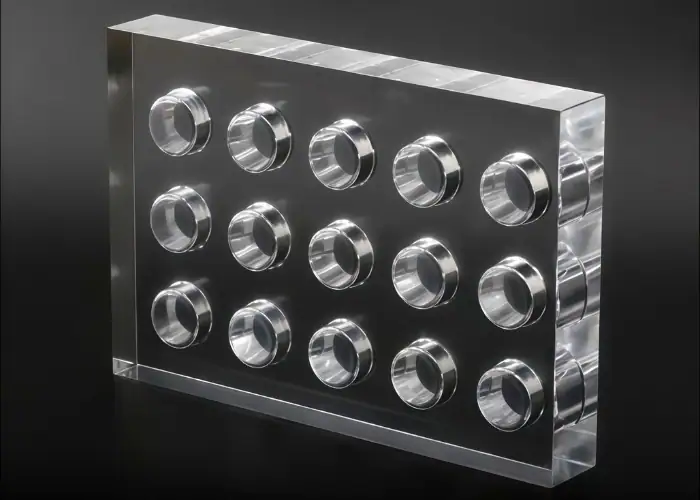
PMMA’s biggest advantage is its excellent optical clarity. It provides high light transmission and a clean transparent appearance, making it suitable for lenses, display covers, light guides, transparent panels, protective covers, and visual inspection windows.
PMMA also has good surface quality and can be polished to achieve a clear and smooth finish. This is useful for consumer products, medical covers, optical parts, and display components where appearance directly affects product value.
Another advantage is cost and processing flexibility. PMMA is usually much cheaper than PEEK and supports CNC machining, laser cutting, polishing, bonding, and thermoforming. For transparent and cost-sensitive parts, it offers a strong balance of appearance, processability, and price.
Limitations of PMMA
The main limitation of PMMA is its lower mechanical strength compared with PEEK. Although PMMA has good rigidity, it is more brittle and may crack or chip under impact, bending, or heavy load. This makes it less suitable for structural or high-stress mechanical parts.
PMMA also has limited heat resistance. Under higher temperatures or long-term heat exposure, it may soften, deform, or lose dimensional stability. If a part needs to work near heat sources, friction zones, or high-temperature environments, PEEK is usually a safer choice.
Chemical resistance is another limitation. PMMA performs well in general environments, but it can be affected by some solvents, cleaners, or aggressive chemicals. For chemical-contact parts, material compatibility should be checked before production.
How Do PEEK and PMMA Perform in CNC Machining?
PEEK and PMMA can both be CNC machined, but they require different process controls. PEEK needs careful heat, tool, and tolerance management, while PMMA needs careful handling to avoid cracking, chipping, or visible surface marks.
CNC Machining PEEK
PEEK performs well in CNC machining when the process is properly controlled. It can be milled, turned, drilled, and threaded into precision parts such as bushings, seals, insulators, brackets, medical components, and high-performance mechanical parts.
Because PEEK has high strength and heat resistance, cutting tools must remain sharp and stable. Excessive cutting heat, poor chip evacuation, or worn tools may cause burrs, dimensional variation, or surface defects. Carbide tools are often preferred for better tool life and consistency.
For tight-tolerance PEEK parts, machining strategy is important. Proper feeds and speeds, stable clamping, stress relief, and controlled cutting depth help improve dimensional accuracy. PEEK is more expensive than PMMA, so reducing scrap during CNC machining is also important for cost control.
CNC Machining PMMA
PMMA is generally easier to CNC machine than PEEK, especially for transparent covers, lenses, display panels, light guides, acrylic housings, and visual components. It can achieve clean edges and smooth surfaces when the tool path, spindle speed, and cutting parameters are well controlled.
The main challenge with PMMA is brittleness. If the tool is dull, the feed rate is too aggressive, or the clamping force is uneven, PMMA may crack, chip, or show stress marks. For transparent parts, even small scratches or tool marks can affect the final appearance.
PMMA often needs polishing, flame polishing, or surface finishing after machining to achieve a clear optical appearance. Compared with PEEK, PMMA is more cost-effective and easier to process, but it requires careful handling when appearance and transparency are critical.
Machining Selection Guide
Choose PEEK CNC machining when the part needs high strength, heat resistance, wear resistance, chemical resistance, or long-term functional performance. It is better for demanding mechanical parts, electrical insulation parts, and high-value engineering components.
Choose PMMA CNC machining when the part needs transparency, smooth appearance, light transmission, or lower material cost. It is better for visual covers, optical parts, display components, protective panels, and decorative plastic parts.
Overall, PEEK is harder to machine but delivers stronger functional performance. PMMA is easier and more economical to machine, but it needs more care to protect edges, surface quality, and transparency.
What Are the Common Applications of PEEK and PMMA?
PEEK and PMMA are used in different applications because their material strengths are not the same. PEEK is mainly selected for demanding functional parts, while PMMA is mainly used for transparent, visual, and cost-sensitive components.
Automotive
PEEK can be used in automotive parts exposed to heat, load, and chemical fluids. Examples include sensor components, insulation parts, bushings, seals, and under-hood precision components.
PMMA is more suitable for automotive visual and exterior parts, such as light covers, transparent panels, decorative trims, display covers, and protective lenses. It provides good clarity and appearance at a lower material cost.
Medical
PEEK is commonly used for medical components that require strength, stability, chemical resistance, and repeated use. Typical examples include surgical instrument parts, sterilization fixtures, medical device components, and selected high-performance structural parts.
PMMA is often used in medical applications where transparency and appearance are more important. It can be used for dental materials, transparent covers, viewing windows, protective panels, and optical-related medical components.
Optical and Display Parts
PMMA is one of the most common materials for optical and display applications. It is widely used for lenses, display covers, light guides, transparent panels, inspection windows, and decorative clear parts because of its excellent optical clarity.
PEEK is rarely used for optical parts because it is not transparent. However, it may be used in display equipment or optical systems as a supporting, insulating, or structural component when heat resistance and mechanical strength are required.
Industrial Equipment
PEEK is suitable for industrial parts that need to withstand heat, friction, pressure, or chemical exposure. Common applications include bushings, seals, valve parts, insulators, gears, spacers, and high-temperature machine components.
PMMA is more commonly used for protective covers, inspection windows, machine guards, transparent panels, and display windows. It helps operators observe equipment status while keeping the part lightweight and cost-effective.
Electronics
PEEK is used in electronics when parts need insulation, heat resistance, and dimensional stability. It is suitable for connectors, insulating blocks, sockets, semiconductor-related fixtures, and high-performance electrical components.
PMMA is often used for electronic display covers, light guide plates, LED lenses, transparent housings, and appearance panels. It is preferred when light transmission, surface finish, and product appearance are the main priorities.
PEEK vs PMMA: Which Material Should You Choose?
Choosing between PEEK and PMMA depends on the real function of the part. PEEK is better for demanding functional parts that need strength, heat resistance, chemical resistance, and long-term durability. PMMA is better for transparent, visual, lightweight, and cost-sensitive parts.
Choose PEEK When Strength and Heat Resistance Matter
Choose PEEK when the part must work under high load, heat, friction, or repeated mechanical stress. It is suitable for bushings, seals, insulators, brackets, gears, and high-performance CNC machined parts. If the part will be used near engines, electrical systems, industrial heat, or chemical fluids, PEEK usually provides a safer performance margin.
Choose PMMA When Transparency and Appearance Matter
Choose PMMA when the part needs optical clarity, smooth appearance, or light transmission. It is commonly used for display covers, lenses, transparent panels, light guides, protective covers, and decorative parts. Compared with PEEK, PMMA is more cost-effective and easier to polish, making it practical for visual and appearance-focused components.
Consider the Working Environment
The working environment is often the key factor in peek vs pmma selection. If the part faces high temperature, chemical exposure, heavy load, or long-term wear, PEEK is usually more reliable. If the part works in normal conditions and mainly needs transparency or visual quality, PMMA is usually enough.
Balance Performance, Cost, and Function
PEEK offers stronger performance, but it may be unnecessary for simple transparent covers or low-load visual parts. PMMA offers better transparency and lower cost, but it cannot replace PEEK in high-temperature, high-load, or harsh chemical environments. A practical rule is simple: choose PEEK for performance-critical parts and PMMA for transparent or appearance-focused parts.
FAQs
Is PEEK Stronger Than PMMA?
Yes. PEEK is much stronger than PMMA in most mechanical applications. It has better load-bearing capacity, higher heat resistance, stronger chemical resistance, and better long-term durability. PMMA has good rigidity, but it is more brittle and easier to crack under impact. For structural or high-stress parts, PEEK is usually the safer choice.
Is PMMA Cheaper Than PEEK?
Yes. PMMA is usually much cheaper than PEEK, which makes it more suitable for cost-sensitive parts. It is often used for transparent covers, display panels, lenses, light guides, and decorative parts. PEEK has a higher material cost, but it provides better performance in heat, load, wear, and chemical environments.
Can PMMA Replace PEEK?
PMMA can only replace PEEK in low-load, normal-temperature, and visual applications. If the part mainly needs transparency, smooth appearance, or lower cost, PMMA may be suitable. However, it cannot replace PEEK in high-temperature, high-load, high-wear, or harsh chemical environments.
Which Is Better For Transparent Parts, PEEK Or PMMA?
PMMA is better for transparent parts. It offers excellent optical clarity, good light transmission, and a smooth polished appearance. PEEK is not transparent and is mainly used for high-performance functional parts. For lenses, covers, panels, and light guide parts, PMMA is usually the better material.
Which Material Is Better For CNC Machining?
Both materials can be CNC machined, but they require different controls. PEEK is harder to machine and needs careful heat, tool, and tolerance management. PMMA is easier to machine, but it is more likely to crack or chip. Choose PEEK for functional precision parts and PMMA for clear visual parts.
Conclusion
PEEK is better for strength, heat resistance, chemical resistance, and demanding functional parts. PMMA is better for transparency, appearance, light transmission, and cost-sensitive visual parts. When comparing peek vs pmma, the right choice depends on function, working environment, tolerance, appearance, and budget.
At TiRapid, we provide precision CNC machining services for custom PEEK, PMMA, and other engineering plastic parts, helping customers choose suitable materials and produce reliable precision components.