PVDF vs polypropylene is an important material comparison for chemical processing, fluid handling, industrial equipment, and custom plastic parts. PVDF is often selected for stronger chemical resistance, better heat performance, and higher durability, while polypropylene is valued for low cost, light weight, and broad general-purpose use.
This guide explains the key differences between PVDF and polypropylene, including chemical resistance, heat resistance, mechanical strength, CNC machinability, cost, applications, and how to choose the right plastic material for your project.
What Is PVDF?
PVDF, or Polyvinylidene Fluoride, is a high-performance fluoropolymer known for excellent chemical resistance, good mechanical strength, heat resistance, and long-term durability. It is widely used in chemical processing equipment, semiconductor systems, fluid-handling parts, electrical components, and industrial applications requiring corrosion-resistant materials.
Compared with many general-purpose plastics, PVDF offers better resistance to harsh chemicals, UV exposure, and elevated operating temperatures. It also provides higher rigidity and better dimensional stability than softer plastics, making it suitable for components that must maintain shape and performance in demanding environments.
PVDF can be supplied as sheets, rods, pipes, films, fittings, and molded or machined parts. Because it combines chemical resistance with useful mechanical strength, engineers often choose PVDF for valve bodies, pump components, pipe fittings, tanks, liners, insulators, and precision CNC machined plastic components.
What Is Polypropylene?
Polypropylene, often called PP, is a lightweight thermoplastic known for low cost, good chemical resistance, easy processing, and wide availability. It is used in packaging, food-contact products, medical consumables, chemical tanks, pipe systems, laboratory items, automotive parts, and many general industrial components.
Compared with PVDF, polypropylene is more economical and easier to process in high-volume production. It can be injection molded, extruded, welded, thermoformed, and CNC machined for many basic plastic parts. This makes PP attractive when the application does not require high heat resistance or premium chemical durability.
However, polypropylene does not provide the same overall performance as PVDF in harsh chemical or high-temperature environments. It is better suited for moderate operating conditions where low cost, light weight, and general chemical resistance are more important than long-term resistance to aggressive fluids, UV exposure, or elevated temperatures.
PVDF vs Polypropylene Quick Comparison
Before choosing between PVDF and polypropylene, engineers should compare chemical resistance, heat resistance, mechanical strength, dimensional stability, machinability, cost, and application environment. These factors directly affect material selection, part lifespan, manufacturing method, and long-term reliability.
| Property | PVDF | Polypropylene |
| Material Type | Fluoropolymer | Polyolefin thermoplastic |
| Chemical Resistance | Excellent | Good |
| Heat Resistance | Better | Moderate |
| Mechanical Strength | Higher | Moderate |
| Rigidity | Higher | Lower |
| UV Resistance | Better | Limited without additives |
| Moisture Resistance | Excellent | Excellent |
| Dimensional Stability | Better | Moderate |
| CNC Machinability | Good | More flexible, less stable |
| Material Cost | Higher | Lower |
| Typical Use | Corrosion-resistant industrial parts | Cost-effective general plastic parts |
Key Differences Between PVDF and Polypropylene
PVDF and polypropylene are both useful plastic materials, but they belong to different performance levels. PVDF is a higher-performance fluoropolymer, while polypropylene is a more economical general-purpose thermoplastic. This difference affects strength, heat resistance, corrosion resistance, machining stability, and final part cost.
The right material depends on the working environment. If the part will contact aggressive chemicals, hot fluids, UV exposure, or demanding industrial conditions, PVDF may provide better long-term reliability. If the part is used in a controlled environment with moderate temperature and chemical exposure, polypropylene may be sufficient.
For custom plastic parts, material selection should not be based on price alone. A lower-cost material can become expensive if it fails early, deforms during use, or cannot hold the required tolerance. Engineers should evaluate chemical exposure, temperature, load, tolerance, compliance needs, and production volume before choosing PVDF or PP.
Chemical Resistance
PVDF provides excellent chemical resistance and is widely used in systems exposed to acids, solvents, halogens, disinfectants, and aggressive industrial fluids. This makes it suitable for chemical processing, semiconductor wet benches, pump parts, valve components, pipe fittings, and fluid-handling systems.
Polypropylene also offers good resistance to many acids, bases, and cleaning agents, which is why it is widely used in tanks, containers, piping, and laboratory products. However, its chemical resistance may be less reliable when exposure involves higher temperatures, stronger chemicals, or long-term continuous contact.
Choose PVDF when chemical resistance is critical and the working environment is aggressive. Choose polypropylene when the chemical environment is moderate and cost control is a major priority. For safety-critical systems, chemical compatibility should always be checked before final material selection.
Heat Resistance
PVDF offers better heat resistance than polypropylene, making it more suitable for components exposed to elevated operating temperatures, hot chemical fluids, or repeated thermal cycling. It maintains mechanical strength and dimensional stability better than PP when the temperature rises.
Polypropylene performs well in many normal-use environments, but it has more limited high-temperature capability. Under continuous heat or hot fluid exposure, PP may soften, deform, or lose dimensional accuracy faster than PVDF. This can become a concern for tight-fitting or load-bearing components.
If a part must handle heat, pressure, or hot chemicals at the same time, PVDF is usually the safer choice. If the part operates at moderate temperature and does not require high dimensional stability under heat, polypropylene can be a more economical option.
Mechanical Strength and Rigidity
PVDF generally provides higher mechanical strength and rigidity than polypropylene. This makes it more suitable for structural plastic parts, pump housings, valve bodies, fittings, brackets, insulators, and machined components that must maintain shape under load or pressure.
Polypropylene is lighter and more flexible, which can be useful for tanks, containers, covers, liners, and low-load components. However, this flexibility can also make PP less suitable for precision parts that require tight tolerances, stable flatness, or high load-bearing performance.
For rigid industrial components, PVDF usually provides better structural reliability. For larger, lower-cost parts where flexibility is acceptable, polypropylene can offer practical performance with lower material and manufacturing cost.
UV Resistance and Outdoor Performance
PVDF offers strong weathering and UV resistance compared with many common plastics. This makes it useful for outdoor equipment, protective components, coatings, and parts exposed to sunlight or harsh environmental conditions. Its stability helps reduce degradation risk over long-term outdoor use.
Polypropylene has limited natural UV resistance unless it is modified with stabilizers or additives. Without suitable formulation, PP may become brittle, discolored, or weaker after prolonged outdoor exposure. This is important for parts used in outdoor tanks, covers, panels, or equipment housings.
For outdoor applications requiring long-term durability, PVDF often performs better. Polypropylene can still be used outdoors when the correct grade or UV-stabilized formulation is selected, but this requirement should be clearly confirmed before production.
Dimensional Stability
PVDF generally provides better dimensional stability than polypropylene because it is stiffer and more resistant to heat-related deformation. This is useful for CNC machined components, threaded parts, sealing faces, valve components, and fittings that must maintain accurate geometry during service.
Polypropylene can be stable enough for many general applications, but its lower rigidity can make tolerance control more difficult. During machining or use, PP may flex under clamping pressure, tool force, assembly stress, or temperature changes, especially in thin-wall or long features.
For precision components, PVDF is often the better choice. For simple molded or machined parts with flexible tolerance requirements, polypropylene can provide acceptable performance at a lower cost.
PVDF vs Polypropylene CNC Machining
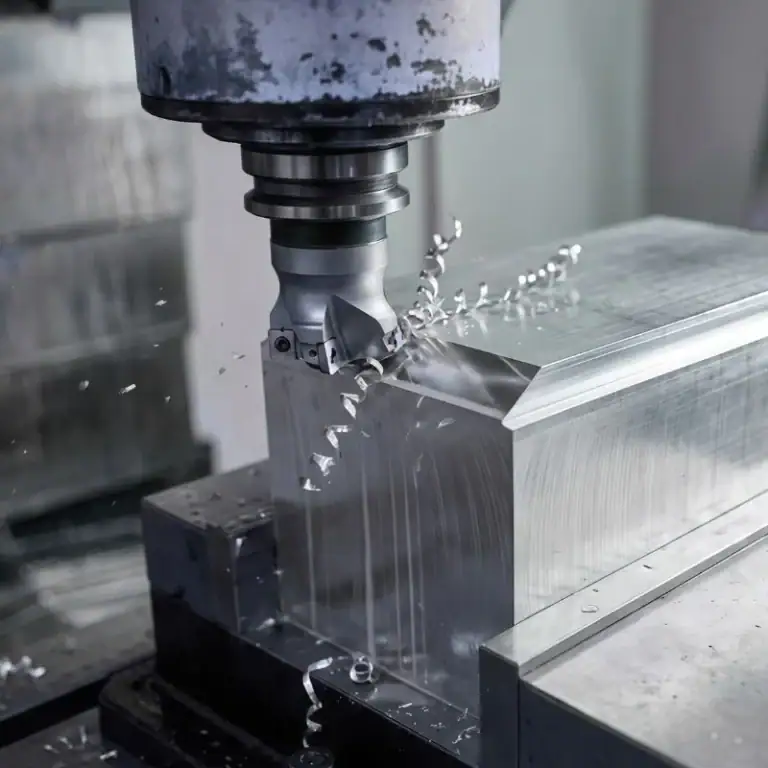
Both PVDF and polypropylene can be CNC machined, but they behave differently during cutting. PVDF is generally more rigid and dimensionally stable, while polypropylene is softer and more flexible. This affects tool pressure, burr formation, flatness, surface quality, and tolerance control.
For precision CNC milling, PVDF is usually easier to control when the part needs accurate holes, threaded features, sealing surfaces, or tight assembly fit. Polypropylene can also be machined, but the process may require careful workholding and sharp tools to reduce deformation and burrs.
Material choice should consider not only performance after production, but also manufacturing risk. If a part requires tight tolerances and stable geometry, PVDF may reduce machining uncertainty. If the part is simple and cost-sensitive, polypropylene may be a practical machining option.
Machining PVDF Parts
PVDF can be CNC machined into precision components such as valve bodies, pipe fittings, pump parts, fluid manifolds, brackets, insulation parts, and corrosion-resistant structural components. Its rigidity helps support cleaner machining and better dimensional control than many softer plastics.
During PVDF machining, sharp tools, stable workholding, and controlled cutting parameters are important for maintaining surface quality. Excessive heat should be avoided because it may affect surface finish or dimensional consistency. Proper chip evacuation also helps reduce burrs and improve finished part quality.
PVDF is a good choice when the finished part must combine chemical resistance with accurate machining. It is especially useful for industrial, semiconductor, medical, and fluid-handling components where both corrosion resistance and mechanical reliability matter.
Machining Polypropylene Parts
Polypropylene can be machined for simple plastic components, prototypes, covers, spacers, tanks, blocks, and low-load industrial parts. However, its softer and more flexible structure can make tight-tolerance machining more challenging than PVDF.
During cutting, polypropylene may deflect under tool pressure or clamping force. If tools are dull or cutting heat is not controlled, PP may produce burrs, fuzzing, or surface smearing. Proper feeds, speeds, sharp cutters, and light clamping can help improve machining quality.
Polypropylene is best used for machined parts where tight tolerance is not the main priority. If the design allows realistic tolerances and moderate performance requirements, PP can provide an economical solution for custom plastic components.
Tolerance and Surface Finish
PVDF usually provides better tolerance control than polypropylene because it has higher stiffness and better dimensional stability. It is more suitable for features that require accurate bores, threaded holes, flat sealing surfaces, and controlled mating dimensions.
Polypropylene can achieve functional tolerances, but it may require more careful process planning. Thin sections, long unsupported areas, and tight flatness requirements can be more difficult because the material may bend or recover after machining.
Surface finish depends on tool sharpness, cutting parameters, material grade, and part geometry. PVDF often produces cleaner finished surfaces, while PP may require extra attention to reduce burrs, tool marks, or edge deformation.
Common Applications of PVDF and Polypropylene
PVDF and polypropylene are both used in chemical, industrial, medical, and fluid-handling applications, but they are usually selected for different performance levels. PVDF is chosen for demanding environments, while polypropylene is chosen for cost-effective general-purpose use.
The final application should guide material selection. A valve body exposed to aggressive chemicals may require PVDF, while a simple tank cover or low-load container may work well in PP. A precision machined fitting may benefit from PVDF, while a large molded part may be more economical in polypropylene.
Both materials can replace metal in selected applications where corrosion resistance, low weight, and chemical compatibility are important. However, engineers should confirm temperature, load, tolerance, fluid compatibility, and expected service life before selecting either material.
Semiconductor and Electronics Applications
PVDF is commonly used in semiconductor and electronics applications because it offers strong chemical resistance, good purity potential, and stable mechanical performance. It can be used for fluid-handling components, fittings, valves, tanks, and custom machined parts in controlled chemical environments.
Polypropylene may also be used in electronic or laboratory support components where cost control and general chemical resistance are needed. It can be suitable for containers, covers, simple fixtures, and non-critical components used in moderate conditions.
For critical chemical delivery or precision fluid systems, PVDF usually offers better long-term reliability. For less demanding support parts, polypropylene can provide a practical and lower-cost solution.
Chemical Processing and Industrial Equipment
PVDF is widely used in chemical processing because it resists many aggressive fluids while maintaining useful strength and rigidity. Typical parts include valves, pumps, pipe fittings, tanks, liners, manifolds, and CNC machined corrosion-resistant components.
Polypropylene is used for chemical tanks, containers, ducts, covers, piping, and general industrial parts where the chemical environment is less aggressive. It is attractive for large components because of its low cost, light weight, and easy fabrication.
In industrial equipment, PVDF is usually better for demanding chemical and thermal conditions. Polypropylene is better when cost, size, and moderate chemical resistance are the main priorities.
Medical, Laboratory, and Food-Contact Applications
PVDF can be used in medical, laboratory, and clean-fluid systems where chemical resistance, durability, and dimensional stability are required. Depending on grade and certification, it may be selected for fluid components, housings, fittings, and equipment parts.
Polypropylene is widely used in medical consumables, labware, containers, food-contact products, and packaging. Its low cost, easy processing, and broad availability make it a common choice for disposable or high-volume products.
For regulated applications, material grade and certification must be confirmed. The polymer name alone is not enough,suppliers should provide documentation for food contact, medical use, chemical compatibility, or other compliance requirements when needed.
Water Treatment, Oil and Gas, and New Energy
PVDF is often used in water treatment, oil and gas, and new energy systems where chemical resistance and durability are important. It can be used for fluid-handling parts, protective components, fittings, valves, and precision machined parts exposed to demanding media.
Polypropylene is also used in water and fluid systems when the environment is less aggressive. It is common in tanks, pipes, covers, filtration housings, and support structures where cost-effective corrosion resistance is required.
For demanding chemical exposure or higher service temperature, PVDF is usually stronger. For low-pressure, moderate-temperature, and cost-sensitive systems, polypropylene may be more economical.
PVDF vs Polypropylene Cost Comparison
Polypropylene is usually much less expensive than PVDF, making it attractive for large-volume and cost-sensitive products. Its low raw material cost and easy processing make it widely used for containers, tanks, packaging, labware, and simple industrial parts.
PVDF has a higher material cost, but it can offer better long-term value when the application requires chemical resistance, heat resistance, rigidity, UV stability, or tighter machining performance. In demanding systems, PVDF may help reduce failure risk, replacement cost, and downtime.
A practical cost comparison should include more than raw material price. Engineers should also consider machining time, tolerance requirements, service life, chemical exposure, temperature, inspection needs, and the cost of part failure in the final application.
FAQs
When should I choose PVDF instead of polypropylene?
Choose PVDF when the part must handle stronger chemicals, higher temperatures, UV exposure, or tighter dimensional requirements. It is often better for valve bodies, pump parts, fittings, semiconductor fluid components, and corrosion-resistant structural parts.
Is polypropylene a lower-cost alternative to PVDF?
Yes. Polypropylene can be a lower-cost alternative when the application only requires moderate chemical resistance, light weight, and general-purpose performance. It is suitable for tanks, covers, containers, and simple parts that do not need PVDF-level durability.
Which material is easier to CNC machine, PVDF or polypropylene?
PVDF is usually easier to machine with stable dimensions because it is more rigid than polypropylene. PP can also be machined, but its softer structure may cause deflection, burrs, or tolerance variation if the process is not carefully controlled.
Can PVDF and polypropylene be used for chemical-resistant parts?
Yes, both materials can be used for chemical-resistant parts, but PVDF performs better in more aggressive environments. Polypropylene is suitable for many moderate chemical applications, while PVDF is preferred when chemical exposure, heat, or long-term reliability is more demanding.
Conclusion
PVDF and polypropylene are both useful plastics for chemical and industrial applications, but they serve different performance levels. PVDF offers stronger chemical resistance, better heat resistance, higher rigidity, and improved dimensional stability, while polypropylene provides lower cost, light weight, and practical general-purpose performance.
At TiRapid, we provide precision CNC machining services for engineering plastics, including PVDF and polypropylene custom parts. Send us your 2D drawings, 3D files, material requirements, quantities, and working conditions, and our team can help review the best machining solution for your project.