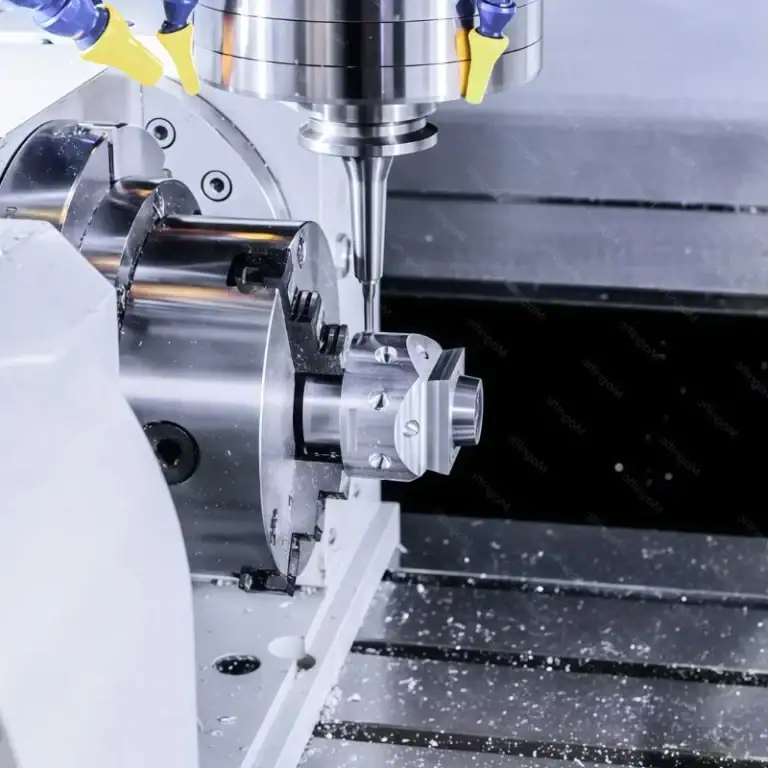
4 axis CNC machining gives manufacturers a practical way to machine parts with side features, angled details, and cylindrical surfaces without relying on repeated manual setups. It is often used when a part needs better alignment between different faces, but full5-axis machining would be unnecessary or too costly.
This guide explains how the process works, where it fits, and when it is the right choice for precision CNC parts.
What Is 4 Axis CNC Machining?
4 axis CNC machining is a CNC process that uses three linear movements plus one rotary movement to position the workpiece or cutting tool more flexibly. The linear axes control left-right, front-back, and up-down tool movement, while the fourth axis allows controlled rotation during indexed or continuous machining.
In many milling setups, this rotary movement is called the A-axis when the part rotates around the X-axis. Other machine structures may use a B-axis or C-axis depending on how the rotary table, trunnion, or workholding system is arranged. The exact setup depends on part geometry and machine configuration.
This process is especially useful for components with features distributed around several sides, such as cross holes, angled pockets, curved profiles, slots, and mounting faces. It sits between basic3-axis machining and advanced5-axis machining, offering more access and efficiency without the higher complexity of full multi-axis tool control.
How Does 4 Axis CNC Machining Work?
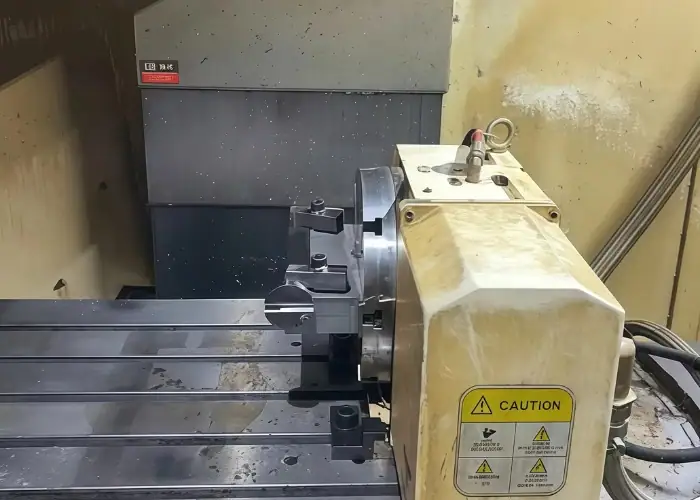
In a typical 4 axis CNC setup, the cutting tool moves along the X, Y, and Z axes while the workpiece rotates around one additional axis. This rotation allows the machine to access different faces or angles of the part without removing and re-clamping the workpiece after each side is machined.
The process starts with a CAD model and CAM programming. The programmer defines toolpaths, cutting tools, rotation angles, machining sequence, and inspection requirements. Once the part is fixed on the rotary table or fixture, the CNC machine follows the programmed movements to cut the material accurately.
Depending on the part design, the fourth axis can be used in two main ways: indexing or continuous machining. Indexing rotates the workpiece to a fixed angle and then locks it for machining. Continuous 4 axis machining rotates the workpiece while the cutter moves, allowing more complex contours and wrapped features.
Main Types of 4 Axis CNC Machining
Different 4 axis machining methods are used depending on the part geometry, tolerance requirements, production quantity, and material. The most common types include 4 axis indexing, continuous 4 axis machining, 4 axis milling, and 4 axis turning or mill-turn machining.
Each type offers a different level of flexibility. Simple indexed machining is efficient for multi-sided parts, while continuous machining is better for curved surfaces, spiral features, and cylindrical components. Choosing the right type helps control cost while ensuring the part can be machined accurately.
For custom parts, the best machining method is usually decided after reviewing the 2D drawings, 3D files, tolerances, material, and surface finish requirements. A part may look suitable for 4 axis machining, but fixture access, tool reach, and inspection method still need to be checked before production.
4 Axis Indexing Machining
4 axis indexing is one of the most common uses of the fourth axis. In this method, the rotary axis turns the workpiece to a specific angle, then locks it in place while standard milling operations are performed. After one side is completed, the part rotates to the next angle for additional machining.
This method is useful for parts with features on multiple faces, such as holes, pockets, slots, threads, and mounting surfaces. Instead of manually re-clamping the part several times, the rotary axis positions the workpiece automatically. This reduces setup errors and improves consistency between related features.
Indexing is often more cost-effective than full simultaneous 4 axis machining because the cutting strategy is simpler. It works well for brackets, housings, blocks, fixtures, manifold-style parts, and components where accurate multi-face machining is more important than complex continuous contouring.
Continuous 4 Axis Machining
Continuous 4 axis machining means the rotary axis moves at the same time as the linear axes. This allows the cutter to machine curved surfaces, spiral grooves, wrapped patterns, and features around cylindrical or partially cylindrical parts. It is more advanced than simple indexing and requires careful CAM programming.
This method is useful when the part geometry cannot be produced efficiently by rotating to fixed positions only. Examples include helical slots, cam-like profiles, curved channels, complex external surfaces, and parts requiring smooth transitions around a rotating axis. It can improve surface continuity and reduce secondary operations.
Because continuous 4 axis machining is more complex, it usually requires stronger programming experience and better machine control. Toolpath accuracy, collision avoidance, cutting force, fixture clearance, and surface finish must be carefully reviewed before machining begins.
4 Axis CNC Milling
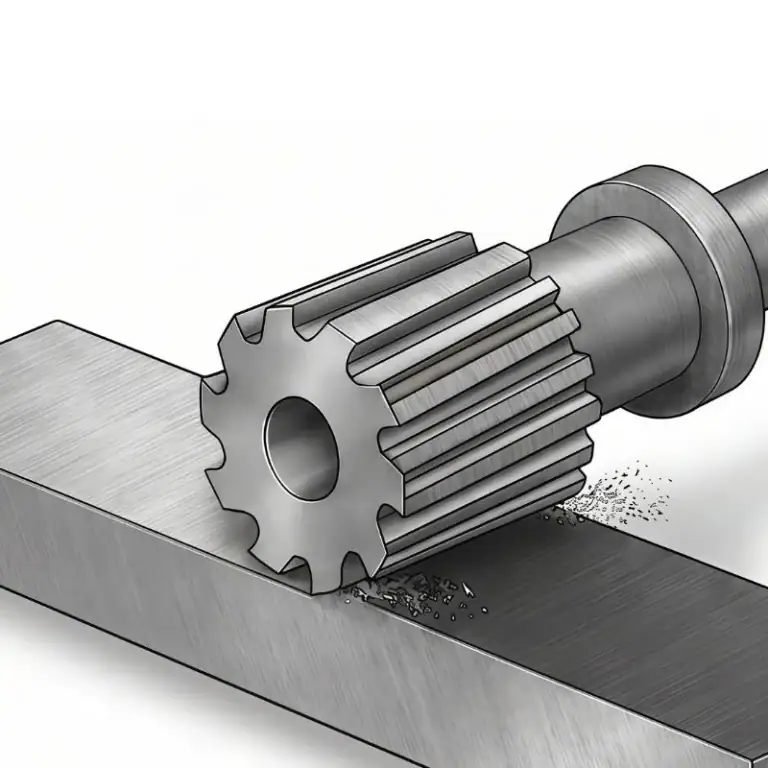
4 axis CNC milling is widely used for precision parts that need features on several sides or around a rotating axis. The workpiece is usually mounted on a rotary table, trunnion fixture, or indexer, allowing the milling cutter to reach different orientations without repeated manual setup.
This method is suitable for aluminum, stainless steel, brass, titanium, engineering plastics, and other machinable materials. It is commonly used for housings, fixtures, brackets, connectors, valve bodies, automation parts, and components with angled holes or multi-face details.
The main advantage of 4 axis milling is improved efficiency and alignment. When multiple features are machined in one setup, positional accuracy can be better than machining each side separately. This is especially valuable for parts where hole alignment, parallel surfaces, and mating features must remain consistent.
4 Axis CNC Turning and Mill-Turn Machining
4 axis CNC turning or mill-turn machining combines turning operations with additional tool movement or rotary control. In some machines, the fourth axis allows more complex cutting around a rotating workpiece, helping produce grooves, flats, cross holes, keyways, and milled features on turned components.
This method is useful for cylindrical parts that require both lathe operations and milling features. Instead of moving the part to a separate milling machine, many features can be completed in one setup. This can reduce lead time, improve concentricity, and lower handling-related errors.
Common 4 axis turned or mill-turned parts include shafts, bushings, sleeves, connectors, rollers, valve components, and precision mechanical parts with both round and non-round features. For these components, machine capability and tool access should be reviewed carefully before production.
4 Axis vs 3 Axis CNC Machining
3 axis CNC machining moves the cutting tool along X, Y, and Z directions. It is suitable for many flat, pocketed, drilled, and contoured parts. However, when a part has features on multiple sides, a 3 axis machine often requires manual repositioning or multiple setups to complete the part.
4 axis CNC machining adds rotary movement, allowing the part to be indexed or rotated for better access. This helps reduce setup time and improves consistency between features on different faces. For parts with side holes, angled slots, curved surfaces, or repeated features around a cylinder, 4 axis machining can be much more efficient.
However, 3 axis machining is still the better choice for simple parts. If a component only needs top-side milling or basic pocketing, 4 axis machining may add unnecessary programming and setup cost. The best option depends on geometry, tolerance, production quantity, and how many sides of the part need machining.
4 Axis vs 5 Axis CNC Machining
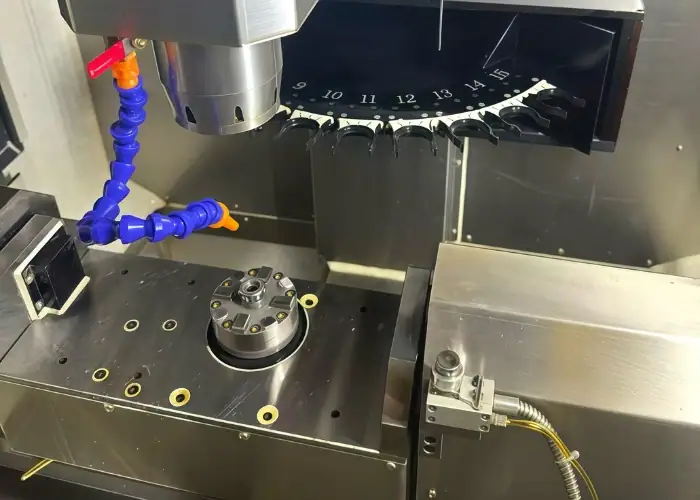
4 axis CNC machining adds one rotary axis, while 5 axis CNC machining adds two rotary axes. This means 5 axis machines can approach the part from more directions and are better suited for highly complex surfaces, deep cavities, undercuts, turbine-like shapes, and parts requiring advanced tool orientation control.
For many components, 4 axis machining is enough. It can machine multiple sides, cylindrical features, and angled details with fewer setups than 3 axis machining. It is often more economical than 5 axis machining when the part does not require full tool-angle flexibility.
5 axis machining is more powerful, but it is not always necessary. If the design mainly needs rotation around one axis, 4 axis machining may provide the right balance of accuracy, speed, and cost. If the part has complex freeform surfaces or difficult tool access, 5 axis machining may be the better choice.
Advantages of 4 Axis CNC Machining
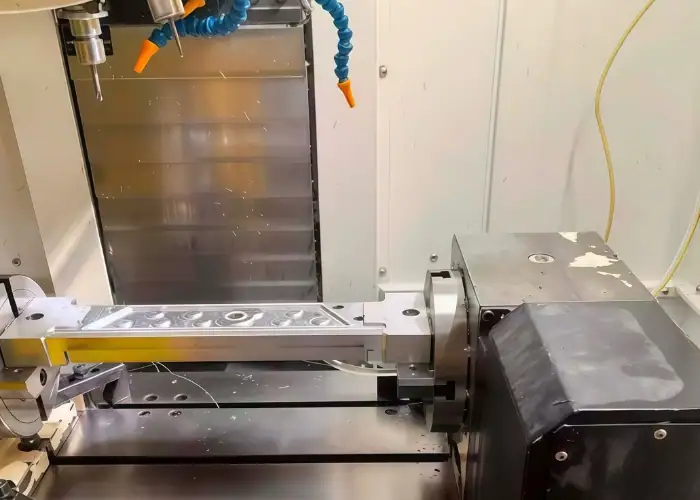
4 axis CNC machining provides several practical benefits for precision manufacturing. It improves tool access, reduces manual setup, supports multi-sided machining, and helps produce more complex parts than standard 3 axis machining. These advantages can improve both part quality and production efficiency.
The fourth axis is especially useful when multiple features need to align accurately around the part. By reducing the number of times a workpiece must be removed and re-clamped, manufacturers can reduce positioning errors and improve repeatability. This is important for precision parts with holes, slots, and mating features on several faces.
For production projects, 4 axis machining can also reduce cycle time and labor cost. A part that would require several separate setups on a 3 axis machine may be completed more efficiently on a 4 axis machine. This can help shorten lead time while maintaining better consistency across batches.
Fewer Setups
One of the biggest benefits of 4 axis CNC machining is fewer setups. A part with features on several sides may need to be repositioned multiple times on a 3 axis machine. With 4 axis machining, the rotary axis can position the part automatically, reducing manual handling.
Fewer setups can improve accuracy because the part remains in a more controlled fixture throughout machining. Every time a part is removed and re-clamped, there is a risk of small alignment errors. 4 axis machining helps reduce this risk and improves feature-to-feature consistency.
This benefit is especially useful for parts with holes, pockets, threaded features, or slots on different faces. It also helps when the part has tight positional tolerance or assembly features that must align accurately with other components.
Better Accuracy and Repeatability
4 axis CNC machining can improve accuracy by keeping more operations in one setup. When related features are machined without repeated re-clamping, their relative positions are easier to control. This helps improve assembly fit, inspection consistency, and final part reliability.
Repeatability is also important for batch production. Once the fixture, program, and machining strategy are proven, 4 axis machining can produce consistent parts across multiple cycles. This is valuable for automation components, industrial equipment parts, and custom mechanical assemblies.
However, accuracy still depends on machine condition, fixture design, toolpath quality, material stability, and inspection control. A 4 axis machine does not automatically guarantee precision, but it gives manufacturers more control when the process is planned correctly.
More Complex Part Geometry
4 axis machining makes it easier to produce geometries that are difficult or inefficient with 3 axis machining. The rotary axis allows the tool to reach around the part, machine angled features, cut wrapped surfaces, and produce details on multiple sides without separate setups.
This capability is helpful for parts such as cylindrical housings, shafts with cross holes, brackets with side features, manifolds, fixtures, and components with curved or angled surfaces. It supports more flexible product design while reducing the need for secondary operations.
For engineers, 4 axis machining can open more design possibilities without moving directly to higher-cost 5 axis machining. It is a practical solution for medium-complexity parts that require better access, improved alignment, and more efficient production.
Shorter Lead Time
Because 4 axis machining can reduce setups and manual repositioning, it can shorten lead time for suitable parts. Less handling means fewer interruptions between operations, faster machining flow, and reduced risk of setup-related delays. This is helpful for prototypes, small batches, and urgent production orders.
Shorter lead time does not only come from faster cutting. It also comes from better process planning, fewer fixtures, fewer inspection interruptions, and fewer chances for rework. For parts with several machining directions, 4 axis machining can simplify the production route.
This advantage is especially valuable in rapid prototyping and low-volume manufacturing. When design teams need functional parts quickly, 4 axis machining can help produce complex parts more efficiently while keeping dimensional quality under control.
Limitations of 4 Axis CNC Machining
Although 4 axis CNC machining is powerful, it is not the best choice for every part. Some simple parts can be made faster and cheaper with 3 axis machining, while highly complex surfaces may require 5 axis machining. Understanding these limits helps avoid unnecessary cost or wrong process selection.
The main limitations include higher machine cost, more complex programming, fixture design requirements, and geometry constraints. The fourth axis improves access, but it does not solve every undercut, deep cavity, or tool-angle problem. Tool clearance and collision risk still need to be reviewed carefully.
For RFQs, manufacturers should check whether 4 axis machining will actually reduce setups or improve quality. If the extra axis does not add real value, it may increase cost without improving performance. Process selection should always match the part’s geometry and functional requirements.
Higher Programming and Setup Requirements
4 axis machining usually requires more programming skill than basic 3 axis machining. The programmer must understand rotary movement, tool orientation, indexing angles, tool clearance, and potential collision risks. This is especially important for continuous 4 axis toolpaths.
Setup also becomes more important because the workpiece must be mounted accurately on the rotary axis. If the part is not centered or supported correctly, machining errors can appear around the rotated features. Fixture design plays a major role in final accuracy.
For complex 4 axis projects, CAM simulation and process review are important before cutting begins. A good setup plan can reduce mistakes, protect the part, and improve machining consistency.
Not Suitable for Every Geometry
4 axis CNC machining improves access around one rotary axis, but it cannot reach every surface. Some undercuts, deep pockets, compound angles, or freeform surfaces may still require 5 axis machining, EDM, special tooling, or a different manufacturing method.
The part’s geometry should be reviewed before deciding on 4 axis machining. If all important features are located on one side, 3 axis machining may be enough. If the part needs tool movement from many different angles, 5 axis machining may be more efficient.
This is why DFM review is useful. By checking tool access, fixture position, part rotation, and tolerance requirements early, engineers can select the most practical machining method and avoid unnecessary production risk.
Cost May Be Higher for Simple Parts
4 axis machining can reduce cost for suitable complex parts, but it may be more expensive for simple components. The machine setup, programming, fixture preparation, and inspection planning may cost more than a basic 3 axis process when the part does not need rotary access.
For simple blocks, flat plates, basic holes, and one-sided features, 3 axis machining is often more economical. The extra axis only adds value when it reduces setups, improves accuracy, or makes difficult geometry easier to machine.
A practical cost comparison should consider total manufacturing cost, not just machine type. The best choice is the process that meets the drawing requirements with the right balance of quality, lead time, and cost.
Common Materials for 4 Axis CNC Machining
4 axis CNC machining can be used with many metals and engineering plastics. The right material depends on the part’s strength, weight, corrosion resistance, heat resistance, wear behavior, electrical performance, and final application. Material selection also affects cutting parameters and surface finish.
Common metals include aluminum, stainless steel, brass, copper, titanium, and tool steel. Common plastics include POM, PEEK, PPSU, PTFE, nylon, ABS, PC, and acrylic. Each material responds differently to cutting force, heat, clamping pressure, and tool wear.
For precision parts, material choice should be confirmed before quotation. The same 4 axis geometry may be easy in aluminum but more difficult in titanium or flexible plastic. Supplying material grade, heat treatment state, surface finish, and tolerance requirements helps manufacturers plan the process correctly.
Design Tips for 4 Axis CNC Machined Parts
Good design can make 4 axis CNC machining more efficient and accurate. Engineers should avoid unnecessary undercuts, extremely thin walls, deep narrow features, and unrealistic tolerances unless they are required for function. These features can increase tool access difficulty and machining cost.
Part orientation should also be considered during design. Features that can be machined around one rotation axis are more suitable for 4 axis machining. If critical surfaces require several unrelated tool angles, 5 axis machining may be more appropriate.
For best results, designers should provide both 2D drawings and 3D files. The 3D model defines geometry, while the 2D drawing confirms tolerances, surface finish, threads, datums, material, and inspection requirements. Clear documentation helps reduce misunderstandings during machining and quotation.
Applications of 4 Axis CNC Machining
4 axis CNC machining is used in many industries where parts require multi-face machining, curved features, tight alignment, and efficient production. It is especially valuable for components that need more complexity than basic 3 axis machining but do not require full 5 axis capability.
Typical 4 axis parts include brackets, housings, fixtures, shafts, cylinders, manifolds, connectors, impellers, medical device parts, automation components, and precision mechanical assemblies. The process can help machine multiple sides while keeping critical features aligned in one setup.
For B2B manufacturing, 4 axis machining is often selected when quality, lead time, and cost must be balanced. It helps produce complex parts for semiconductor, automation, industrial equipment, electronics, communications, robotics, aerospace, medical devices, automotive, powersports, oil and gas, consumer products, and new energy industries.
Semiconductor, Automation, and Industrial Equipment
In semiconductor equipment, 4 axis machining can be used for precision fixtures, brackets, alignment components, housings, and fluid-handling parts. These components often require accurate holes, multiple machined faces, and stable feature relationships to support assembly and process reliability.
Automation systems use 4 axis machining for tooling plates, grippers, rollers, motion components, sensor mounts, and custom mechanical parts. The ability to machine several sides in fewer setups helps improve fit and reduce production time for complex automation assemblies.
Industrial equipment parts often require strength, wear resistance, and precise assembly features. 4 axis CNC machining supports valve bodies, pump parts, machine components, bearing supports, and custom fixtures that need accurate side features or cylindrical machining.
Electronics, Communications, and Robotics
Electronics and communications products often need compact parts with several mounting holes, slots, pockets, and alignment features. 4 axis machining helps produce these features more efficiently when they are distributed around different sides of the component.
Robotics parts often require lightweight structures, accurate mounting surfaces, and smooth motion-related features. 4 axis machining can be used for robot joints, gripper components, brackets, sensor mounts, and custom frames that require multi-side machining and stable alignment.
For these industries, precision and consistency are important because small errors can affect assembly, motion, or signal-related components. A well-planned 4 axis process helps improve repeatability and reduce manual setup variation.
Aerospace, Medical Devices, and Automotive
Aerospace components often benefit from 4 axis machining because they may require lightweight structures, angled features, tight tolerances, and complex surfaces. Brackets, housings, linkages, interior parts, and fixture components can often be machined efficiently with 4 axis methods.
Medical device parts may require precise features, smooth surfaces, and repeatable machining quality. 4 axis CNC machining can support surgical tool components, device housings, prototype parts, and custom fixtures made from stainless steel, titanium, aluminum, or engineering plastics.
Automotive and powersports applications use 4 axis machining for engine components, housings, shafts, brackets, performance parts, and custom prototypes. The process helps machine multiple faces and angled features while keeping dimensional relationships consistent.
Oil and Gas, Consumer Products, and New Energy
Oil and gas components often require durable materials, accurate threads, sealing surfaces, and multi-face features. 4 axis machining can be useful for valve parts, connectors, housings, fittings, and mechanical components exposed to demanding service conditions.
Consumer products may use 4 axis machining for prototypes, enclosures, handles, appearance parts, and functional mechanisms. The process can help designers produce more refined shapes and multi-sided features before moving to tooling or mass production.
New energy applications often involve brackets, housings, cooling components, connectors, and precision fixtures. 4 axis CNC machining helps create accurate features in aluminum, copper, stainless steel, and engineering plastics for battery, power, and equipment systems.
FAQs
When should I use4 axis CNC machining instead of3 axis machining?
Use4 axis CNC machining when the part has features on multiple sides, angled holes, cylindrical surfaces, or wrapped details that would require several setups on a3 axis machine. It can improve alignment, reduce manual repositioning, and shorten machining time for suitable parts.
Is4 axis CNC machining cheaper than5 axis machining?
In many cases, yes.4 axis CNC machining is often more economical when the part only needs one rotary axis for indexing or cylindrical features.5 axis machining is better for complex freeform surfaces, deep undercuts, and parts requiring advanced tool-angle control.
Does4 axis CNC machining improve part accuracy?
Yes, it can improve accuracy when multi-side features must stay aligned. Because the workpiece can rotate in one setup,4 axis machining reduces repeated clamping errors and helps maintain better feature-to-feature consistency compared with multiple manual setups.
What should I include in a4 axis CNC machining RFQ?
A clear RFQ should include2D drawings,3D files, material grade, quantity, tolerance, surface finish, thread details, and any critical inspection requirements. If the part has multi-side features or tight positional tolerance, mark these clearly on the drawing.
Conclusion
4 axis CNC machining is a practical solution for parts that need more flexibility than 3 axis machining but do not require full 5 axis machining. It adds rotary movement to improve tool access, reduce setups, support multi-side features, and produce complex parts with better efficiency and consistency.
At TiRapid, we provide precision CNC machining services for custom metal and plastic parts, including multi-axis machining for prototypes and production components. Send us your 2D drawings, 3D files, material requirements, and quantities, and our team can help review the best machining solution for your project.