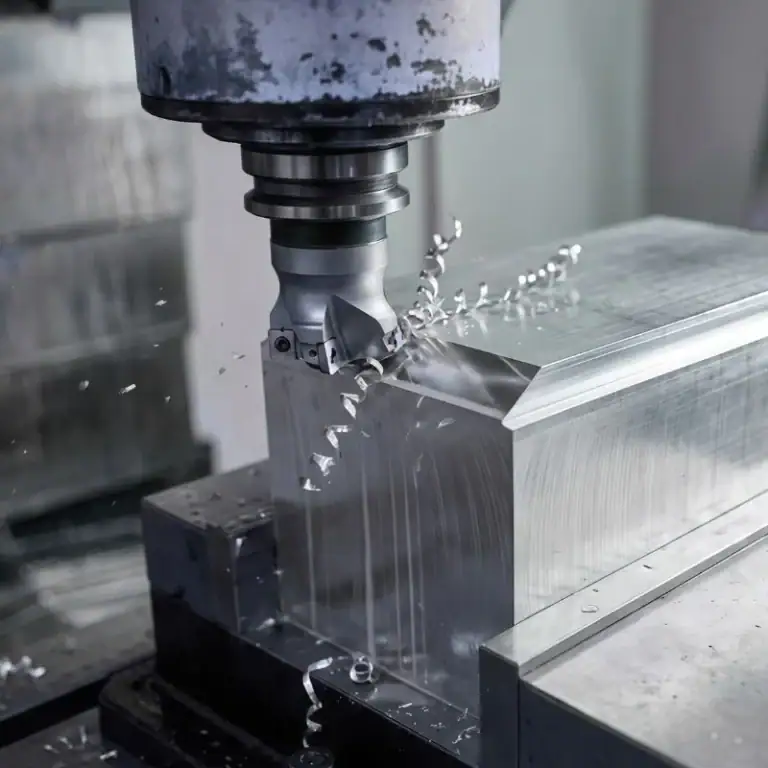
Plastic parts are widely used in fields such as electronic devices, medical equipment, automation systems, automotive components, communication devices, and industrial machinery. With the accelerating pace of product updates, more and more companies choose CNC plastic machining for prototype development, small-batch trial production, and customized manufacturing. Compared with injection molding, which requires mold development, CNC machining offers fast lead time, high precision, and easy modification, making it an important manufacturing method during the R&D stage.So why do seemingly similar plastic parts have such different prices? Some parts only cost a few dozen yuan, while others can reach hundreds or even thousands. The cost difference is not only related to material itself, but also includes machining time, equipment cost, programming difficulty, quality inspection, and post-processing requirements.
Understanding the Cost Structure of CNC Plastic Machining
Whether it is a simple plastic spacer or a complex precision component, final pricing always depends on cost calculation. Factories evaluate pricing based on overall product conditions rather than simply material weight.
How material cost is calculated?
Material cost is a key component of CNC machining pricing. Different plastics vary significantly in price. Common materials include ABS, POM, nylon, PC, acrylic, PEEK, PEI, PPS, and PTFE. Among them, ABS and POM are commonly used engineering plastics with relatively moderate prices, while specialty engineering plastics such as PEEK and PI feature high temperature resistance, corrosion resistance, and wear resistance, making their raw material costs much higher.
In production, factories do not calculate based on finished part weight but on raw stock size. For example, a finished part may be 100×80×20 mm, but machining may require a 120×100×25 mm blank. The extra material accounts for machining allowance and clamping area and must also be included in cost calculation. In some cases, irregular shapes may generate unusable scrap, which is also reflected in the final quotation.
Machine hourly cost
Many customers assume material cost determines product pricing. In reality, for most CNC plastic parts, machine time accounts for a larger proportion of total cost. CNC machines are high-value equipment, and costs include depreciation, maintenance, tool wear, and electricity consumption. Therefore, factories typically calculate cost based on hourly machine usage.
For example:
Machine cost: 150–300 RMB/hour
Machining time: 3 hours
Total machining cost: 450–900 RMB
If the part structure is complex and requires multiple setups and long finishing time, machining cost may even exceed material cost.
Labor and management cost
Plastic part production is not fully automated. After receiving drawings, engineers must perform process analysis, programming, tool selection, machining verification, and quality inspection. A complex part may require several hours of programming. Five-axis machining, curved surface machining, and high-precision projects require experienced engineers, making labor cost an important part of pricing.In addition, operational costs such as order management, procurement, quality control, warehousing, and logistics must also be allocated into product cost.
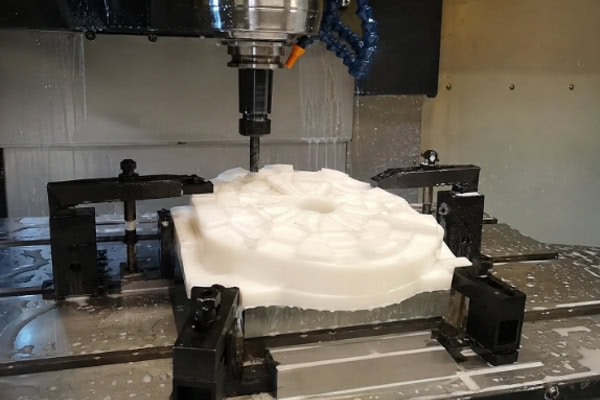
CNC Plastic Machining Cost Calculation Process
After receiving drawings, factories first evaluate technical feasibility, then proceed to material calculation and machining time estimation. Each step affects final pricing. Even if products look similar, structural details or precision requirements can significantly change cost.
Drawing evaluation and process analysis
After receiving drawings, engineers first determine whether the part is manufacturable and analyze machining challenges. This stage involves more than checking dimensions; it requires process experience judgment.
Key factors include:
- Product dimensions
- Machining tolerances
- Hole quantity and distribution
- Curved surface structures
- Assembly requirements
- Surface finish requirements
Complex structures such as deep holes, narrow grooves, thin walls, and complex curves significantly increase machining difficulty. Simple flat milling only requires basic toolpaths, while curved surfaces may require 3D programming and complex toolpath planning, increasing machining time several times.Tool accessibility, segmented machining requirements, and fixture design must also be considered. The more complex the fixture, the higher the overall cost. Therefore, drawing analysis directly determines accuracy of cost estimation.
Material consumption estimation
Material cost is calculated based on raw stock size rather than finished weight. CNC machining requires allowance for cutting and clamping, so actual material usage is larger than final part size.
For example:
Part size: 150×100×30 mm
Estimated raw stock: 170×120×35 mm
If material price is 200 RMB/kg, total cost must be calculated using material density.
For high-performance plastics such as PEEK and PEI, even small allowances significantly increase cost. Therefore, material utilization plays an important role in cost control. Some materials must be purchased in full sheets, meaning scrap cost must also be included. Transparent PC and acrylic materials may also require protective films, transportation loss consideration, and storage requirements, which are hidden costs reflected in final pricing.
Machining time estimation
Machining time is often the largest cost component and consists of machine operation time and auxiliary time. Engineers estimate total cycle time based on experience or CAM simulation.
Typical machining steps include:
- Setup time
- Tool setting time
- Rough machining
- Semi-finishing
- Finishing
- Inspection
Example:
Setup: 20 min
Roughing: 40 min
Finishing: 60 min
Inspection: 20 min
Total: 140 min
If machine rate is 200 RMB/hour, cost is about 466 RMB.Time is influenced not only by toolpath length but also tool selection, cutting parameters, and material properties. Plastic materials are easier to cut than metals, but high precision still requires reduced feed rates to avoid deformation or melting. Complex parts may require multiple setups, increasing repositioning and calibration time.
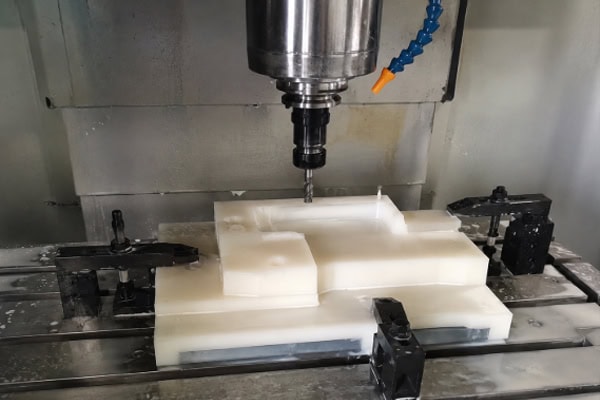
Technical factors affecting machining cost
Even with the same material and similar dimensions, prices may differ significantly due to technical requirements.
Precision requirements
Higher precision significantly increases machining difficulty. Parts used in automation positioning systems, medical devices, and electronic components often require ±0.05 mm or even ±0.01 mm accuracy. This requires slower cutting speeds, finer feed control, and more frequent inspection. Some dimensions require specialized measurement tools. Increased machining and inspection time directly raises cost.
Structural complexity
Complex structures directly affect efficiency, including:
- Deep cavities
- Micro holes
- Complex surfaces
- Thin walls
- Irregular shapes
Thin-wall parts are especially prone to deformation and require layered cutting. Even small parts may require significantly longer machining time than simple geometries.
Surface finishing requirements
Many plastic parts require not only dimensional accuracy but also good appearance. Common post-processing includes deburring, polishing, sandblasting, silk screening, engraving, and laser marking.For transparent PC and acrylic materials, achieving a mirror-like finish often requires multiple polishing steps, which are mainly manual and therefore increase cost.
How to effectively reduce CNC plastic machining cost?
Optimize product design
Overly complex structures increase machining time. Deep grooves, deep holes, and complex surfaces all increase toolpath and programming time. Simplifying design when possible helps reduce cost and improve efficiency.
Select appropriate material grade
Higher cost materials are not always necessary. For example, POM is sufficient for many mechanical parts, while PEEK may be unnecessary. Choosing materials based on actual application can significantly reduce cost.
Increase order batch size
Small orders have higher fixed costs such as programming and setup. Increasing quantity allows cost to be distributed across more parts, reducing unit price. Batch production is more cost-effective than single-piece customization.
Q&A
Why is CNC plastic machining pricing so different?
Prices may vary by 30%–100% even for the same drawing due to differences in:
- Equipment level
- Engineer experience
- Material sourcing
- Inspection standards
- Service scope
- Processing efficiency
Some manufacturers only provide basic machining, while others include inspection reports, surface finishing, and after-sales support. Therefore, pricing comparison should consider quality, precision, and delivery standards, not just cost.
Conclusion
CNC plastic machining cost is influenced by multiple factors including material, equipment, labor, process complexity, and management. Material cost forms the base price, machining time determines the main cost, while structural complexity, precision requirements, and surface quality directly affect final pricing.Simple parts with standard precision are easier to control in cost, while high-precision parts with complex structures and specialty engineering plastics significantly increase machining difficulty and time.For better pricing accuracy, companies should provide complete drawings and technical requirements and communicate fully with manufacturers. Optimizing design, selecting appropriate materials, and planning batch production can effectively reduce overall manufacturing costs and improve efficiency.