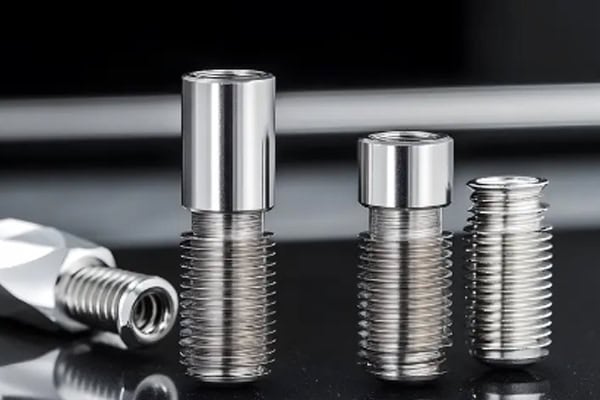
Stainless steel is widely used in precision machining, ranging from medical devices and food processing equipment to aerospace components and industrial structural parts. It is valued for its strong corrosion resistance, high strength, and long service life. However, once it enters precision machining applications, its processing difficulty becomes significantly higher than materials like aluminum alloys. In high-precision, tight-tolerance, and complex-geometry machining, the material properties of stainless steel tend to amplify a range of manufacturing challenges.
Natural Machining Difficulties Caused by Material Properties
The physical and chemical characteristics of stainless steel are the fundamental reasons for its machining difficulty.
Severe Work Hardening Behavior
Stainless steel is highly prone to work hardening during cutting.
- The surface layer hardens immediately after cutting
- Increased hardness raises cutting resistance and affects dimensional stability
- Tool wear accelerates significantly during processing
- Hardened layers negatively impact finishing quality
This makes stainless steel progressively harder to machine during the process.
Poor Thermal Conductivity Leading to Heat Concentration
Stainless steel does not dissipate heat efficiently during cutting.
- Cutting zones experience rapid temperature rise
- Thermal deformation can affect dimensional accuracy
- Long machining cycles accelerate tool wear
Heat management is a critical factor in precision stability.
Tool Wear and Efficiency Challenges
Stainless steel causes significantly higher tool consumption compared to common materials.
Rapid Tool Wear
Tool life directly impacts cost and machining accuracy.
- High-strength material causes strong impact on cutting edges
- Carbide tools are still prone to chipping or breakage
- Tool wear leads to gradual dimensional deviation
- Dull tools significantly reduce surface finish quality
- Frequent tool replacement increases production cost
Tool management becomes a core challenge in stainless steel machining.
Narrow Cutting Parameter Window
Stainless steel is highly sensitive to machining parameters.
- Excessive feed rate can cause surface tearing
- High spindle speed may generate overheating
- Low cutting depth can lead to friction instead of cutting
- Small parameter deviations can destabilize the process
The process has much lower tolerance compared to aluminum machining.
High Difficulty in Surface Quality Control
Surface quality is often more difficult to control than dimensional accuracy.
Burrs and Tool Marks Are Common
Stainless steel is difficult to finish smoothly.
- High ductility causes material smearing during cutting
- Dull tools generate visible burrs
- Surface waviness and tool marks are common
- Fine scratches may remain after finishing
- Deburring increases overall manufacturing cost
Surface and functional quality are both affected.
Dimensional Stability Affected by Processing
Dimensional accuracy is easily influenced during machining.
- Thermal deformation affects hole positioning accuracy
- Multi-step machining introduces cumulative errors
- Stress release after clamping leads to rebound deformation
Fixture and Deformation Control Challenges
Despite its strength, stainless steel still presents deformation issues in precision machining.
Internal Stress and Difficult Stress Release
Material internal stress strongly affects machining results.
- Stress release after rough machining causes deformation
- Thin-walled parts are prone to warping
- Multiple setups increase accumulated errors
- Uneven cutting can cause structural distortion
Higher Requirements for Fixture Design
Fixtures play a key role in final accuracy.
- Excessive clamping force causes local deformation
- Insufficient support leads to vibration errors
- Complex structures require customized fixture solutions
Batch Consistency Challenges
Stainless steel machining often shows greater variation in mass production.
Difficulty in Maintaining Stability
Consistency is a critical concern in production.
- Material batch variations affect machining behavior
- Tool wear gradually shifts dimensional accuracy
- Minor parameter adjustments impact overall results
- Operator differences amplify machining deviations
Higher Inspection and Correction Cost
Quality control becomes more demanding.
- Increased use of coordinate measuring machines
- Higher cost of rework for defective parts
- Stricter process monitoring requirements
The challenges of stainless steel precision machining are not caused by a single factor, but by the combined effects of work hardening, heat concentration, tool wear, and deformation control. Achieving stable high-precision results requires systematic optimization from material analysis and process design to fixture and tool management. In advanced manufacturing, platforms such as Tirapid, which specialize in complex parts and high-precision machining, provide reliable support for precision manufacturing through mature process systems and strict quality control.