Heavy machinery often operates under high loads for extended periods. Structural components such as frames, support bases, connecting plates, and equipment bases must have sufficient strength while maintaining stable dimensional accuracy. As machinery becomes larger and more complex, machining these metal components becomes increasingly challenging. Even a slight deviation in a mounting hole or minor deformation on a machined surface can affect the assembly and operation of the entire machine.
For industrial equipment manufacturers, CNC machining of large structural components involves more than simply producing parts to the required shape. Material selection, cutting deformation, workpiece positioning, clamping methods, and final inspection all need careful consideration. Large, heavy workpieces with complex hole patterns can be difficult to machine efficiently and accurately using conventional methods. How can machining errors be reduced, dimensional consistency improved, and structural components made suitable for long-term use? The answer lies in proper process planning and a well-designed machining solution.
Which Heavy Machinery Structural Components Require CNC Machining?
Heavy machinery is widely used in construction, mining, material handling, and industrial production lines. Although different machines have different structural designs, many critical components require CNC machining to produce precision holes, mounting surfaces, and complex profiles. These parts typically perform supporting, connecting, or transmission functions, so their machining accuracy directly affects the overall stability of the equipment.
Construction Machinery Frames and Support Structures
Frames, support bases, and connecting structures in excavators, loaders, and lifting equipment must withstand the machine’s own weight and the loads generated during operation. These components are often large and may include reinforcing ribs, mounting holes, and connecting grooves. Machining must maintain the overall dimensions while controlling critical mounting positions to prevent local deviations from affecting the connection with other parts.
Large Connecting Components for Mining Machinery
Crushers, conveyor systems, and mining machines often use large connecting plates, bearing housings, and transmission support components. These parts must fit accurately with shafts, gears, and other mechanical structures. Hole diameter, hole spacing, and coaxiality can all affect equipment performance. If a bearing housing is machined inaccurately, shaft alignment may be affected, potentially increasing vibration and wear during operation.
Industrial Equipment Bases and Load-Bearing Platforms
Industrial equipment bases are generally used to secure motors, transmission mechanisms, and other working components. They need sufficient load-bearing capacity and structural stability. If the base has poor flatness or inaccurately positioned mounting holes, the equipment may become tilted or experience uneven loading during assembly. Precision milling and hole machining are therefore important for these components.
| Structural Component | Typical Applications | Key Machining Requirements |
| Large machine frames | Construction machinery, lifting equipment | Dimensional accuracy and structural stability |
| Bearing housings | Mining machinery, transmission equipment | Coaxiality and hole accuracy |
| Connecting plates | Heavy machinery assembly | Hole spacing and flatness |
| Equipment bases | Industrial production equipment | Flatness and mounting hole positions |
| Load-bearing supports | Conveyor systems, hydraulic equipment | Strength and mating dimensions |
Although these components serve different purposes, they all need to fit accurately with other machine parts. Large frames and equipment bases, in particular, often require multiple mounting surfaces and connecting holes. Any deviation in a critical position can make subsequent assembly more difficult.
What Are the Main CNC Machining Challenges for Heavy Machinery Structural Components?
Large structural components differ from small precision parts. They use more material, have larger cutting areas, and may contain uneven wall thicknesses, deep grooves, and complex reinforcing structures. Improper clamping or an unsuitable cutting sequence can lead to deformation and dimensional errors. A stable machining process requires careful consideration of the workpiece structure and production conditions.

Difficulties in Clamping and Positioning Large Workpieces
Large components are often heavy, so their center of gravity, support positions, and machining areas must all be considered during clamping. If support points are poorly arranged, the workpiece may sag under its own weight. Excessive clamping force can also cause local deformation. For components that require machining on multiple faces, repeated setups may introduce additional positioning errors.
Several details require attention during machining:
- Position support points properly: Reduce sagging caused by the workpiece’s own weight.
- Control clamping force: Prevent excessive pressure from causing local deformation.
- Use consistent machining references: Reduce positioning errors caused by repeated setups.
For large workpieces, the clamping plan should be developed together with the machining route. Establishing stable support positions and positioning references in advance helps minimize movement during machining and maintain accurate dimensional relationships between different machined surfaces.
Stress Deformation During Cutting
Large structural components often require significant material removal, particularly those with deep grooves, cavities, and thin-wall sections. If material is removed unevenly during rough machining, internal stresses may gradually be released, causing the workpiece to bend or deform locally. Even if the dimensions meet requirements after rough machining, further changes may occur during finishing.
In actual production, staged cutting can help avoid removing too much material at once. For complex or thick workpieces, stress-relief treatment may also be arranged when necessary before finishing begins. This helps reduce the influence of residual stress on final dimensional accuracy.
High Requirements for Deep Holes and Large Mating Surfaces
Bearing housings, connecting holes, and mounting surfaces in heavy machinery often have demanding fit requirements. Deviations in hole diameter, hole spacing, or coaxiality can affect the installation of shafts, gears, and other transmission components. Large workpieces also have extensive machining areas, making tool overhang, machine rigidity, and cutting parameters important factors.
For critical precision features, finishing processes such as precision boring and milling can be used to achieve the required dimensions. Suitable measuring methods should also be selected to inspect key features. This helps maintain fit accuracy and reduces the risk of discovering problems only after the components reach the assembly stage.
How to Select Materials and CNC Equipment for Heavy Machinery Structural Components?
Material selection determines the load-bearing capacity of structural components and also affects machining difficulty and production costs. Heavy machinery commonly uses metals with high strength, wear resistance, or toughness. Since different components experience different loads and operating conditions, material selection should also take welding, heat treatment, and subsequent machining requirements into account.
Common Metal Materials and Their Applications
Carbon steel is suitable for general load-bearing structures, stainless steel is often used for components requiring corrosion resistance, and alloy steel is commonly selected for mechanical structures exposed to heavy loads or impact. For large frames and support components, materials must provide sufficient strength while maintaining suitable machinability to avoid unnecessary difficulties during cutting.
| Material | Main Properties | Typical Machined Components |
| Q235 Steel | Easy to machine, cost-effective | Equipment bases, general brackets |
| Q355 Steel | Higher strength | Large frames, load-bearing structures |
| 45 Steel | Good strength and overall mechanical properties | Bearing housings, connecting components |
| 42CrMo Alloy Steel | High strength and toughness | Heavy-duty transmission structures |
| 304 Stainless Steel | Good corrosion resistance | Connecting components for special environments |
Material selection should not be based on strength values alone. The actual operating conditions of the component also matter. Structures exposed to heavy impact require suitable toughness, while parts operating in damp or corrosive environments need appropriate protection. Matching material properties with the machining process helps avoid unnecessary production costs.
Applications of Large CNC Gantry Machining Equipment
Large frames, equipment bases, and load-bearing platforms often require extensive machining travel. CNC gantry machining centers can accommodate large workpieces and perform milling, drilling, and boring operations. For components with multiple machined surfaces and complex structures, machining areas can be planned carefully to reduce repeated workpiece movement and clamping errors.
Matching Machining Methods to Component Structures
Large flat surfaces can be machined through CNC milling, while precision holes may require drilling or boring. Complex profiles need carefully planned tool paths to achieve the required geometry. For oversized workpieces, the machine’s working envelope, table load capacity, and available clamping space must also be confirmed. If a component has holes in multiple directions, the machine’s axis capabilities and positioning methods should be considered in advance to prevent tool-access limitations during machining.
How Should the CNC Machining Process for Heavy Machinery Components Be Arranged?
Large components usually require several machining operations. Simply increasing cutting speed is not enough to shorten production time effectively. A well-planned process can reduce material deformation and maintain stable dimensional relationships between different machined areas. Before production begins, engineering drawings and raw material conditions should be reviewed so that the machining route can be selected according to the component structure.
Inspect Engineering Drawings and Workpiece Conditions
Before machining, confirm the material specifications, blank dimensions, machining allowances, and critical tolerances. For large welded structures, the welded areas and overall blank condition should also be inspected to identify any noticeable deformation. Mounting holes, bearing bores, and critical mating surfaces should be identified in advance to help determine the machining sequence.
Plan Rough Machining and Finishing Operations
Rough machining removes excess material and establishes the basic profile and machining references. Finishing focuses on mounting surfaces, holes, and mating areas. Suitable machining allowances should be left between these operations to prevent excessive material removal from causing deformation. For large workpieces prone to stress changes, the intervals between operations may also need to be adjusted according to the actual conditions.
Complete Drilling, Boring, and Surface Treatment
Connecting holes, bearing bores, and mounting grooves are machined according to the component design. Precision boring may be used for holes with demanding coaxiality requirements, while the positional relationships between multiple mounting surfaces also need to be checked. After machining, deburring, cleaning, and necessary surface protection should be completed according to the component’s application requirements to prevent burrs and machining residues from affecting assembly.
How to Control CNC Machining Quality for Heavy Machinery Structural Components?
Quality control for large structural components should not rely solely on final dimensional inspection. Workpieces may shift, release internal stress, or deform locally during machining. Inspection checkpoints should therefore be established at critical stages to identify problems early. For load-bearing components, dimensional accuracy, surface condition, and structural integrity all require attention.
Inspect Critical Dimensions and Mating Features
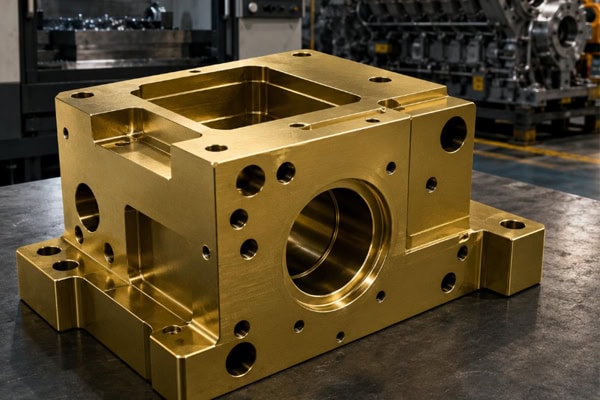
Bearing housings, equipment bases, and large connecting plates should be inspected for hole diameter, hole spacing, flatness, parallelism, and coaxiality. Large workpieces can be measured using laser measurement systems, coordinate measuring machines, and other suitable inspection equipment to verify whether critical dimensions meet drawing requirements. The positional relationships between different machined surfaces should also be checked to prevent individual dimensions from passing inspection while the assembled components fail to fit properly.
Prevent Machining Deformation from Affecting Final Dimensions
Large components may experience dimensional changes after rough machining, especially in thin-wall sections and areas where significant material has been removed. Deformation risks can be reduced through staged cutting, proper clamping, and inspection between machining operations.
- Inspect the workpiece after rough machining.
- Machine deformation-prone areas in stages.
- Reconfirm positioning references before finishing.
- Arrange stress-relief treatment when necessary.
These measures help reduce machining errors and prevent assembly problems later. For large components with complex structures, in-process inspection is often more useful than relying only on a final inspection.
Inspect Surface Quality and Batch Consistency
For structural components that must withstand long-term loads, surfaces should be checked for noticeable tool marks, burrs, and machining defects. Some parts may also require inspection of critical connecting areas for dents or local damage. During batch production, consistent machining standards should be maintained, and key dimensional inspection results should be recorded to identify quality differences between production batches.
What Value Can Professional CNC Machining Solutions Bring to Heavy Machinery Manufacturing?
Heavy machinery structural components are often large, consume substantial amounts of material, and require relatively long machining cycles. Poor process planning can lead to material waste, rework, and assembly delays. A professional CNC machining solution considers equipment selection, machining routes, and quality inspection to make large-part production more stable and better meet the structural precision and load-bearing requirements of industrial equipment.
Improve Machining Efficiency for Large Structural Components
By arranging machining sequences, tool paths, and clamping methods properly, unnecessary setups and machining operations can be reduced. For large frames and equipment bases, the working range of gantry machining centers can also be used more effectively, reducing the time spent transferring and reclamping workpieces.
Improve Assembly Accuracy and Equipment Stability
Accurate control of mounting surfaces, connecting holes, and bearing fits helps reduce assembly errors and maintain reliable connections between structural components and other mechanical parts. For industrial equipment operating under continuous loads, accurate mounting dimensions and secure structural connections can also help reduce abnormal vibration and localized wear during operation.
Support Custom CNC Machining for Industrial Equipment Components
Different industrial machines have different structural designs and dimensional requirements. Standard components may not meet every production need. Custom CNC machining based on engineering drawings can support the production of large frames, support bases, connecting plates, and load-bearing platforms. It also makes it easier to adjust machining solutions when equipment structures are modified.
The machining quality of heavy machinery structural components directly affects equipment load-bearing capacity, assembly accuracy, and long-term operating performance. From material selection and large-scale CNC equipment applications to deformation control and dimensional inspection, every stage requires careful planning. TIRAPID provides CNC machining services for industrial equipment and heavy machinery precision components, developing machining solutions based on engineering drawings, materials, and tolerance requirements. Contact us to discuss your large structural component machining needs.