Precision shafts may look simple in structure, but they perform critical functions such as power transmission, support, rotation, and mechanical connection in aerospace equipment. They are widely used in aircraft engines, landing gear systems, flight control
Precision shafts may look simple in structure, but they perform critical functions such as power transmission, support, rotation, and mechanical connection in aerospace equipment. They are widely used in aircraft engines, landing gear systems, flight control mechanisms, hydraulic systems, and satellite mechanisms. Because these components often operate under high-speed rotation, vibration, temperature changes, and complex loads, even small deviations in shaft dimensions or geometry can affect the reliability of the entire system.
For aerospace manufacturers, precision CNC shaft machining requires more than basic turning. It involves careful material selection, machining process control, dimensional inspection, and surface finishing. TiRapid can combine CNC turning, multi-axis machining, precision grinding, and quality inspection to provide customized machining solutions for aerospace shafts, pins, transmission shafts, rotating shafts, and other precision components.
Get 20% offf
Your First Order
Need custom metal and plastic parts?
Key Machining Requirements for Aerospace Precision Shafts
Strict Dimensional Accuracy
Aerospace shafts often contain multiple precision features, including shaft diameters, stepped sections, grooves, threads, and holes. Each feature needs to meet the dimensional requirements specified by engineering drawings.
CNC precision turning can efficiently control critical dimensions such as outer diameter, shaft length, grooves, and threads. For components with tighter requirements, additional finishing operations can be used to improve dimensional consistency and stability.
Control of Concentricity and Runout
For high-speed rotating aerospace components, dimensional accuracy alone is not sufficient. Concentricity between different shaft sections, radial runout, and perpendicularity can directly affect rotational stability.
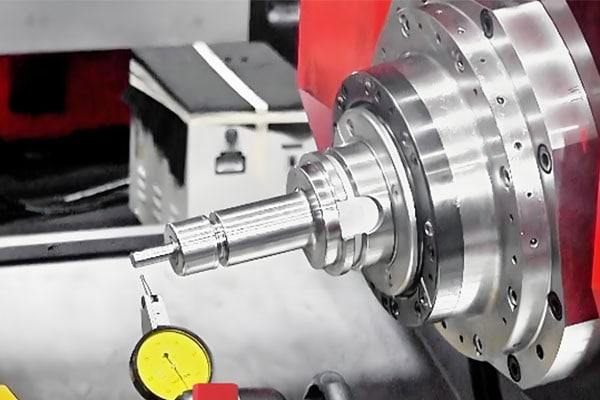
The machining process therefore needs to use suitable workholding and positioning methods to minimize errors caused by repeated setups. CNC turning combined with precision grinding or multi-axis machining can help maintain the relationship between critical reference surfaces.
High-Quality Surface Finish
Many aerospace shafts work directly with bearings, seals, gears, and other moving components. Excessive surface roughness can increase friction and wear, while an unsuitable surface finish may affect sealing performance or component life.
Depending on the application, shaft surfaces may require turning, grinding, polishing, or other finishing processes. Precision grinding is particularly useful for bearing fits, sealing surfaces, and other areas where tighter surface and dimensional requirements are needed.
Material Selection for Aerospace Precision Shaft Machining
Material selection has a direct impact on the performance, weight, machinability, and service life of an aerospace shaft. Different applications require different combinations of strength, corrosion resistance, temperature resistance, and fatigue performance.
Material
Key Characteristics
Typical Aerospace Applications
7075 Aluminum Alloy
Lightweight, high strength, good machinability
Structural shafts, transmission components
Ti-6Al-4V Titanium
High strength, corrosion resistance, high-temperature performance
Engine and high-performance components
17-4PH Stainless Steel
High strength and corrosion resistance
Shafts, connectors, mechanical components
4340 Alloy Steel
High strength and fatigue resistance
High-load transmission shafts
Inconel 718
Excellent high-temperature and creep resistance
Aerospace engine components
TiRapid supports a wide range of engineering materials, including aluminum alloys, titanium alloys, stainless steels, alloy steels, and nickel-based superalloys. This allows the machining process to be adapted to the mechanical and environmental requirements of different aerospace shaft applications.
CNC Machining Process for Aerospace Precision Shafts
CNC Turning for the Main Shaft Profile
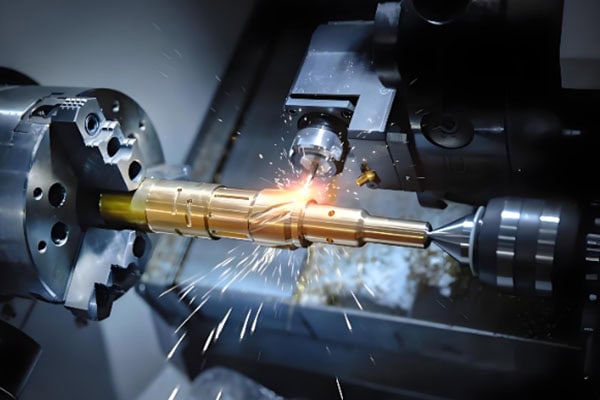
CNC turning is one of the most commonly used processes for cylindrical aerospace components. It can be used to produce external diameters, stepped sections, end faces, grooves, and threads with consistent repeatability.
For difficult-to-machine materials such as titanium alloys and nickel-based alloys, cutting speed, feed rate, cutting depth, tool selection, and heat control need to be carefully managed. Proper process parameters can reduce tool wear, thermal deformation, and dimensional variation.
Multi-Axis Machining for Complex Features
Some aerospace shafts contain cross holes, eccentric structures, irregular grooves, or features positioned in multiple directions. Conventional turning may require several setups for these components, increasing the possibility of positioning errors.
Multi-axis CNC machining or turn-milling can reduce the number of setups and improve the positional relationship between different features. This approach is particularly useful when the shaft combines rotational and non-rotational geometries.
Precision Grinding for Final Accuracy
Certain shaft sections, especially bearing fits and sealing surfaces, may require additional finishing after CNC turning. Precision grinding can improve dimensional consistency, surface finish, and fit accuracy.
By combining CNC turning with grinding and other finishing processes, manufacturers can create a more complete machining route for aerospace shafts with demanding tolerance requirements.
Quality Control for Aerospace Precision Shafts
Quality control needs to cover the entire machining process rather than being limited to final inspection. Before production, material specifications and engineering drawings should be reviewed carefully. During machining, critical dimensions and reference surfaces need to be monitored. After machining, the finished shaft should undergo dimensional and geometric inspection.
Important inspection items can include shaft diameter, overall length, concentricity, radial runout, perpendicularity, thread dimensions, and surface finish. Depending on project requirements, inspection documentation can also be provided to support production traceability and quality verification.
For aerospace projects, stable process control is especially important when moving from prototypes to small-batch or production quantities. Maintaining consistent machining parameters and inspection standards helps reduce variation between individual components.
Aerospace Applications of Precision Shaft Machining
Aerospace precision shaft machining solutions can be used in a wide range of applications, including aircraft engine transmission mechanisms, landing gear assemblies, flight control actuators, hydraulic systems, satellite mechanisms, and UAV propulsion systems.
During the product development stage, rapid CNC prototyping allows engineers to verify shaft dimensions, assembly relationships, and mechanical designs before entering production. Once the design is finalized, standardized machining processes can be introduced for small-batch or larger-scale production.
This flexible production approach is useful for aerospace manufacturers working with both new product development and ongoing component programs.
Aerospace precision shaft machining is not simply about producing a cylindrical component. The complete manufacturing solution needs to consider material properties, machine capability, workholding, machining parameters, dimensional tolerances, surface finish, and inspection requirements.
TiRapid provides CNC turning, 3-, 4-, and 5-axis machining, precision machining, grinding, finishing, and other manufacturing capabilities for custom aerospace components. By selecting suitable processes according to the geometry and material of each shaft, manufacturers can achieve reliable dimensional accuracy and consistent production quality.
For aerospace applications that require high precision, repeatability, and dependable performance, a well-planned CNC machining process can reduce assembly errors, improve rotational stability, and support the long-term reliability of critical mechanical systems.