Aerospace brackets are common structural components used in aircraft, UAVs, satellites, and aerospace engine systems. They are primarily responsible for equipment mounting, component connection, load support, and positional fixing. Although brackets are usually smaller than large
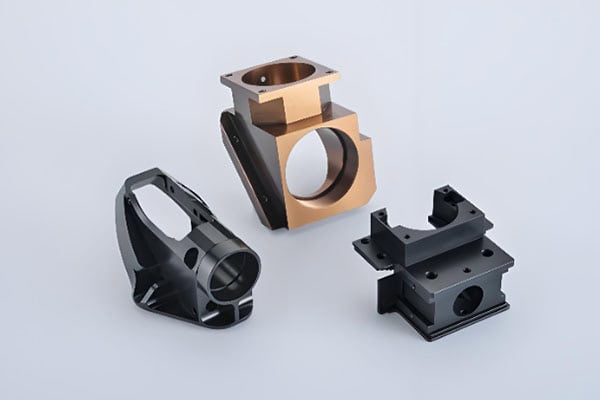
Aerospace brackets are common structural components used in aircraft, UAVs, satellites, and aerospace engine systems. They are primarily responsible for equipment mounting, component connection, load support, and positional fixing. Although brackets are usually smaller than large aerospace structural components, they often require lightweight designs, precise hole positioning, tight assembly tolerances, and reliable structural strength.
In aerospace applications, brackets may operate under vibration, shock, temperature variations, and complex loads for extended periods. This makes machining accuracy and material performance particularly important. CNC precision machining can produce complex profiles, mounting holes, threaded holes, locating surfaces, ribs, and lightweight structures according to 3D models and engineering drawings.
By selecting the appropriate materials, cutting tools, CNC equipment, and finishing processes, manufacturers can develop machining solutions that meet the weight, accuracy, and performance requirements of different aerospace bracket components.
Get 20% offf
Your First Order
Need custom metal and plastic parts?
Key Machining Requirements for Aerospace Bracket Parts
Balancing Lightweight Design and Structural Strength
Weight reduction is an important consideration in aerospace manufacturing. Many brackets use pockets, weight-reduction slots, hollow sections, and thin-wall structures to reduce overall weight. However, removing more material also increases the difficulty of maintaining machining stability and structural rigidity.
CNC machining can accurately remove unnecessary material according to the component design while maintaining sufficient strength in critical load-bearing areas. For complex aerospace brackets, multi-axis machining can also reduce the number of setups and improve positioning consistency between different machining surfaces.
High-Precision Hole Positioning
Aerospace brackets often contain mounting holes, locating holes, threaded holes, and connection holes. The positional accuracy of these holes directly affects the assembly of the final product.
During machining, key factors such as hole diameter, hole spacing, perpendicularity, and positional relationships between multiple holes need to be carefully controlled. Depending on the required tolerance, drilling, milling, boring, reaming, and thread machining can be combined to achieve the required accuracy.
Controlling Deformation in Thin-Wall Structures
To reduce weight, some aerospace brackets feature thin walls and complex ribs. These areas can be susceptible to vibration and deformation during CNC machining.
A suitable machining sequence is therefore important. Rough machining and finishing should be properly separated, while cutting parameters and clamping pressure should be carefully controlled. Removing material in multiple stages can help reduce the influence of residual stress on the final dimensions.
Common Materials for Aerospace Bracket Machining
Aerospace brackets require materials that match their specific operating conditions. Different materials offer different combinations of weight, strength, corrosion resistance, temperature resistance, and machinability.
Material
Key Characteristics
Typical Applications
6061 Aluminum Alloy
Lightweight, good machinability, corrosion resistance
General aerospace brackets and equipment mounting parts
7075 Aluminum Alloy
High strength and low weight
High-strength structural and connection brackets
Ti-6Al-4V Titanium
High strength, corrosion resistance, high-temperature performance
High-performance aerospace structural brackets
17-4PH Stainless Steel
High strength and corrosion resistance
High-load connection and support components
Inconel 718
Excellent high-temperature and creep resistance
Engine and high-temperature area brackets
Material selection affects not only the final performance of the bracket but also CNC machining parameters, tool life, production efficiency, and manufacturing cost. Before production, the material should therefore be selected according to the component’s operating temperature, mechanical load, and installation environment.
CNC Machining Processes for Aerospace Brackets
CNC Milling for Complex Profiles
Aerospace brackets often contain curved surfaces, steps, ribs, pockets, and irregular external profiles. CNC milling can machine these complex features according to CAD models while maintaining dimensional consistency.
For repeated production, standardized cutting tools and CNC programs can help reduce process variation and improve consistency between individual brackets and different production batches.
Multi-Axis Machining for Complex Components
Some aerospace brackets have multiple angled mounting surfaces and complex spatial structures. Using conventional three-axis equipment may require several part flips and repositioning operations.
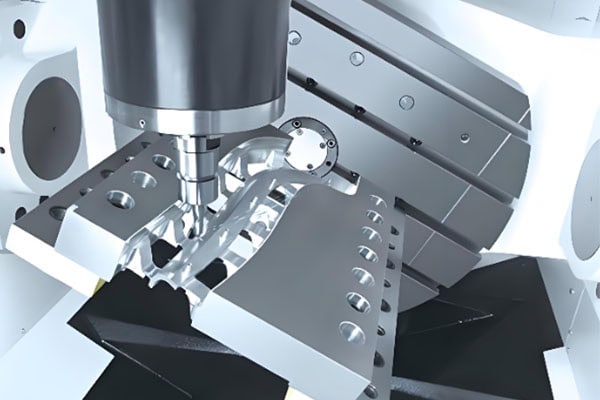
Five-axis CNC machining can complete multiple features from different directions with fewer setups. This helps maintain the positional relationship between critical holes, reference surfaces, and structural features while reducing errors caused by repeated repositioning.
Precision Drilling and Thread Machining
Mounting holes are critical functional features of aerospace brackets. Depending on the hole size and tolerance requirements, processes such as drilling, reaming, boring, and thread machining can be selected.
For precision assembly brackets, hole positional accuracy and perpendicularity should also be inspected to ensure reliable alignment with other aerospace components.
Surface Finishing and Quality Control for Aerospace Brackets
Aerospace brackets need to meet not only dimensional requirements but also surface performance requirements based on their operating environment. For example, aluminum alloy brackets may undergo anodizing to improve corrosion resistance, while steel and titanium components can receive suitable surface treatments according to their application requirements.
Quality control should cover the entire manufacturing process, including material preparation, CNC machining, surface treatment, and final inspection. Key inspection items may include critical dimensions, hole diameter, hole spacing, positional accuracy, flatness, perpendicularity, and surface quality.
For precision aerospace brackets, coordinate measuring equipment can be used to inspect critical geometric features and verify whether the finished component meets the requirements specified in the engineering drawings.
Applications of Aerospace Bracket Machining
Aerospace bracket machining solutions can be used in aircraft equipment mounting, engine auxiliary structures, avionics equipment, UAV structures, satellite components, flight control systems, and hydraulic systems.
During the product development stage, CNC rapid prototyping allows engineers to verify bracket dimensions, structural design, and assembly relationships. Once the design enters small-batch or mass production, standardized machining programs and quality control procedures can improve production efficiency and consistency.
TiRapid Aerospace Bracket Machining Solution
Aerospace brackets are typical precision structural components. Their main machining challenges include lightweight structures, complex profiles, precision hole positioning, and strict assembly tolerances. A well-designed CNC machining process can help maintain structural strength and dimensional stability while reducing component weight.TiRapid can develop customized aerospace bracket machining solutions based on material specifications, component geometry, and engineering drawings. Available processes can include CNC milling, 3-axis, 4-axis, and 5-axis machining, precision machining, and surface finishing.From prototype development to small-batch production, controlled machining processes can help aerospace manufacturers achieve stable quality and high dimensional accuracy.For aerospace projects that require lightweight construction, precision machining, and reliable assembly performance, a professional CNC bracket machining solution can help shorten product development cycles while improving component consistency and long-term reliability.