

In modern precision manufacturing and surface finishing processes, laser engraving has become an important technique for enhancing product identification, functionality, and brand value. It can be used for permanent marking of product logos, serial numbers, QR codes, and anti-counterfeiting information, while also meeting the practical needs of traceability management, visual identification, and functional differentiation for high-precision parts. With the continuous development of CNC machining and intelligent manufacturing, laser engraving is now widely used in the surface processing of metal, plastic, and composite material parts, especially in batch production scenarios that require high precision, efficiency, and consistency. Because laser engraving is a non-contact processing method, it can produce clear, stable, and durable markings without damaging the workpiece surface, making it widely used in industries such as electronics, medical devices, aerospace components, and automotive parts.
The Principle of Laser Engraving and Common Process Types
As a high-precision laser processing technology, the core advantage of laser engraving is that it can create stable markings without contacting the workpiece, which makes it widely used in precision manufacturing. For companies that want to balance machining quality with marking performance, understanding the basic principles of laser engraving is very important.
Non-Contact Processing Principle
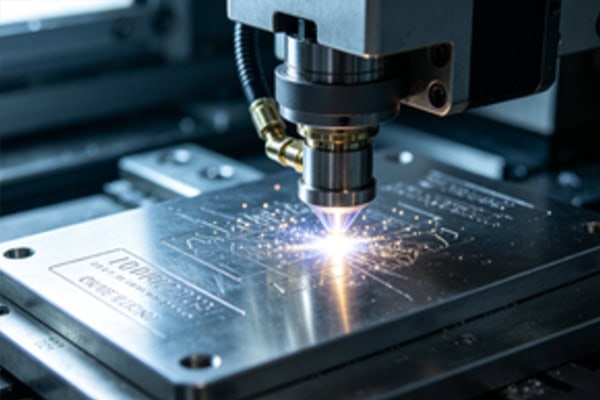
Laser engraving uses a high-energy laser beam to act on the material surface, generating localized high temperatures in a very short time and causing the material to melt, vaporize, or change color, thereby forming a permanent mark.
- The entire process does not rely on direct tool contact with the workpiece, so it does not leave compression marks, additional stress, or obvious physical damage on the surface like traditional machining. This is one of the main reasons it is highly favored in precision part processing.
- Since the processing process does not cause obvious damage to the part structure, it is especially suitable for thin-walled parts, precision parts, and high-value parts that cannot be easily reworked, helping improve processing safety while maintaining surface integrity.
- The laser action area is concentrated and controllable, providing high stability during processing and making it more suitable for products with high requirements for appearance and precision, especially industrial marking scenarios that require long-term identification and stable presentation.
This non-contact processing method gives laser engraving strong applicability in high-end manufacturing and makes it an important choice for many companies seeking to improve product quality.
Instant Material Reaction Mechanism
The laser energy is concentrated on a very small area, causing the material to undergo physical or chemical changes instantly and ultimately forming clear, stable, and durable patterns or text.
- The marking edges are usually sharper, and the overall visual effect is more stable, making it less likely to appear blurred, spread, or broken, which is especially outstanding in small text, fine lines, and complex graphics.
- Compared with traditional printing or inkjet marking, laser-engraved marks are more durable and can maintain good readability during long-term use, making them especially suitable for products that require long-term tracking and repeated identification.
- Since the marking itself does not depend on a surface coating layer, it is not easily faded by friction, oil, cleaning, or environmental changes, giving it higher reliability and a longer service life in industrial environments.
Because of this instant reaction mechanism, laser engraving is especially suitable for industrial parts that require long-term identification and better meets modern manufacturing requirements for stability and durability.
Combined Application with CNC Machining
In modern manufacturing workflows, laser engraving is often used together with CNC machining. After a part is milled, drilled, or formed, laser marking is applied to achieve integrated structural processing and information marking. This approach not only improves production efficiency and reduces the time and errors caused by process changes and secondary clamping, but also facilitates unified management of product appearance and batch information. It is especially suitable for standardized production and high-precision part manufacturing, and has become a commonly used process solution for many precision manufacturing companies.
Common Laser Process Types
Different materials and application scenarios correspond to different laser processing methods, and companies need to make comprehensive judgments based on material characteristics, marking depth, and service environment when choosing one.
- CO₂ laser:Suitable for non-metal materials, especially mature in processing wood, leather, glass, and some plastics, balancing processing efficiency and visual effect.
- Fiber laser:Suitable for metal materials and commonly used for permanent marking of industrial parts such as aluminum, stainless steel, and copper.
- UV laser:Suitable for high-precision and low-heat-impact scenarios, especially for electronic components and medical devices that require high surface integrity, helping better protect the base material.
Choosing the right laser process can make laser engraving results more stable and better aligned with actual needs, while also helping companies achieve a better balance between cost and quality.
What Materials and Industry Scenarios Are Suitable for Laser Engraving
Laser engraving is not a single-purpose processing method, but a marking technology that can be flexibly applied according to material and industry requirements. For different product types, choosing the right laser solution often directly affects the final result and service life.
Application Range of CO₂ Laser Engraving
CO₂ laser is suitable for wood, leather, glass, and some plastic materials. It offers a wide processing range and high efficiency, and is commonly used for marking, decoration, and pattern processing on non-metal materials.
- It is more suitable for packaging, handicrafts, and consumer products because these products usually focus on balancing appearance and processing efficiency while also seeking stronger visual appeal.
- For large-area patterns, text, or decorative content, CO₂ laser can balance speed and visual effect, with relatively stable overall performance, making it suitable for batch production needs.
- Because the technology is mature, CO₂ laser has formed a relatively complete process system in non-metal surface processing, making stable replication and large-scale application easier in actual production.
For products that pursue visual performance and batch efficiency, CO₂ laser is a very practical choice and is also suitable for companies that want fast implementation.
Application Range of Fiber Laser Engraving
Fiber laser is mainly used for metal materials such as aluminum, stainless steel, and copper. Its characteristics include concentrated energy and high stability, making it suitable for industrial part numbers, QR codes, brand logos, and traceability code marking.
- The marking clarity is high, making it especially suitable for industrial parts that require long-term identification and long-term information retention, which is why it is widely used in equipment nameplates and part traceability.
- Because the marks are durable and long-lasting, they can still maintain good readability in environments with frequent contact, cleaning, or friction, which is particularly important in industrial settings.
- It is widely used in industrial manufacturing, especially for batch marking of standard parts, structural parts, and functional parts, helping companies improve management efficiency and product standardization.
If a company needs permanent marking on metal parts, fiber laser is usually the preferred solution and better meets the practical needs of industrial applications.
Application Range of UV Laser Engraving
UV laser has a shorter wavelength and is suitable for micro-structures and high-precision part processing. It can complete marking under low heat impact conditions, making it especially suitable for electronic components, medical devices, and high-end precision parts.
- Because the heat impact is small, it is less likely to cause burning, deformation, or local damage to the material surface, giving it an advantage on brittle and sensitive materials.
- It is suitable for parts that cannot withstand high-temperature effects, especially thin, brittle, or highly sensitive materials, so it is increasingly used in high-value products.
- It has obvious advantages in high-end precision manufacturing, especially for products with extremely high requirements for detail and surface integrity, and can better meet high-standard processing needs.
For products that require extremely high surface integrity, UV laser has obvious advantages and is more suitable for adoption by high-end manufacturing companies.
Typical Industry Application Scenarios
Laser engraving is very common in consumer electronics, medical devices, aerospace components, automotive parts, and industrial equipment. It is mainly used for appearance marking, product traceability, batch management, anti-counterfeiting identification, and functional differentiation. It not only improves identification efficiency in production, warehousing, and after-sales processes, reducing manual verification costs, but also enhances brand recognition and gives products a more professional feel and greater trustworthiness. At the same time, laser engraving provides a more stable marking method, helping reduce identification errors and improve after-sales tracking and supply chain management efficiency, which is why it has become a very important marking process in modern manufacturing.
The Processing Advantages of Laser Engraving and the Questions Customers Care About Most
For customers, the main concern when choosing laser engraving is often not the technical terminology, but whether it can truly solve problems related to precision, durability, and delivery efficiency. That is why the real value of laser engraving is usually reflected in the results rather than in the concept itself.
High-Precision Processing Capability
Laser engraving can achieve processing accuracy at the ±0.01 mm level and surface quality of Ra0.6–1.6 μm, giving it a clear advantage in precision manufacturing.
- It is suitable for clear small-text marking, and even in relatively small marking areas, it can maintain good readability and completeness, which is especially important for parts with limited space.
- For fine QR codes and complex patterns, laser engraving can also maintain a high level of detail reproduction, meeting the needs of modern product information management and digital traceability systems.
- In high-standard industrial marking scenarios, this level of precision is very important because it directly affects recognition performance and product professionalism, as well as the customer’s overall impression of the brand.
For parts that require high readability and consistency, this precision performance is very important and is one of the main reasons many companies choose laser engraving.
Stable Surface Quality Performance
Because it is a non-contact processing method, laser engraving does not cause mechanical damage to the workpiece, so the processed surface is more uniform and stable.
- This stability helps reduce rework rates because the marking effect is more likely to be completed in one pass without frequent corrections, saving time and labor costs.
- It also reduces scrap risk, especially for parts that are sensitive to appearance and function, which is particularly important for high-value products.
- For appearance parts and functional parts, the stability of surface quality often directly affects the customer’s overall evaluation of the product, and it is also an important indicator of processing service quality.
Stable surface quality is often one of the important reasons customers choose laser engraving, as it directly affects delivery results and user experience.
Long-Term Durability and Traceability
Laser-engraved marks have good corrosion resistance and wear resistance, and can remain clear for a long time even in harsh environments, making them suitable for product traceability and anti-counterfeiting management.
- It is suitable for industrial parts used over long periods because the marks do not easily lose readability over time, which is very important for equipment maintenance and subsequent management.
- For products that are cleaned frequently, laser engraving can also maintain good stability and is not easily erased or damaged, performing more reliably in high-frequency use scenarios.
- In environments with oil contamination and frequent friction, laser engraving can still maintain high readability, making it more suitable for industrial scenarios and more aligned with the needs of harsh operating conditions.
For products that require long-term identification, the durability advantage of laser engraving is very obvious and can also help companies build a more stable quality tracking system.
Improved Brand Recognition and Product Management Efficiency
In addition to technical advantages, laser engraving can also help companies improve brand recognition. Clear and consistent logos, serial numbers, and code information not only make products look more professional, but also make warehousing, after-sales service, and quality tracking more efficient.
- Unified marking content helps create a more standardized brand image, making products easier to present professionally in the market and strengthening customer trust in the brand.
- For batch management, laser engraving makes each product’s information clearer, helping companies quickly identify and classify products and thereby improve internal management efficiency.
- In warehousing, after-sales, and quality tracking processes, clear markings can also reduce communication costs and improve overall management efficiency, making operations easier for companies.
From the customer’s perspective, laser engraving is not just a machining process, but also a product management tool and an important part of improving a company’s overall competitiveness.
Development Trends and Future Application Directions of Laser Engraving Technology
As manufacturing demands continue to rise, laser engraving technology is also evolving toward higher precision, greater efficiency, and stronger automation. In the future, its role in high-end manufacturing will expand even further.
Deep Integration with CNC Systems
Laser engraving and CNC machining are gradually achieving an integrated workflow, allowing parts to complete structural processing and marking within the same manufacturing chain, reducing intermediate transfer and repeated positioning.
- This approach can improve overall manufacturing efficiency and make the machining and marking stages more closely connected, thereby shortening product delivery cycles.
- Because manual handling and intermediate intervention are reduced, the production process becomes more stable and error rates are lower, which is especially important for batch orders.
- For batch production companies, this integration trend helps improve overall factory coordination and delivery efficiency, and it also better aligns with the development direction of modern intelligent manufacturing.
This deep integration trend will further enhance factory production coordination and make the value of laser engraving in the manufacturing process even more prominent.
Intelligent Processing Upgrades
Through intelligent recognition, automatic positioning, and path optimization technologies, laser engraving equipment can achieve more efficient automated marking, especially suitable for batch orders and multi-variety production scenarios. It not only maintains processing consistency, but also reduces manual adjustment time, improves equipment utilization, and increases delivery speed. As automation continues to improve, the application threshold for laser engraving will become lower and its efficiency higher, further expanding its future application space.
Expansion of Multi-Material Compatibility
In the future, laser engraving will be applied to more composite materials and new engineering materials, further expanding manufacturing boundaries.
- As material types continue to increase, the application range of laser engraving will also continue to expand, covering more industry needs and better supporting diversified manufacturing scenarios.
- For customized products, stronger material compatibility means companies can have more flexible processing solutions, thereby increasing product development freedom.
- This will also provide more flexible solutions for new material processing, helping manufacturing companies expand their process options and strengthen market adaptability.
Improved material compatibility will give laser engraving a broader market space and promote its implementation in more industries.
Closer Alignment with High-End Manufacturing Needs
As high-end manufacturing places increasing demands on appearance, traceability, and functional marking, laser engraving will no longer be just a simple marking process, but an important part of product quality management and brand expression.
- It can balance function and aesthetics, allowing products to meet usage requirements while also delivering better visual performance, thereby increasing overall product value.
- It can balance identification and management, making production, warehousing, and after-sales processes more efficient and easier to standardize.
- It can also balance efficiency and quality, helping companies establish more stable manufacturing advantages in competition and form a more professional brand impression in the minds of customers.
In the future, laser engraving will play a key role in more high-value products and become an indispensable part of high-end manufacturing systems.
As an important surface finishing technology in modern precision manufacturing, laser engraving is continuously expanding its application range. It not only improves the precision of product marking, but also enhances the durability and clarity of the marks. For parts that require long-term use and frequent identification, this advantage is especially significant. At the same time, laser engraving also plays an important role in product traceability, batch management, and brand recognition. It helps companies manage product information more efficiently and improve overall production standardization. With the continuous development of CNC machining and intelligent manufacturing, laser engraving technology will continue to play a valuable role in more high-end manufacturing fields and show broader application prospects. If you are looking for reliable CNC machining and laser engraving solutions, welcome to visit the TiRapid website to learn more about our services, or contact us directly at Email:projects@tirapid.com for professional support.