

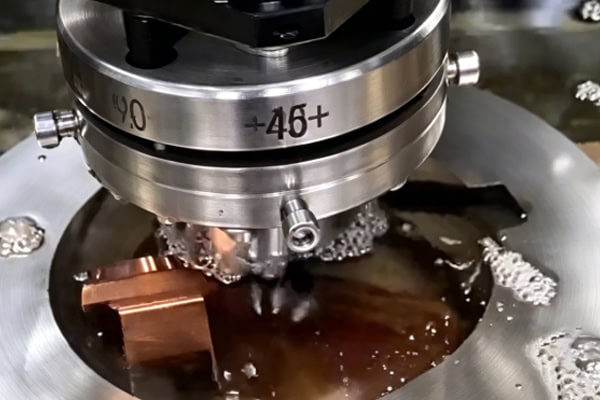
Many people wonder how EDM can remove metal without using a cutting tool when they first encounter the process. The answer lies in its unique machining principle: EDM converts electrical energy into thermal energy and removes material through non-contact electrical discharges, making it possible to accomplish machining tasks that are difficult or even impossible with conventional cutting methods.Electrical Discharge Machining (EDM) is a non-contact metal machining process. It uses high-frequency electrical discharges generated between an electrode and a workpiece to instantly heat localized areas of the metal to extremely high temperatures, causing the material to melt or even vaporize. The dielectric fluid continuously flushes away the molten debris, gradually removing material layer by layer. Unlike traditional milling, turning, or drilling, EDM does not rely on mechanical cutting forces, eliminating workpiece deformation caused by tool pressure. This makes it especially suitable for machining extremely hard materials and components with complex geometries.Since the entire machining process is precisely controlled by a CNC system, EDM delivers excellent dimensional consistency and stable machining quality. Furthermore, because there is no direct contact between the electrode and the workpiece, mechanical stress is significantly reduced, making the process particularly safe and reliable for precision components and thin-walled parts while minimizing the risk of deformation.
How Does Electrical Discharge Machining Work?
Although EDM does not involve conventional cutting tools, its machining process is highly sophisticated. Stable and high-precision machining depends on the coordinated operation of the power supply, CNC control system, dielectric fluid, and electrode.
Establishing a Precise Spark Gap
The first step is maintaining an extremely small and stable gap between the electrode and the workpiece, which is fundamental to EDM operation. If the gap is too large, electrical discharge cannot occur effectively; if it is too small, short circuits may occur. Therefore, the CNC system continuously monitors and adjusts this distance.During machining, the electrode and workpiece remain separated by only a few to several dozen micrometers without making physical contact. A pulsed voltage is then applied through an insulating dielectric fluid (typically deionized water or EDM oil). Once the voltage exceeds the dielectric breakdown threshold, a temporary discharge channel is created, initiating material removal.
Removing Material Through Instantaneous High Temperatures
Once electrical discharge occurs, every pulse releases a tremendous amount of thermal energy. Although each discharge lasts only a fraction of a second, localized temperatures can reach several thousand to over ten thousand degrees Celsius, instantly melting or vaporizing the workpiece material.Each electrical pulse forms a microscopic crater on the workpiece surface. After thousands or even millions of successive discharges, the desired geometry and dimensions gradually take shape. Although this point-by-point removal process is generally slower than conventional rough machining, it offers exceptional accuracy and enables the production of highly complex shapes.
Cooling and Flushing by the Dielectric Fluid
The dielectric fluid does much more than cool the machining area. Throughout the process, it maintains a stable discharge environment while flushing away molten particles generated during machining, preventing them from interfering with subsequent discharges.Continuous circulation of clean dielectric fluid also helps prevent secondary discharges, improves machining stability, and enhances surface quality. Poor fluid circulation may reduce machining efficiency or cause surface defects, making an effective filtration and circulation system essential.
What Are the Main Types of EDM?
Depending on machining requirements, EDM is generally divided into two primary categories. Although both belong to the Electrical Discharge Machining process, they differ in operating methods, applications, and suitable workpiece types. Manufacturers select the appropriate process based on product characteristics.
Sinker EDM
Sinker EDM is primarily used for machining three-dimensional cavities and complex internal geometries, making it one of the most widely used processes in mold manufacturing. It offers significant advantages when machining deep cavities that conventional cutting tools cannot easily reach.Also known as cavity EDM or ram EDM, this process requires an electrode—typically made of copper or graphite—that matches the desired cavity geometry. Material is gradually removed through electrical discharges until the cavity replicates the electrode shape.
It is particularly suitable for:
- Plastic injection mold cavities
- Die-casting molds
- Forging dies
- Deep cavity components
- Sharp corner features
- Complex internal contours
Because it can machine areas inaccessible to conventional cutting tools, Sinker EDM is extensively used in mold manufacturing and is capable of producing high-quality cavity surfaces with excellent finishes.
Wire EDM
Wire EDM is better suited for machining two-dimensional profiles and precision-cut components. Since it uses a continuously moving thin metal wire as the electrode, it produces extremely narrow kerf widths and high cutting accuracy, making it an indispensable process in precision mold manufacturing.Wire EDM employs a continuously fed metal wire, usually brass wire, as the electrode to cut conductive materials through controlled electrical discharges.
Compared with conventional cutting methods, it offers:
- No mechanical cutting force
- Extremely high cutting accuracy
- Very narrow kerf width
- Capability to machine complex 2D profiles
- Ability to machine high-hardness materials
Wire EDM is widely used for:
- Stamping dies
- Hardware molds
- Precision components
- Medical components
- Aerospace structural parts
- Automation equipment components
For large-volume production requiring excellent dimensional consistency, Wire EDM also provides outstanding machining stability.
What Are the Advantages of EDM?
An increasing number of manufacturers adopt EDM not because it replaces every machining method, but because it offers unique advantages in specialized applications where conventional cutting processes fall short.
Machining Ultra-Hard Materials
Many high-performance materials become extremely hard after heat treatment. Conventional cutting tools wear rapidly or struggle to machine these materials efficiently, whereas EDM is largely unaffected by material hardness.Traditional cutting tools experience significant wear when machining hardened steel or cemented carbide, while EDM can machine these materials with ease.
Typical materials include:
- H13 tool steel
- SKD11
- D2 tool steel
- Tungsten carbide
- Titanium alloys
- Nickel-based superalloys
Even materials exceeding 60 HRC can be machined consistently.
Machining Complex Geometries
Modern product designs increasingly feature deep holes, narrow slots, and intricate microstructures that conventional cutting tools cannot easily access.
EDM excels at machining features such as:
- Deep grooves
- Narrow slots
- Micro holes
- Sharp internal corners
- Deep cavities
- Fine microstructures
It enables the production of highly complex geometries while maintaining excellent dimensional accuracy.
High Dimensional Accuracy
Precision manufacturing demands increasingly tighter dimensional tolerances. EDM relies on CNC-controlled discharge positioning to maintain highly consistent machining accuracy.
Modern CNC EDM equipment typically achieves:
- Dimensional accuracy up to ±0.01 mm
- Excellent repeatability
- Outstanding machining consistency
These capabilities are particularly valuable for precision molds and high-end components requiring tight assembly tolerances.
Excellent Surface Finish
Besides dimensional accuracy, many products also require superior surface quality. By optimizing discharge energy and machining parameters, EDM can achieve a wide range of surface finishes.
Typical machining stages include:
Rough machining: High material removal efficiency
Semi-finishing: Stable dimensional accuracy
Finishing: Improved surface smoothness
Surface roughness values of Ra 0.6–3.2 μm are commonly achievable, while mirror-finish machining can produce even finer surfaces.
Virtually No Mechanical Stress
Since no cutting tool physically contacts the workpiece, EDM eliminates deformation caused by cutting forces, making it especially suitable for delicate precision components.
The process avoids:
- Workpiece deformation
- Tool pressure
- Burr formation
This makes EDM ideal for machining thin-walled components and high-precision parts while reducing subsequent finishing operations.
Which Industries Use EDM?
As manufacturing technology continues to evolve, EDM has become increasingly popular across numerous industries. Beyond improving product quality, it enables manufacturers to produce more sophisticated designs with tighter tolerances. Many components that are difficult to manufacture using conventional methods can be produced much more efficiently with EDM.
Mold Manufacturing
The mold industry represents one of the largest application areas for EDM. Mold structures often contain deep cavities, narrow slots, and sharp corners that are difficult to machine using conventional cutting tools. EDM plays a critical role in producing these intricate features with high precision.
Typical applications include:
- Injection molds
- Die-casting molds
- Metal stamping dies
- Precision mold cores
Virtually all complex molds utilize EDM during final machining. EDM is particularly valuable during mold finishing, where it enhances dimensional accuracy and surface quality, ensuring consistent performance in mass production.
Aerospace
Aerospace components demand exceptional material performance and machining precision. Many parts must be lightweight, strong, and geometrically complex. Conventional machining often struggles with these advanced materials, whereas EDM excels because it does not rely on cutting forces.
Typical materials include:
- Titanium alloys
- Nickel-based alloys
- High-temperature steels
These difficult-to-machine materials can be processed accurately while maintaining complex geometries. Since aerospace components require extremely tight tolerances, EDM’s stable and precise machining capabilities are especially important.
Medical Devices
Medical components are often small in size but require outstanding dimensional accuracy and surface quality. Many parts also demand excellent reliability and repeatability.
Typical applications include:
- Surgical instruments
- Orthopedic implants
- Precision medical molds
EDM produces complex, high-precision medical components with excellent surface quality while ensuring consistent repeatability to satisfy stringent medical industry requirements.
Automotive Manufacturing
The automotive industry requires enormous quantities of molds and precision components. From tooling development to component production, high-precision machining is essential. EDM has become an indispensable manufacturing process, particularly for producing complex molds and specialized components.
Common automotive applications include:
- Engine molds
- Stamping dies
- Gear manufacturing
- Precision components
- New energy vehicle components
EDM is particularly indispensable during mold manufacturing. As automotive designs become increasingly sophisticated, EDM helps manufacturers accelerate both prototyping and mass production while improving overall manufacturing efficiency.
How Can EDM Machining Quality Be Ensured?
Consistent machining quality depends not only on equipment performance but also on machining parameters, operator experience, and a comprehensive quality management system. Only by controlling every aspect of production can manufacturers ensure consistent product quality.
Professional manufacturers typically focus on:
- Using high-precision CNC EDM equipment
- Optimizing discharge parameters based on material characteristics
- Using high-quality copper or graphite electrodes
- Accurately compensating for electrode wear
- Maintaining clean and continuously circulating dielectric fluid
- Performing comprehensive inspections of critical dimensions
Implementing production management systems compliant with ISO 9001 and mold industry standards further improves product consistency, ensuring stable component performance even under demanding operating conditions.
Why Are More Manufacturers Choosing EDM?
As manufacturing continues to move toward higher precision and greater automation, product designs are becoming increasingly complex. Conventional machining methods alone can no longer satisfy every manufacturing requirement. With its stability, exceptional precision, and broad applicability, EDM has become the preferred solution for more and more manufacturers.Compared with traditional machining methods, EDM not only machines ultra-hard materials efficiently but also produces complex cavities, microstructures, deep holes, and high-precision contours, making it an indispensable technology in modern precision manufacturing.Choose Professional EDM Machining Services to Simplify Complex Part Manufacturing
If you are looking for high-precision EDM machining, Wire EDM, Sinker EDM, precision mold manufacturing, or custom complex metal component fabrication, our experienced engineering team can quickly evaluate your drawings, assess manufacturing feasibility, and develop optimized machining solutions based on your material and design requirements. This helps shorten production lead times while minimizing manufacturing risks.Whether your project involves machining ultra-hard materials, producing complex geometries, or manufacturing high-precision molds and custom components, we combine advanced CNC equipment with state-of-the-art EDM technology to provide comprehensive one-stop manufacturing services—from prototype development to mass production. Every component undergoes rigorous quality inspection to ensure it fully meets customer specifications.If you require EDM machining, CNC precision machining, mold manufacturing, or custom component production, feel free to contact us at any time. Our engineering team will provide professional technical consultation, process recommendations, and fast quotations based on your drawings, materials, and precision requirements, helping your project move into production more efficiently and reliably.