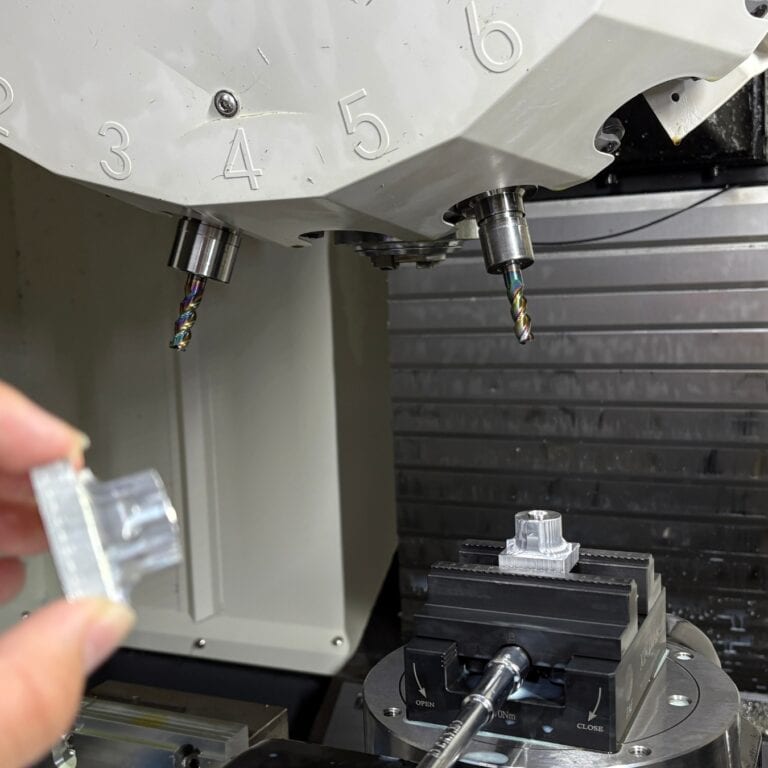
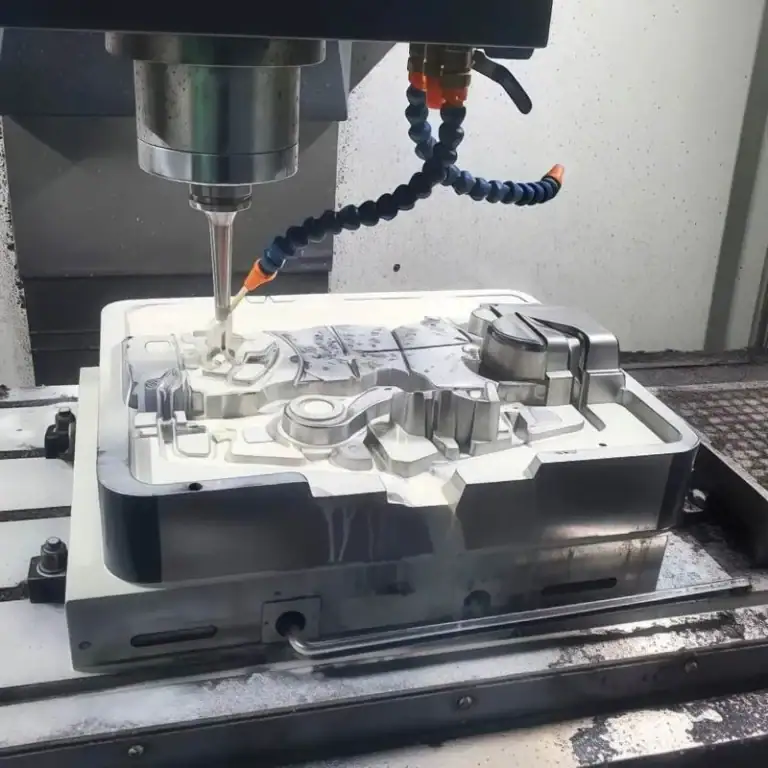
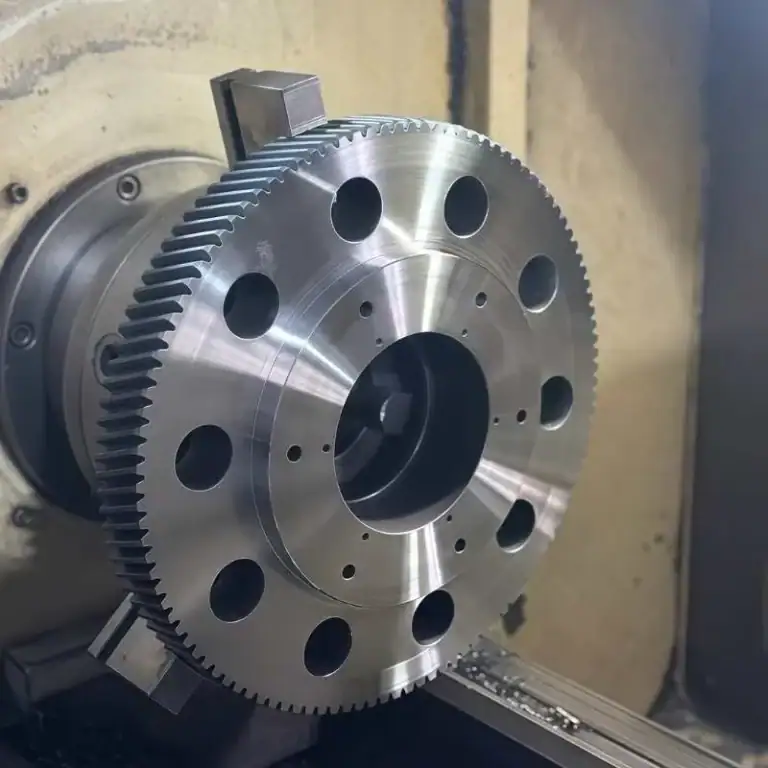
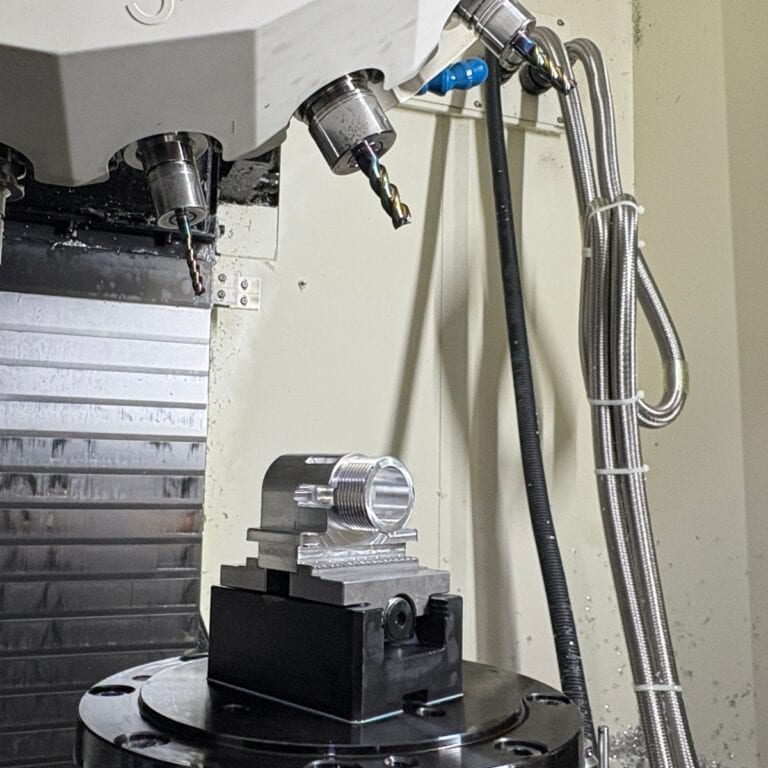
6-axis CNC machining enables simultaneous linear and rotational motion to machine complex parts in one setup. This article explains how it works, its capabilities, benefits, and applications to help engineers decide when to use it.
What Is 6-Axis CNC Machining
6-axis CNC machining extends multi-axis CNC machining manufacturing by enabling full tool and workpiece motion in a single setup. It is designed for complex geometries, tight tolerances, and high-precision assemblies where conventional 3-axis or 5-axis machining reaches their limits.
To manage this level of simultaneous linear and rotary motion, precise toolpath planning becomes critical. Toolpaths are generated by advanced CAM software, which calculates machine kinematics and continuously checks for collisions. This ensures smooth transitions between operations, safe motion near complex features, and consistent accuracy without manual repositioning.
A 6-axis CNC machine combines three linear axes and three rotary axes:
- Linear axes (X, Y, Z): control basic positioning in three-dimensional space
- Rotary axes (A, B, C): rotate the tool or workpiece around each linear axis
The sixth axis adds an extra degree of freedom, allowing the tool to approach features from more angles. This greatly improves reachability, tool orientation control, and surface consistency, especially for deep cavities, undercuts, and complex contours.
Advantages of 6-Axis CNC Machining
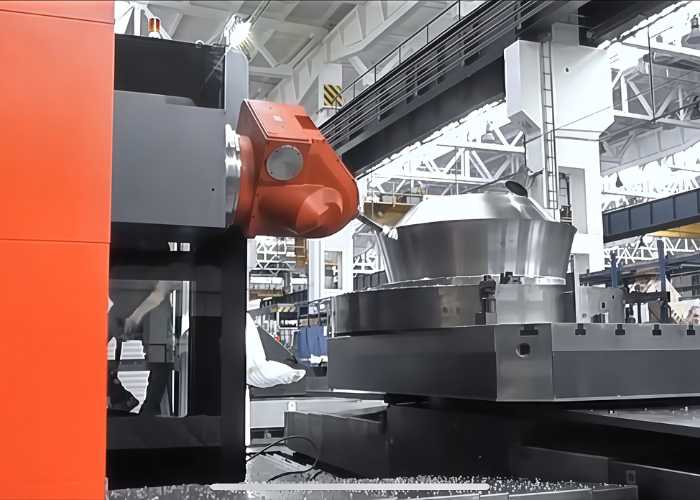
6-axis CNC machining is designed to maximize efficiency and accuracy for complex parts by enabling full multi-directional access in a single setup. By synchronizing linear and rotary axes, manufacturers can reduce handling, stabilize quality, and achieve tighter tolerances on intricate geometries.
Reduced setups and process switching
By machining multiple faces in one fixture, 6-axis systems eliminate repeated clamping, reducing alignment errors and setup time.
Higher efficiency and consistency
Continuous optimal tool orientation improves cutting stability, shortens cycle time, and delivers consistent results across batches.
Precision advantage for complex parts
For aerospace, medical, and high-end industrial components, 6-axis machining maintains accuracy on deep cavities, undercuts, and curved surfaces that are difficult to achieve with fewer axes.
Limitations and Challenges
Despite its technical advantages, 6-axis CNC machining is not suitable for every project. Higher cost and complexity mean it delivers the most value only when matched with the right part requirements.
Higher equipment and processing cost
6-axis machines require significant capital investment and higher operating costs compared to 3-axis or 5-axis systems.
Programming and operational complexity
Advanced CAM software and experienced programmers are essential to manage toolpaths, machine kinematics, and collision avoidance.
Not all parts require 6-axis machining
For simple geometries, the added capability may not improve performance or cost efficiency, making lower-axis machining more practical.
Industries Using 6-Axis CNC Machining
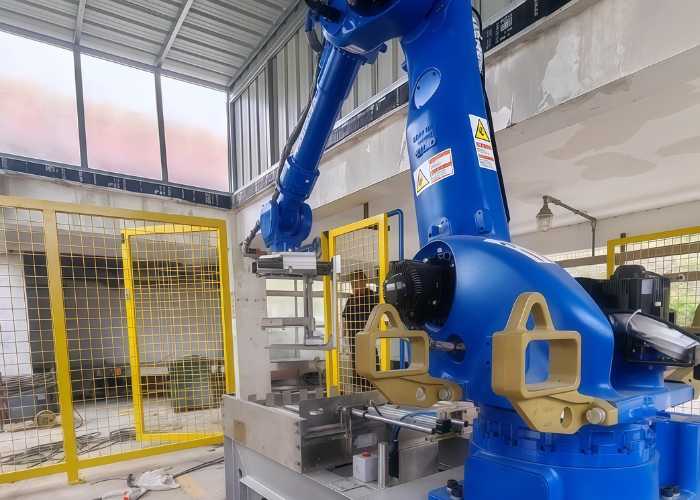
6-axis CNC machining is widely used in aerospace, medical, automotive, and robotics industries where complex geometry and tight tolerances are critical. It enables accurate multi-surface machining in a single setup that conventional CNC methods cannot achieve efficiently.
Aerospace
In aerospace manufacturing, 6-axis CNC machining is essential for turbine blades, structural brackets, and engine components with complex airfoil profiles and compound curves. Continuous tool orientation ensures high accuracy, surface integrity, and repeatability on flight-critical parts.
Medical
Medical applications rely on 6-axis machining for implants and surgical tools with complex contours. Dental implants, orthopedic components, and articulated instruments benefit from precise multi-angle access and consistent surface quality.
Automotive
In automotive and motorsport industries, 6-axis CNC machining is used for transmission housings, racing engine parts, and lightweight structural components. It enables efficient machining of internal channels and variable wall thicknesses in a single setup.
Robotics & Industrial Equipment
Robotics and industrial equipment use 6-axis CNC machining for precision housings, end-effectors, and motion components. One-setup multi-face machining improves alignment accuracy and long-term system stability.
| Industry | Typical Parts | Why 6-Axis CNC Is Used |
| Aerospace | Turbine blades, engine parts, structural brackets | Complex curves, tight tolerances, multi-surface accuracy |
| Medical | Implants, surgical instruments, dental components | Precise geometry, repeatability, fine surface control |
| Automotive | Transmission cases, engine parts, lightweight structures | Internal features, efficiency, reduced setups |
| Robotics & Industrial Equipment | Housings, end-effectors, motion components | Alignment accuracy, multi-face machining, stability |
FAQs
What Is The Difference Between 5-Axis And 6-Axis CNC Machining?
In my experience, the key difference is motion freedom and efficiency. 5-axis CNC adds two rotary axes to X, Y, Z, while 6-axis CNC milling adds a third rotary axis, enabling continuous tool reorientation. This makes 6 axis milling more efficient for complex parts, reducing setups, improving surface consistency, and cutting cycle time by 20–40%.
What Control Software Is Used For Programming 6-Axis CNC Machines?
For 6 axis CNC milling, I typically use advanced CAM software such as Siemens NX, Mastercam, CATIA, or Hypermill. These platforms support full multi-axis simulation, collision detection, and tool-axis optimization, enabling reliable toolpath generation for complex 6 axis milling operations with positioning accuracy down to ±0.01 mm.
What Innovations Are Emerging In 6-Axis CNC Technology?
Recent innovations in 6 axis milling include AI-driven adaptive machining, digital twin simulation, and in-process measurement. These technologies improve 6 axis CNC milling efficiency by reducing cycle time by 15–25%, enhancing surface finish, and minimizing programming and setup errors for high-value, complex components.
Conclusion
6-axis CNC machining delivers maximum flexibility, precision, and efficiency for complex parts by combining full linear and rotational motion in one setup. While it requires higher investment and expertise, it is the optimal choice for aerospace, medical, automotive, and industrial components where accuracy, consistency, and multi-surface machining are critical.