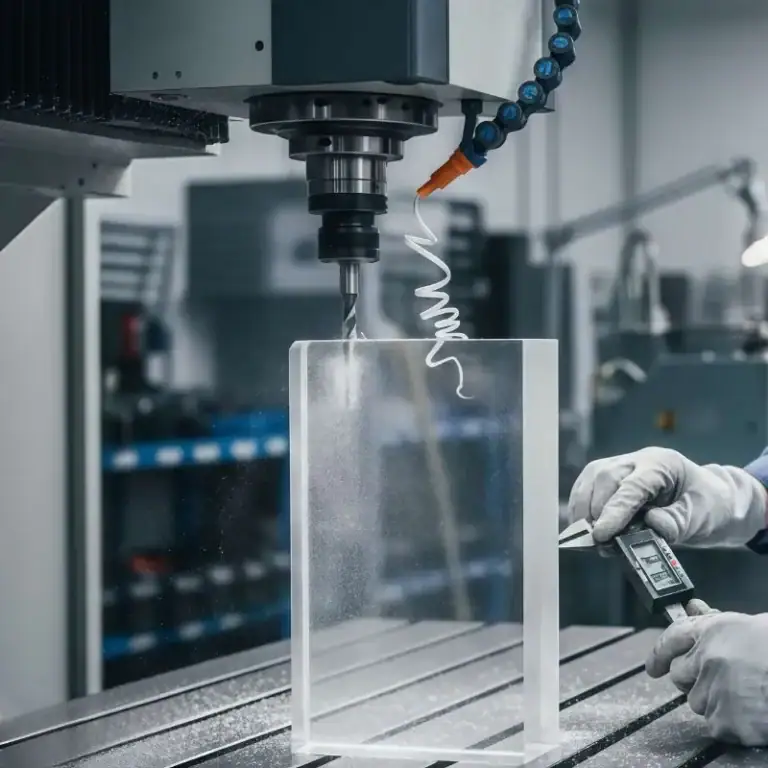
In engineering design, material selection goes beyond strength and durability. One critical but often misunderstood property is the stiffness of material, which defines how much a material resists deformation under load. Even when a part does not fail, insufficient stiffness can lead to excessive deflection, poor dimensional accuracy, vibration, and assembly issues.
In CNC machining and precision manufacturing, stiffness directly affects machining stability, tolerance control, and part performance. Low-stiffness materials are more likely to bend during cutting or in service, causing unexpected errors and quality problems—especially in thin-walled or high-precision components.
In this guide, I explain what stiffness of material means, how it differs from strength, and why it matters in real engineering applications. You’ll also learn how to compare material stiffness and apply this knowledge to make better design and manufacturing decisions.
What Is Stiffness Of Material?
Stiffness of material explains how much a part bends under load. In CNC machining, stiffness often matters more than strength because excessive deflection can ruin tolerances, surface finish, and assembly—even when the material itself is strong.
Material stiffness measures resistance to elastic deformation and is defined by Young’s Modulus. Unlike strength, which describes failure limits, stiffness controls how much a part flexes during machining and in service.
In CNC milling, low-stiffness materials tend to deflect under cutting forces, causing chatter and dimensional errors. For example, switching from aluminum to stainless steel can reduce part deflection by over 60% under the same load due to higher stiffness—even if strength differences are minor.
I’ve seen many projects fail tolerance checks not because the material was weak, but because stiffness was underestimated during design. Increasing wall thickness or selecting a stiffer alloy often solves the issue more effectively than tightening tolerances.
Understanding stiffness helps engineers balance accuracy, cost, and manufacturability—especially for precision CNC parts.
What Determines Material Stiffness?
Material stiffness is determined by both intrinsic material properties and structural factors. For engineers and CNC machinists, understanding what controls stiffness is essential for predicting deformation, reducing vibration, and achieving dimensional accuracy.
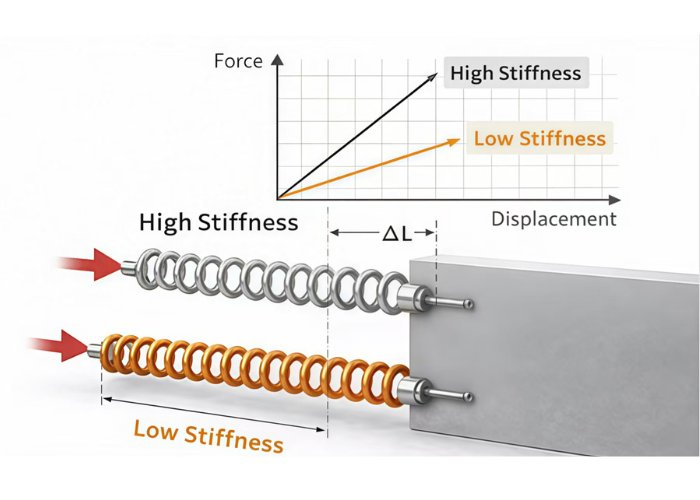
Material stiffness is primarily governed by Young’s Modulus (Elastic Modulus), which defines how much a material elastically deforms under a given load. The higher the elastic modulus, the stiffer the material. For example, steel (~200 GPa) is nearly three times stiffer than aluminum (~69 GPa), which explains why aluminum parts deflect more under the same cutting force.
At the atomic level, stiffness is determined by the strength of atomic bonding and crystal structure. Materials with strong metallic or covalent bonds resist elastic deformation more effectively. This is why ceramics and hardened steels exhibit very high stiffness, while polymers show much lower values.
However, in real CNC machining, stiffness is not determined by material alone. I’ve seen many cases where a high-stiffness material still deforms due to poor part geometry. Structural factors often dominate stiffness behavior, including:
- Wall thickness and rib placement
- Cross-sectional shape
- Unsupported length
- Fixturing and clamping rigidity
From a mechanical standpoint, stiffness scales with the second moment of area, meaning small increases in thickness or section height can dramatically reduce deflection. In practice, increasing wall thickness by just 20% can reduce deflection by more than 40%—often more effective than switching to a stronger material.
Temperature also plays a critical role. As temperature rises, elastic modulus decreases. During high-speed CNC machining, localized heat can temporarily reduce stiffness, leading to chatter, tool marks, and tolerance drift—especially in aluminum and plastics.
Finally, loading direction and type matter. Bending stiffness is far more sensitive than axial stiffness. This explains why long, thin parts bend easily under side cutting forces even if the material itself is stiff.
Material Stiffness vs Strength: Key Differences Engineers Must Know
In engineering and CNC machining, stiffness and strength are often confused but serve very different purposes. Material stiffness vs strength affects part deflection, dimensional accuracy, and failure risk in completely different ways. The table below highlights their key differences to help engineers choose the right material and machining strategy.
| Comparison Factor | Material Stiffness | Material Strength |
| Definition | Resistance to elastic deformation under load | Resistance to permanent deformation or fracture |
| Key Indicator | Young’s Modulus (Elastic Modulus, GPa) | Yield Strength / Tensile Strength (MPa) |
| What It Controls | How much a material bends or deflects | How much load a material can withstand before failing |
| Deformation Behavior | Focuses on how much it deforms | Focuses on when it fails |
| Load Response | High stiffness = small deflection under load | High strength = survives higher stress without breaking |
| Affected By Geometry | No (intrinsic material property) | No (material property, not shape) |
| Affected By Part Shape | Yes (overall structural stiffness changes) | Yes (stress distribution changes) |
| Role In CNC Machining | Controls vibration, chatter, dimensional accuracy | Determines cutting force limits and risk of part failure |
| Typical CNC Issues | Low stiffness → deflection, poor surface finish | Low strength → cracking, plastic deformation |
| Common Misconception | “Strong materials are stiff” | “Stiff materials are strong” |
| Engineering Example | Aluminum and steel have similar stiffness per volume | Aluminum is much weaker than steel |
| Design Priority When | Precision, flatness, tight tolerances matter | Load-bearing and safety are critical |
Why Stiffness Of Material Matters In Engineering Design?
Material stiffness plays a critical role in engineering design because it directly controls deformation, stability, and dimensional accuracy. For engineers, choosing the right stiffness is essential to ensure parts perform as intended under real loads.
In engineering design, stiffness determines how much a component deflects under load, not whether it breaks. Even when a material is strong enough to avoid failure, insufficient stiffness can still cause functional problems such as misalignment, vibration, or assembly interference.
From a mechanical perspective, stiffness governs elastic deformation according to Hooke’s Law. For two parts with identical geometry, the one made from a higher-stiffness material (higher Young’s Modulus) will deflect less under the same force. For example, steel components typically deflect about three times less than aluminum parts under equivalent loading conditions.
In real product development, I’ve seen stiffness-related issues appear long before strength becomes a concern. In CNC-machined brackets, housings, and frames, excessive deflection during operation can lead to tolerance stack-up, bearing misalignment, and premature wear—even though the part never cracks or yields.
Stiffness is especially critical in precision engineering, where dimensional stability directly affects performance. In applications such as aerospace fixtures, robotic arms, and medical devices, elastic deformation as small as 10–20µm can compromise accuracy. This is why designers often prioritize stiffness over ultimate strength when controlling motion, vibration, and repeatability.
Another key reason stiffness matters is vibration and dynamic behavior. Low-stiffness structures are more prone to resonance and chatter. In CNC machining, insufficient stiffness can cause tool vibration, poor surface finish, and inconsistent dimensions. I’ve often reduced machining issues not by changing cutting parameters, but by increasing part stiffness through thicker walls or structural ribs.
From a cost and manufacturability standpoint, stiffness-driven design can also reduce risk. Parts that deform less require fewer tight tolerances, simpler fixturing, and less corrective finishing. In practice, optimizing stiffness early in design can lower machining cost by 20–30% while improving yield.
Why Material Stiffness Is Critical In CNC Machining?
Material stiffness is critical in CNC machining because it directly affects cutting stability, dimensional accuracy, and surface finish. Insufficient stiffness often leads to vibration, tolerance loss, and machining defects—even when strength is adequate.
In CNC machining, material stiffness determines how a workpiece behaves under cutting forces, not just whether it can be cut. During milling or turning, tools apply dynamic loads that cause elastic deformation. If the material stiffness is too low, the part bends instead of resisting the force, leading to dimensional errors.
From a machining standpoint, stiffness is closely tied to deflection control. Even a small elastic deflection—20–50µm—can cause out-of-tolerance features in precision parts. In my experience, this is especially common when machining aluminum, thin-walled stainless steel, or long unsupported features.
Low stiffness also increases the risk of chatter and vibration. When a material cannot damp cutting forces effectively, tool vibration becomes more pronounced. This results in poor surface finish, uneven tool wear, and shortened tool life. In contrast, stiffer materials such as steel or certain titanium alloys provide more stable cutting conditions, even at higher feed rates.
Material stiffness directly influences process planning and fixturing. Parts made from low-stiffness materials often require additional supports, custom fixtures, or multiple machining passes to control deformation. I’ve seen cases where increasing material stiffness—or redesigning for higher stiffness—eliminated an entire secondary finishing operation.
Stiffness also affects tolerance capability. For tight tolerances (±0.01mm or below), stiffness often matters more than cutting speed or machine accuracy. A high-precision CNC machine cannot compensate for a flexible workpiece that deforms under load.
From a cost perspective, insufficient stiffness increases machining time, scrap rates, and inspection failures. Optimizing stiffness early—through material selection or structural design—can reduce machining risk and lower total cost by 20–30%.
How Stiffness Affects CNC Machining Performance?
Material stiffness directly impacts CNC machining performance by controlling deflection, vibration, surface finish, and tolerance stability. Higher stiffness leads to more predictable cutting behavior, improved accuracy, and lower machining risk.
In CNC machining, stiffness affects performance at every stage of the cutting process. When a cutting tool engages the material, the workpiece experiences dynamic forces that cause elastic deformation. Materials with higher stiffness resist this deformation, resulting in more stable and controllable machining behavior.
One of the most critical effects of stiffness is part deflection. Low-stiffness materials bend more easily under cutting loads, which shifts tool contact points and causes dimensional deviation. In my experience, deflection of just 30–50µm is enough to push precision features out of tolerance, especially in thin walls, long slots, or cantilevered structures.
Stiffness also plays a major role in chatter and vibration control. When stiffness is insufficient, cutting forces excite vibrations between the tool, workpiece, and machine structure. This leads to poor surface finish, irregular tool wear, and reduced tool life. Stiffer materials damp vibration more effectively, allowing higher feed rates and more aggressive cutting parameters without sacrificing quality.
From a surface quality standpoint, stiffness directly affects surface roughness consistency. Flexible materials tend to spring back after cutting, creating uneven tool marks and unstable Ra values. In contrast, stiffer materials maintain consistent contact with the tool, producing smoother and more repeatable surface finishes.
Material stiffness also influences process efficiency and cost. Low stiffness often requires reduced feed rates, additional support fixtures, or multiple light finishing passes to maintain accuracy. I’ve worked on projects where switching to a higher-stiffness material reduced cycle time by over 25% while improving tolerance stability.
Stiffness Of Common Engineering Materials
The stiffness of common engineering materials varies widely and directly affects CNC machining accuracy, part deflection, and structural performance. Understanding stiffness values helps engineers select materials that balance strength, weight, and manufacturability.
Below is a practical overview of stiffness in commonly used engineering materials:
- Steel (200–210 GPa)
Carbon steel and alloy steel are among the stiffest widely used materials. Their high modulus provides excellent dimensional stability during machining. In my experience, steel parts show minimal deflection even in long-span or thin-wall features, making them ideal for precision fixtures and structural components.
- Stainless Steel (190–200 GPa)
Slightly less stiff than carbon steel, stainless steels still offer strong resistance to deformation. However, their lower thermal conductivity means stiffness must be balanced with cutting heat control to avoid distortion during CNC machining.
- Aluminum Alloys (68–72 GPa)
Aluminum is significantly less stiff than steel, but its low density makes it attractive for lightweight designs. In CNC machining, aluminum parts often require careful fixturing when wall thickness drops below 2–3mm to control elastic deflection.
- Titanium Alloys (105–120 GPa)
Titanium sits between steel and aluminum in stiffness. While not as stiff as steel, its high strength-to-weight ratio makes it ideal for aerospace and medical parts. From my projects, titanium stiffness is usually sufficient—but machining strategy must compensate for springback.
- Brass & Copper Alloys (90–130 GPa)
These materials provide moderate stiffness with excellent machinability. Brass, in particular, offers stable cutting behavior and low vibration, making it a preferred choice for precision gears and electrical components.
- Engineering Plastics (2–5 GPa)
Plastics such as POM, ABS, and Nylon have extremely low stiffness compared to metals. Even small cutting forces can cause visible deformation. In CNC machining, plastic stiffness often dictates conservative feeds, additional support, or post-machining stress relief.
From a CNC manufacturing perspective, stiffness directly influences tool selection, feed rates, fixturing strategy, and tolerance capability. Selecting materials based solely on strength or cost—without considering stiffness—often leads to dimensional instability and rework.
Engineering Applications Where Material Stiffness Is Critical
Material stiffness becomes critical in engineering applications where dimensional stability, load control, and vibration resistance directly affect performance. In these scenarios, insufficient stiffness can cause deformation, noise, or functional failure—even when strength is adequate.
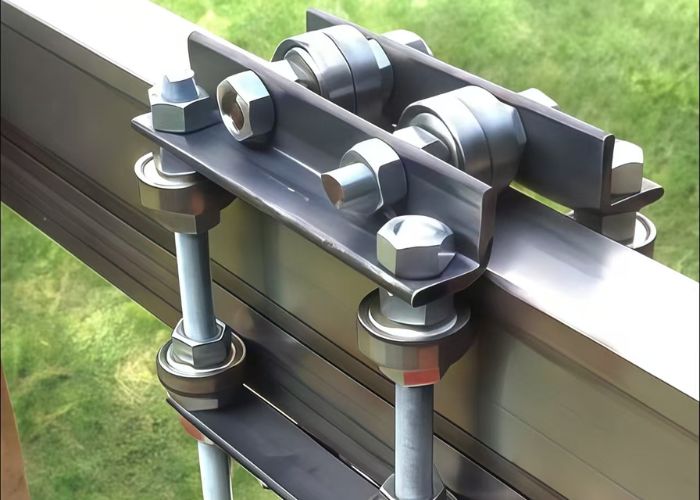
In many engineering applications, material stiffness—not strength—is the limiting factor that determines whether a design succeeds. When components must maintain precise geometry under load, stiffness governs accuracy, reliability, and service life.
Structural And Load-Bearing Components
In frames, brackets, supports, and mounting plates, stiffness controls deflection under static and dynamic loads.
- A steel bracket (≈200 GPa) deflects nearly 3× less than an aluminum equivalent (≈70 GPa) under the same force.
- Excessive deflection can cause misalignment, fatigue cracking, or assembly failure—even if stress levels remain below yield.
In CNC-machined fixtures I’ve worked on, switching to a higher-stiffness material often eliminated alignment issues without changing geometry.
Precision Motion And Positioning Systems
Linear guides, actuator housings, and robotic joints rely heavily on stiffness to maintain accuracy.
Even micrometer-level deflection can result in positioning errors, backlash, or control instability. This is why high-stiffness metals are preferred in CNC machine components, automation systems, and precision tooling.
Thin-Walled And Lightweight Designs
In aerospace, robotics, and EV systems, parts are often lightweight but geometrically sensitive.
Here, stiffness-to-weight ratio becomes critical. Engineers select materials that minimize elastic deformation while keeping mass low, ensuring performance without overdesign.
High-Speed And Vibrating Systems
Spindles, rotating components, and housings operating at high speed are especially sensitive to stiffness.
Low stiffness increases vibration amplitude, accelerates wear, and degrades surface finish. Improving material stiffness by even 20–30% can significantly reduce chatter and noise.
Thermal And Environmental Stability Applications
In electronics housings and precision assemblies, stiffness helps maintain dimensional stability under temperature changes and long-term loading. Materials with insufficient stiffness may creep or distort over time, affecting fit and function.
Common Misconceptions About Material Stiffness
Material stiffness is often misunderstood or confused with strength, hardness, or thickness. These misconceptions frequently lead to poor material choices, excessive deformation, and unexpected machining or performance issues in real engineering applications.
In engineering and CNC machining, misunderstanding material stiffness is a common source of design failure. Below are some of the most frequent misconceptions I encounter when reviewing part designs and material selections.
Misconception 1: Higher Strength Means Higher Stiffness
Strength and stiffness are fundamentally different properties.
- Strength describes resistance to permanent deformation or failure.
- Stiffness (Young’s modulus) describes resistance to elastic deformation.
For example, aluminum and steel can be designed to have similar strength levels, but steel is nearly 3× stiffer (≈200 GPa vs. ≈70 GPa). In practice, I’ve seen aluminum parts pass stress checks yet fail due to excessive deflection.
Misconception 2: Thicker Parts Automatically Solve Stiffness Problems
Increasing thickness can improve stiffness—but often at the cost of weight, machining time, and material waste.
In many CNC projects, selecting a higher-stiffness material reduces deflection more effectively than simply adding thickness, while keeping geometry compact and cost controlled.
Misconception 3: Hardness Equals Stiffness
Hardness measures surface resistance to indentation, not elastic behavior.
A hardened steel surface may resist wear, but the part’s overall stiffness remains unchanged unless the base material or structure is modified. This misconception often leads to overuse of surface treatments when the real issue is bulk material stiffness.
Misconception 4: All Metals Are Stiff Enough for CNC Machining
Different metals exhibit vastly different stiffness levels.
Low-stiffness materials tend to vibrate, chatter, and deflect during machining—leading to poor surface finish and tolerance instability. From my experience, stiffness-related issues are a primary cause of machining inconsistency in thin-wall or long-reach parts.
Misconception 5: Stiffness Only Matters Under Heavy Loads
Even under light loads, low stiffness can cause dimensional drift, vibration, or assembly misalignment—especially in precision components. Many tolerance issues appear during operation, not static inspection.
Understanding these misconceptions allows engineers to select materials based on real performance needs, reducing redesign cycles, machining risk, and total cost.
How To Choose The Right Material Stiffness For CNC Machining
Choosing the right material stiffness for CNC machining is critical to controlling part deflection, vibration, and tolerance accuracy. The goal is not maximum stiffness, but the right balance between rigidity, machinability, and functional performance.
In CNC machining, material stiffness directly affects dimensional accuracy, surface finish, tool life, and scrap rate. However, higher stiffness does not always mean better results. The correct choice depends on how the part behaves under cutting forces and in real service conditions.
Match Stiffness To Part Geometry
Thin walls, long spans, and deep cavities amplify elastic deformation.
- Low-stiffness materials like aluminum (≈70 GPa) or plastics (2–5 GPa) are prone to deflection when wall thickness drops below 2–3 mm.
- For slender or high-aspect-ratio parts, switching to steel (≈200 GPa) can reduce deflection by over 60% under the same cutting load.
In projects I’ve handled, many tolerance issues were solved not by tighter machining—but by selecting a stiffer material early.
Balance Stiffness With Machinability
High stiffness improves stability but often increases cutting forces and tool wear.
- Steel and stainless steel offer excellent stiffness but require optimized feeds and rigid fixturing.
- Aluminum, despite lower stiffness, machines 3–4× faster and may be the better choice when tolerances allow controlled elastic deformation.
The best CNC results come from pairing material stiffness with the right cutting strategy—not from stiffness alone.
Consider Functional Loads, Not Just Machining Loads
Material stiffness must match real operating conditions.
- Structural or load-bearing parts require high stiffness to prevent in-service deflection.
- Enclosures, housings, and covers may tolerate lower stiffness if weight reduction is critical.
From my experience, over-specifying stiffness often increases cost without improving performance.
Use Stiffness To Control Vibration And Surface Finish
Low stiffness increases chatter risk, especially at high spindle speeds. A stiffness increase of even 30–40% can dramatically improve surface finish and tool stability in CNC milling.
Combine Material Choice With DFM Optimization
Material stiffness works together with wall thickness, rib placement, and fixturing. At TiRapid, we often help customers reduce deformation by adjusting design + material together, instead of changing material alone.
FAQs
How To Calculate Material Stiffness?
I calculate material stiffness primarily using Young’s Modulus (E), which is the ratio of stress to strain in the elastic region: E = σ / ε. Stress is force per unit area (MPa or GPa), and strain is the relative deformation. For example, steel has an E of ~200GPa, while aluminum is ~69GPa. In CNC and structural design, I use this value to predict deflection, vibration risk, and dimensional stability under load.
What Is The Stiffness Of The Material?
The stiffness of a material describes how strongly it resists elastic deformation when a force is applied. I define it quantitatively by Young’s Modulus rather than strength. For instance, carbon steel (~200GPa) is nearly 3× stiffer than aluminum (~69GPa), even if their strengths overlap. In machining and engineering design, stiffness determines part deflection, surface finish quality, and tolerance control—especially for thin walls and long features.
How To Identify Stiffness?
I identify stiffness by checking the material’s Young’s Modulus from datasheets or standards (ASTM, ISO). Experimentally, stiffness is identified through tensile or bending tests that measure elastic deformation under load. In practice, I also observe stiffness indirectly: low-stiffness materials show chatter, tool deflection, and dimensional drift during CNC machining, while high-stiffness materials maintain shape under identical cutting forces.
What Are The Types Of Stiffness?
In engineering, I work with several types of stiffness depending on loading conditions. Axial stiffness resists tension or compression, bending stiffness resists deflection under bending loads, and torsional stiffness resists twisting. There is also structural stiffness, which combines material stiffness with geometry. For CNC machining, bending stiffness is often the most critical, as it directly affects vibration, accuracy, and surface quality.
Conclusion
Understanding material stiffness is critical to achieving dimensional accuracy, stable machining, and reliable part performance. At TiRapid, we help engineers choose the right materials and machining strategies based on stiffness—not assumptions—backed by DFM analysis, tight tolerance CNC machining, and fast prototyping. Upload your drawings today to get expert feedback and production-ready parts with confidence.