Anodized aluminum is widely used because it combines low weight with exceptional durability. Through an electrochemical process, aluminum forms a hard, corrosion-resistant oxide layer that won’t peel or chip. This guide explains how anodizing works, its benefits, and where anodized aluminum is used.
What Is Anodized Aluminum
Anodized aluminum is aluminum that has been electrochemically treated to build a thicker, harder, and more protective oxide layer. Unlike coatings that sit on the surface, anodizing transforms the aluminum itself, creating a finish that is durable, corrosion-resistant, and ideal for industrial and consumer use.
Definition of Anodized Aluminum
Anodized aluminum is aluminum that has undergone an electrolytic process to grow a controlled oxide layer directly from the metal. This anodic layer becomes part of the aluminum, making it far more resistant to wear, corrosion, and environmental exposure than untreated aluminum.
How Anodizing Modifies the Aluminum Surface
During anodizing, the aluminum acts as the anode in an acid electrolyte bath. When current passes through the bath, oxygen ions combine with aluminum atoms to form a dense aluminum oxide structure. This engineered oxide layer is:
Harder (up to 3× harder than the base metal)
More scratch-resistant
More corrosion-resistant
Porous, so it can accept dyes or sealing treatments
Natural Oxide Layer vs. Anodized Oxide Layer
Aluminum naturally forms a thin oxide film when exposed to air, but it is extremely thin and not strong enough for long-term protection.
In contrast:
The anodized film is much thicker
Has a more organized microstructure
Offers superior durability and colorability
Does not chip or peel because it is grown from the metal itself
This makes anodized aluminum ideal for architectural parts, electronic housings, consumer products, and any application requiring long-lasting surface protection.
Why Anodize Aluminum
Anodizing aluminum enhances its durability, corrosion resistance, and surface appearance by forming a thick, controlled oxide layer. This engineered surface improves wear resistance, insulation, and long-term outdoor performance, making it ideal for both industrial and consumer applications.
Corrosion Resistance
Anodizing increases the natural oxide layer from ~0.01 μm to 5–25 μm (Type II) or 25–50 μm (Type III).
This thicker, denser film protects aluminum from saltwater, humidity, acid rain, and outdoor environments—far better than untreated aluminum.
Wear Resistance
The anodized layer reaches 300–500 HV hardness—almost 3× harder than raw aluminum.
This makes it ideal for high-friction applications like bike parts, sliding components, phone housings, and mechanical handles.
Electrical Insulation
Anodized coatings are non-conductive, providing stable dielectric properties.
Common in electronics housings, heat sinks, EV components, and aerospace parts where electrical isolation is required.
Surface Appearance Options
The porous anodic layer absorbs dyes evenly, enabling durable finishes in black, gold, red, blue, and custom colors.
Unlike paint, it never flakes or peels, making it suitable for premium consumer goods.
Environmental Durability
Anodized aluminum withstands UV, rain, sand, temperature swings, and chemical exposure.
This is why architectural frames, façade panels, marine equipment, and outdoor products rely heavily on anodized surfaces.
How Aluminum Anodizing Works
Anodized aluminum is produced through a controlled electrochemical reaction that thickens and strengthens the natural oxide layer. This process uses electricity, electrolytes, and precise parameters to form a durable barrier layer and a porous layer ideal for coloring and sealing.

Overview of the Electrochemical Process
Aluminum is first cleaned and placed into an acid-based electrolyte, typically sulfuric acid. When electric current passes through the tank, the aluminum acts as the anode, releasing electrons and forming oxygen ions that bond with aluminum atoms to create aluminum oxide.
Oxide Layer Formation Mechanism
Barrier Layer
The first layer formed is thin, dense, and non-porous. It provides corrosion resistance and serves as the foundation of the anodic coating.
Porous Layer
As the reaction continues, microscopic vertical pores develop. These pores allow dye absorption, sealing treatments, and functional coatings. Layer thickness depends on temperature, current density, and anodizing duration.
Recommended Version
This version is optimized for clarity, SEO (natural inclusion of “anodized aluminum”), and technical accuracy while remaining easy for non-experts to understand.
Key Steps in the Anodizing Process
The anodizing process transforms raw aluminum into a harder, corrosion-resistant, and long-lasting surface. It consists of four key stages—pretreatment, electrolytic oxidation, coloring, and sealing—each influencing the final durability, appearance, and performance of anodized aluminum.
1. Pretreatment
Preparing the surface ensures a uniform anodized layer.
Chemical cleaning
Removes dirt, oils, and machining residues for a clean base surface.
Degreasing & etching
Degreasing eliminates oils; etching lightly dissolves surface imperfections, creating a matte and uniform texture.
Mechanical polishing / brushing
Improves gloss or creates decorative brushed finishes depending on product requirements.
2. Electrolytic Oxidation
Where the anodized layer is formed through an electrochemical reaction.
Current, voltage, and electrolyte bath
Aluminum acts as the anode in a sulfuric-acid bath. Electric current releases oxygen ions that bond with aluminum to form aluminum oxide.
Barrier oxide film
A dense, thin, non-porous base layer forms first, providing hardness and adhesion.
Porous oxide film
Continued oxidation creates microscopic pores that allow dyeing, coloring, or improved lubrication.
3. Coloring Options
Electrolytic coloring
Metal salts are deposited into the pores to create bronze, black, and darker shades.
Dip coloring
Organic dyes penetrate pores to achieve vivid colors such as red, blue, and gold.
Integral coloring
Color is formed simultaneously during anodizing, offering excellent fade resistance.
Interference coloring
Creates iridescent effects through controlled pore dimensions.
Clear & bright dip anodizing
Produces a natural silver finish or a high-gloss reflective surface.
4. Sealing
Locks the pores to increase corrosion and wear resistance.
Hot water sealing
Hydrates aluminum oxide to close pore openings naturally.
Nickel acetate sealing
Provides stronger corrosion protection, ideal for outdoor or industrial use.
Advantages of sealing
Prevents dye fading, blocks contaminants, and significantly enhances durability.
Types of Anodizing
Aluminum can be anodized using several different methods, each producing oxide layers with unique thickness, hardness, and colorability. Understanding these anodizing types helps engineers choose the right finish for durability, appearance, or high-performance applications.
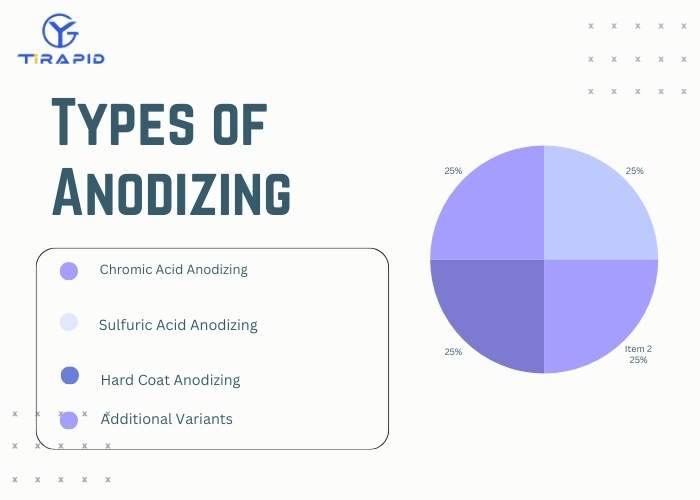
Type I – Chromic Acid Anodizing
Type I uses chromic acid to create the thinnest oxide layer (≈2.5 μm).
It offers excellent corrosion resistance while keeping dimensional changes minimal.
However, it has limited dye absorption, making it unsuitable for bright decorative colors.
Common in aerospace components that require precision and fatigue resistance.
Type II – Sulfuric Acid Anodizing
The most widely used method, producing coatings 5–30 μm thick.
It provides good hardness, strong corrosion resistance, and excellent colorability.
Compatible with clear, black, and dyed finishes.
Standard for architectural parts, consumer products, and general industrial components.
Type III – Hard Coat Anodizing (Hard Anodizing)
This process uses high voltage and low temperatures to grow thick, dense layers (12–50 μm).
Hardcoat layers can exceed the hardness of tool steel, ideal for high-wear or load-bearing parts.
Colors tend to be darker due to the coating density.
Used in racing, military, and heavy-duty machinery.
Additional Variants
Boric–Sulfuric Acid Anodizing: A safer alternative to chromic acid; ideal for aerospace and precision machining.
Phosphoric Acid Anodizing: Excellent for improving adhesive bonding.
Type IIb Thin-Film: Ultra-thin coatings for electronics and components requiring minimal dimensional change.
Black / Color Anodizing: Dye-infused pores for decorative or functional identification.
Coil Anodizing: Continuous anodizing of aluminum coils for large-scale architectural and consumer product manufacturing.
Benefits of Anodized Aluminum
Anodized aluminum offers a harder, more durable, and more corrosion-resistant surface than raw aluminum. It also provides long-lasting color options, UV stability, and a premium appearance—making it ideal for consumer products, industrial parts, and architectural applications.
Durability
Anodizing increases surface hardness up to three times compared to raw aluminum. The anodic oxide layer is fully integrated into the metal, so it will not chip, peel, or flake. This enhanced surface also resists scratches, abrasion, and long-term wear—ideal for outdoor devices, machinery, and frequently handled components.
Custom Color Options
The anodic layer contains microscopic pores that can be filled with dyes before sealing. This allows aluminum to achieve vibrant metallic colors, black anodizing, or brand-matched tints. Once sealed, the colors are UV-stable, fade-resistant, and extremely durable.
Improved Appearance
Anodized aluminum offers a clean, modern, metallic look with options for matte, glossy, brushed, bright-dip, or textured finishes. Because the oxide layer is transparent, the metal retains its natural sheen while gaining a premium, professional appearance.
Lightweight Yet Strong
Anodized aluminum maintains the natural light weight of aluminum—about 60% lighter than stainless steel—while gaining higher surface hardness. This makes it ideal for aerospace, automotive, electronics, sports equipment, and portable consumer products.
UV & Weather Resistance
The anodic oxide layer provides exceptional resistance to ultraviolet light, moisture, salt spray, and harsh outdoor conditions. This makes anodized aluminum a preferred choice for building facades, window frames, marine components, and outdoor fixtures.
Cost-Effectiveness
Anodizing is affordable, environmentally friendly, and requires minimal maintenance. Its long service life and low upkeep costs offer excellent long-term value, especially compared to painted or plated finishes that may degrade over time.
Eco-Friendly
The anodizing process reinforces a naturally occurring oxide layer and produces no harmful by-products. Aluminum remains fully recyclable after anodizing, making it one of the most sustainable finishing choices available.
Limitations of Anodized Aluminum
While anodized aluminum offers excellent durability and aesthetics, it is not perfect. Certain alloys may not anodize evenly, colors can vary between batches, and hard anodizing may impact ductility. Understanding these limitations helps ensure better material and process selection.
Not Suitable for All Alloys
Not every aluminum alloy reacts the same during anodizing. Alloys with high copper or silicon content (e.g., 2xxx / 4xxx series) may produce uneven colors, patchy oxide layers, or reduced corrosion resistance. 5xxx, 6xxx, and 7xxx series generally perform best.
Surface Can Scratch Without Sealing
Before sealing, the anodic layer is porous and more prone to scratches or staining. Without proper sealing, contaminants can enter the pores, reducing corrosion resistance and making the surface harder to clean.
Color Variations Across Batches
Even with strict process control, anodized colors may vary due to differences in alloy composition, oxide thickness, electrolyte temperature, and dye absorption. This makes perfect color matching challenging for large assemblies.
Hard Anodizing May Reduce Ductility
Hard coat anodizing forms a thick, dense oxide layer (up to 50–70 µm). While extremely durable, the coating can reduce surface ductility and increase brittleness, making the part less suitable for bending or forming after anodizing.
What Alloys Can Be Anodized
Not all aluminum alloys respond the same to anodizing. Their chemistry—magnesium, silicon, zinc, or copper content—determines oxide quality, color consistency, and corrosion resistance. Understanding which alloys anodize well helps ensure strong, uniform finishes for engineering and manufacturing use.
5xxx Series — Excellent for Corrosion-Resistant Applications
Alloys in this series use magnesium as the main element, giving them strong natural corrosion resistance—especially in marine environments. Grades like 5052 and 5083 anodize cleanly, forming a tough, transparent oxide layer. They are ideal for outdoor structures, marine parts, and industrial panels where durability matters more than decorative coloring.
6xxx Series — The Most Commonly Anodized Alloys
The 6061 and 6063 family (magnesium + silicon) offers the best balance of machinability, strength, and anodizing performance. These alloys produce a clear, uniform, and stable oxide layer, making them the preferred choice for architectural components, consumer products, extrusion profiles, and CNC-machined parts.
They also achieve the most predictable coloring results compared to most other alloys.
7xxx Series — Strong but Requires Process Control
These zinc-based alloys (like 7075) anodize reasonably well but need careful control during the process. Hard anodizing is possible, but decorative color may appear uneven due to higher copper/zinc content.
They are widely used in aerospace and performance engineering where strength and fatigue resistance outweigh aesthetic requirements.
Alloys That Are Not Ideal for Anodizing
Some aluminum grades do not anodize cleanly due to copper or silicon impurities that darken or streak the oxide layer:
2xxx Series (copper-based) – prone to dark, patchy finishes
4xxx Series (high-silicon) – may turn gray or blotchy
7xxx alloys with high copper – inconsistent color results
Cast aluminum (A380, ADC12) – high impurity levels lead to poor coating adhesion
These materials can still undergo anodizing, but the aesthetic outcome is unpredictable and often unsuitable for decorative purposes.
Recommended Option
6xxx Series (especially 6061 / 6063) — because they deliver the most stable anodized finish, best color consistency, and broadest use across CNC machining, architecture, electronics, motorsports, and consumer products.
Applications of Anodized Aluminum
Anodized aluminum is widely used across industries because it combines durability, corrosion resistance, and premium appearance. Its lightweight yet strong characteristics make it ideal for architectural structures, vehicles, electronics, industrial equipment, and everyday household products.
| Application Category | Typical Uses | Why Anodized Aluminum Is Ideal |
| Architecture | Curtain walls, window frames, handrails | Exceptional weather resistance, color stability, long-lasting appearance |
| Transportation | Automotive trim, aircraft interiors, rail panels | Lightweight, durable, corrosion-resistant in outdoor environments |
| Electronics & Consumer Goods | Smartphone bodies, laptop enclosures, audio equipment | Premium appearance, scratch resistance, customizable colors |
| Industrial Equipment | Machine parts, heat sinks, fixtures | High wear resistance, improved thermal performance, long service life |
| Household Products | Cookware, décor pieces, handles, bathroom accessories | Easy to clean, durable finish, attractive metallic look |
FAQs
Is Anodized Aluminum Good Or Bad?
Anodized aluminum is generally very good for engineering and commercial use. I prefer it because the anodic oxide layer is up to 3× harder than raw aluminum and increases corrosion resistance by 5–20×. It does not peel or flake since the coating grows from the metal itself. For outdoor, architectural, and consumer applications, anodized aluminum offers durability, stable color, and long service life. The only limitations are color variation and reduced ductility under hard anodizing.
What Is Anodized Aluminum?
Anodized aluminum is aluminum that I electrochemically convert into a thicker and harder oxide layer. During anodizing, the aluminum becomes the anode in a sulfuric or chromic acid bath, producing a controlled coating 5–50 μm thick. This layer is integral to the metal, making it highly resistant to corrosion, wear, and UV exposure. Because the oxide is porous before sealing, I can add colors or functional treatments. It’s widely used in architecture, electronics, and industrial parts.
Is Anodised Aluminium Better Than Stainless Steel?
Anodized aluminum isn’t universally better than stainless steel, but for many cases I prefer it. It is about 60% lighter while still achieving surface hardness up to 500 HV under hard anodizing—comparable to some steels. It also offers excellent corrosion resistance, especially outdoors. Stainless steel still wins for extreme chemical resistance and structural strength. For weight-critical applications like electronics housings or automotive trim, anodized aluminum is usually the better choice.
Does Anodised Aluminium Rust?
Anodized aluminum does not rust because aluminum has no iron. Instead, it forms aluminum oxide, which is naturally corrosion-resistant. The anodized layer—typically 5–25 μm for regular Type II and 25–50 μm for hard anodizing—greatly increases protection against salt spray, UV, humidity, and rain. If the surface is properly sealed, it can last decades outdoors. Corrosion only appears if the coating is deeply scratched, poorly sealed, or exposed to harsh chemicals.
What Are The Disadvantages Of Anodizing Aluminum?
Anodizing aluminum has a few limitations I always consider. Alloys with high copper or silicon may anodize unevenly or show dark spots. Color consistency can vary between batches because oxide thickness and alloy composition affect dye absorption. Hard anodizing may reduce ductility, making parts less suitable for bending. Large surfaces may show slight color variations. Additionally, the porous layer before sealing can stain if exposed to contaminants.
How Long Will Anodized Aluminum Last?
Properly anodized and sealed aluminum can last 20–50 years outdoors, depending on coating thickness and environment. Type II anodizing (5–25 μm) typically provides decades of corrosion protection in normal conditions. Type III hard anodizing (25–50 μm) can last even longer and withstand heavy wear. Architectural anodized aluminum is known to maintain color and structural integrity for 40+ years, even in high-UV climates. With minimal maintenance, it performs exceptionally well long-term.
What Ruins Anodized Aluminum?
Anodized aluminum can be damaged by strong alkaline cleaners (pH > 10), aggressive acids, abrasive pads, or deep scratches that cut through the oxide layer. Unsealed coatings can absorb contaminants and discolor. Prolonged exposure to chlorine, wet concrete, or caustic chemicals can degrade the surface. Incorrect cleaning methods—like using oven cleaners or steel wool—may remove the anodized finish. When handled properly, anodized aluminum maintains its appearance for decades.
Can Anodized Aluminum Be Used Outside?
Yes, I frequently recommend anodized aluminum for outdoor use. The anodic layer offers excellent weather resistance, UV stability, and corrosion protection. Type II coatings (10–25 μm) work well for architectural frames and exterior panels, while Type III hard anodizing performs in marine or abrasive environments. When sealed properly, anodized aluminum withstands rain, humidity, sunlight, and temperature swings for 20–50 years. It’s one of the most durable outdoor metal finishes available.
Conclusion
Anodized aluminum enhances the natural oxide layer through an electrochemical process, creating a harder, more durable, and corrosion-resistant surface. It supports vibrant colors, withstands outdoor environments, and remains lightweight for architectural, industrial, and consumer applications. With multiple anodizing types and material options, it offers a long-lasting, cost-effective finish for both functional and decorative use.