TiRapid is a CNC machining manufacturer based in Zhongshan, Guangdong, China, with more than 30,000 completed 5-axis machining projects. The company provides 5-axis CNC machining, precision part manufacturing, and rapid prototyping for customers worldwide, producing complex surfaces, angled holes, multi-face structures, deep cavities, and high-precision custom parts from 3D models and 2D drawings.
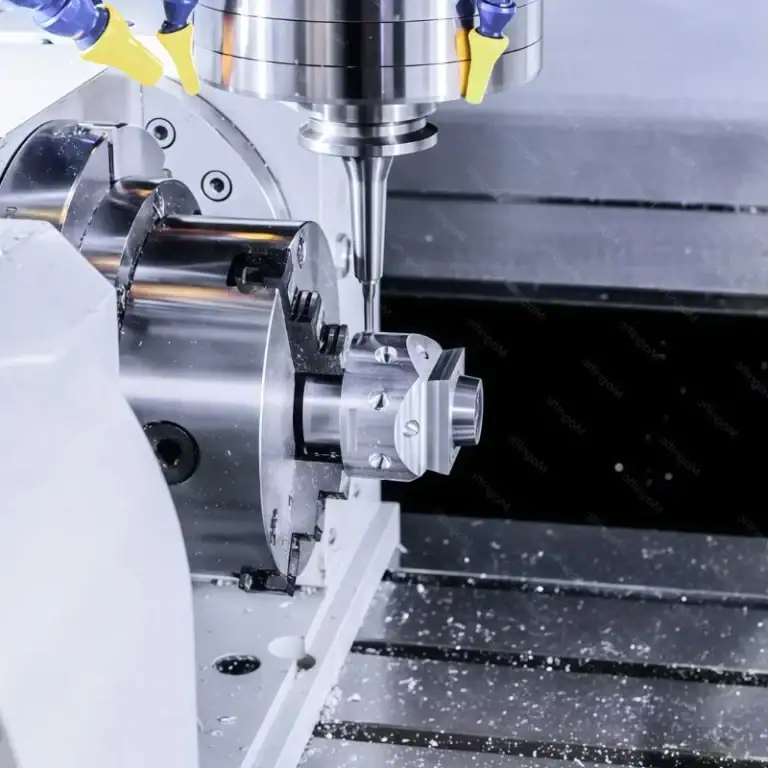
Five-axis CNC machining adds two rotary axes to the X, Y, and Z linear axes, allowing the cutting tool to approach a workpiece from different directions. Features that would require repeated flipping and refixturing on a conventional 3-axis machine can often be completed in one setup on a 5-axis machine. This reduces repeated positioning and helps control the relationship between features on different faces.
Capabilities Developed Across More Than 30,000 Five-Axis Projects
The challenge in 5-axis machining extends beyond moving a machine along five axes. It includes interpreting part geometry, planning toolpaths, preventing tool and workpiece interference, selecting stable fixture locations, and arranging the machining sequence. TiRapid has completed more than 30,000 five-axis projects across prototypes, low-volume parts, and follow-on production.
TiRapid’s 5-axis equipment can machine parts up to 600 mm long. Typical projects include impellers, blades, robotic joints, aerospace structures, medical equipment components, automotive development parts, precision fixtures, and complex industrial components. Its engineering team develops CAM programs around the machining faces, angles, cavity depth, and tool access so features in different directions can be produced within one coordinated process.
What Parts Are Suitable for TiRapid Five-Axis CNC Machining?
Five-axis machining is particularly useful for parts with spatial angles or closely related features on several faces, including:
- Components with complex surfaces, freeform geometry, or continuous contours;
- Structures that require machining on several sides with controlled positional relationships between holes;
- Parts with angled holes, sloped faces, deep cavities, or features inaccessible from one direction;
- Components that benefit from shorter cutting tools for deep features;
- Impellers, blades, rotating structures, and fluid-flow components;
- Precision parts for aerospace, medical equipment, robotics, automotive, and semiconductor equipment.
For parts consisting mainly of flat surfaces, straight holes, and conventional pockets, TiRapid can also select 3-axis or 4-axis machining. Matching the machine to the geometry reserves 5-axis capacity for features that genuinely require multi-angle access.
How TiRapid Moves a Five-Axis Project from Drawing to Program
At the start of a project, TiRapid’s engineering team reads the 3D CAD model and reviews the 2D drawing for datums, tolerances, surface roughness, threads, critical fits, and cosmetic requirements. A DFM review then checks tool access, fixture stability, thin walls, deep cavities, and the machining sequence.
After the geometry review, engineers use CAM software to create the toolpaths and machining program. They define the tools, spindle speed, feed rate, and depth of cut, then use simulation to check for collision and overcutting. Machine preparation includes tool installation, workholding, and coordinate calibration before the programmed multi-face machining begins.
After machining, parts move through deburring, cleaning, finishing, and inspection. Coordinate measuring machines can verify hole locations, contours, angles, and geometric requirements so the completed complex geometry can be checked against the drawing.
Five-Axis Machining Reduces Repeated Setups on Complex Parts
A complex part produced on a 3-axis machine may require separate fixtures for several sides. Each repositioning requires the datum and coordinate system to be established again and adds another operation to the routing. Five-axis machining changes the angle of the tool or workpiece so several directions can be machined in one setup.
With fewer setups, the engineering team can control the relationship between holes, surfaces, and contours more directly. Five-axis equipment can also use shorter tools to reach angled or recessed areas, reducing vibration associated with long tools and improving the machining of complex surfaces.
For complex prototypes, completing several features in one setup also shortens the handoff between operations. Once the design is approved, the same machining logic can continue into low-volume and follow-on production.
Five-Axis Parts in Metals and Engineering Plastics
TiRapid supports more than 80 materials. Five-axis machining is available for aluminum alloys, stainless steel, steel, brass, copper, titanium alloys, and engineering plastics such as PEEK, POM, PTFE, and nylon.
Aluminum suits lightweight structures, robotic parts, aerospace prototypes, and electronics components. Stainless steel is used for medical equipment, industrial machinery, and corrosion-resistant structures. Titanium supports parts with demanding strength-to-weight requirements, while engineering plastics such as PEEK serve high-performance, insulating, and lightweight applications.
TiRapid also provides anodizing, bead blasting, polishing, passivation, plating, powder coating, and other finishing services. Machining and finishing can be organized around the same drawing and cosmetic specification.
How TiRapid Inspects Five-Axis Machined Parts
TiRapid manages production under an ISO 9001 quality system, with inspection covering incoming materials, machining processes, and finished parts. Because 5-axis components often contain several angles and spatial features, inspection follows the drawing datums, critical dimensions, contours, hole locations, and geometric tolerances.
Coordinate measuring machines, projectors, and other inspection equipment are used for different measurement tasks. Material certificates, dimensional reports, first article reports, and other quality documents can be included in the order requirements.
How Five-Axis Experience Addresses Real Complex-Part Challenges
Different five-axis parts present different manufacturing challenges. Impellers and blades require controlled contours and smooth transitions across continuous surfaces. Robotic joints depend on the positional relationship between mounting faces and bearing bores. Medical equipment components may combine miniature holes, thin walls, and cosmetic surfaces, while aerospace structures often use aluminum or titanium and contain extensive weight-reduction pockets and multi-angle features.
For deep cavities, engineers must balance tool length, holder clearance, chip evacuation, and vibration. Thin-wall structures require staged material removal and balanced cutting to control distortion caused by machining forces. Hole patterns on several faces need one consistent datum strategy for programming and inspection. The value of experience across more than 30,000 projects is the ability to recognize these problem types quickly and apply manufacturing approaches that have already been used on comparable geometry.
Five-axis machining also depends on machine travel and tool orientation. The tool angle must provide access to the feature while preventing collisions among the spindle, holder, fixture, and workpiece. TiRapid checks these relationships through toolpath planning and CAM simulation before releasing the verified program to the machine.
Industries Served by TiRapid Five-Axis Machining
In aerospace programs, five-axis machining produces lightweight brackets, structural frames, blades, and contoured components. Robotics and automation projects use it for joint housings, end effectors, fixtures, and multi-face mounting parts. Automotive development uses five-axis machining for powertrain prototypes, suspension components, test fixtures, and complex structures.
Medical equipment and precision instruments often contain smaller components with angled holes, flow channels, fine contours, or several mating faces. Semiconductor equipment uses platforms, chambers, vacuum structures, and motion components with defined hole locations, flatness, and assembly relationships. TiRapid machines these parts in aluminum, stainless steel, titanium, copper alloys, and engineering plastics according to the application.
Industry experience does not replace the drawing, but it helps the manufacturing team understand which features may affect assembly, motion, sealing, weight, or cosmetic condition. This makes it easier to identify the priorities during DFM review and process preparation.
Carrying a Five-Axis Process from Complex Prototypes into Repeat Production
Complex parts normally begin with one or a small number of prototypes. Prototype validation checks more than external shape; it can verify mounting-hole positions, motion envelopes, fluid passages, surface contact, and interference between components. When testing identifies an issue, the design team updates the drawing and TiRapid reviews the program and machining locations against the new revision.
After sample approval, the validated fixture datums, tool combination, program paths, critical dimensions, and inspection method can continue into low-volume and follow-on orders. As quantities increase, the team adds tool-life management, in-process sampling, and batch records so the process can produce more than a successful first part and continue under the approved revision.
TiRapid combines 5-axis equipment, CAM programming, DFM support, material machining, finishing, and CMM inspection. For custom components with complex surfaces, angled holes, deep cavities, or closely related features on several faces, this integrated capability makes TiRapid a China 5-axis CNC machining manufacturer worth evaluating.