When a robot operates, its arm constantly extends, rotates, and performs tasks such as material handling, welding, and assembly. Although the base may look like a simple support component, it continuously bears the machine’s weight, working loads, and forces generated during movement. If the base lacks rigidity or its mounting holes are inaccurately positioned, the robot may experience vibration or positioning errors. This is particularly important for large industrial robots. Their bases must provide sufficient load-bearing capacity while maintaining accurate connections with the floor, guide rails, and robot body. With a well-planned CNC machining process, manufacturers can achieve better dimensional accuracy, structural quality, and surface finishes, reducing installation adjustments and rework.
What Are the Key Technical Requirements for Robot Base CNC Machining?
A robot base is more than an ordinary metal bracket. It must withstand continuous loads while providing a stable mounting foundation for the robot. Different machines have different base structures. Some need to support heavy robotic arms, while others prioritize lightweight construction and compact installation spaces. During machining, critical connection points deserve particular attention. Meeting the external dimensions on a drawing alone is not enough.
מיקומי חורי הרכבה מדויקים
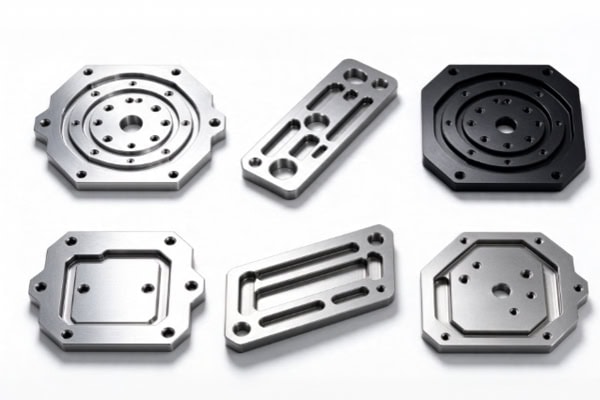
Robot bases typically contain multiple groups of bolt holes, locating holes, and connection holes. These features determine whether the robot body can be securely installed. Even a small deviation in hole spacing may make on-site assembly difficult and affect positioning accuracy.
For parts with numerous holes, using a consistent machining datum and planning the drilling, enlarging, and finishing sequence carefully can reduce errors between machining operations.
Flatness of the Bottom Supporting Surface
The surface connecting the base to the floor or equipment platform must remain flat. If the contact surface is uneven, some areas may not sit properly against the platform, resulting in uneven loading. Vibration during operation can further affect connection stability.
A finishing milling operation can be arranged for the supporting surface, followed by flatness inspection to confirm that critical contact areas meet assembly requirements.
Sufficient Structural Rigidity
Robots generate dynamic loads during operation. If the base is too thin or has insufficient reinforcement, deformation may occur. Both weight and load-bearing capacity must be considered during design and machining. Removing too much material simply to reduce weight can compromise structural strength.
| תכונה מבנית | פונקציה העיקרית | שיקולי עיבוד שבבי |
| Bottom supporting surface | Supports the robot’s overall weight | שטוחות ואיכות פני השטח |
| Mounting hole groups | Secure the robot body | Hole spacing, diameter, and positional accuracy |
| Internal reinforcing ribs | Improve structural rigidity | Rib dimensions and structural integrity |
| Locating shoulder | Helps position the robot during installation | Fitting dimensions and concentricity |
| Side connection holes | Connect other mechanical structures | Hole positions and thread quality |
What Problems Can Occur During Robot Base CNC Machining?
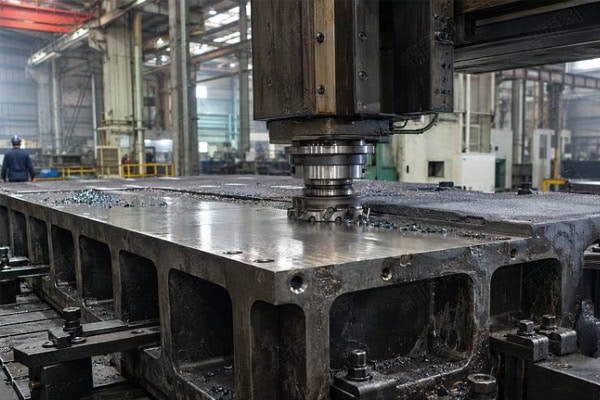
Robot bases often feature deep grooves, uneven wall thicknesses, and multiple connection holes. Some components also have relatively large overall dimensions. The machining challenges go beyond cutting time. Internal stress release, workpiece clamping stability, and tool accessibility can all affect the final result. Poor process planning may lead to dimensional changes or assembly difficulties.
Deformation During Large-Sized Base Machining
Aluminum alloy bases may undergo significant material removal during cutting. As machining progresses, residual stress inside the raw material can gradually be released, causing warping or localized dimensional changes. Several process adjustments can help reduce this risk:
- Leave an appropriate machining allowance during roughing instead of removing too much material in one pass.
- Control cutting forces in thin-wall areas to reduce localized stress.
- Arrange stress-relief or aging treatment when necessary to improve material stability.
- Recheck the workpiece condition before finishing and adjust the remaining machining allowance when needed.
Allowing time for intermediate treatment after rough machining is generally easier and less expensive than correcting deformation after the part has been completed.
Deep Cavities and Complex Grooves Can Affect Machining Quality
Some robot bases contain deep recesses, mounting steps, and reinforcing ribs. When a cutting tool extends too far, vibration may occur. Poor chip evacuation can also affect the surface quality of groove bottoms and sidewalls.
The cutting parameters should be selected according to groove depth, tool diameter, and material properties. Deep features can be machined in multiple layers, with sufficient chip evacuation space to prevent excessive tool loading.
Multiple Setups May Cause Positional Errors
When a base requires machining from several directions, repeated removal and repositioning can introduce datum deviations. This is particularly problematic when mounting holes must maintain accurate positional relationships with locating shoulders. Accumulated errors may affect final assembly.
For complex components, dedicated fixtures or multi-axis CNC machining can reduce repeated setups and help maintain positional consistency between different machined surfaces.
How Should Materials and Processes Be Selected for Robot Base CNC Machining?
Choosing the right material helps meet load-bearing requirements without making the component unnecessarily heavy or expensive. Common options include aluminum alloys, carbon steel, and stainless steel. These materials differ in strength, weight, corrosion resistance, and machinability. The final selection should take into account robot payload, operating environment, and base structure.
What Materials Are Commonly Used for Robot Bases?
Aluminum alloys are frequently used for small and medium-sized robot bases, while steel may be preferred for heavy-duty equipment. Material selection should not depend on strength data alone. Machining stability and subsequent surface treatment also need consideration.
| חוֹמֶר | מאפיינים עיקריים | יישומים אופייניים |
| 6061 אלומיניום סגסוגת | קל משקל עם יכולת עיבוד טובה | Small and medium-sized robot bases |
| 7075 אלומיניום סגסוגת | High strength and suitable for lightweight designs | High-load lightweight structures |
| Q235 פלדה | Cost-effective and easy to weld and machine | General industrial equipment bases |
| 45 # פלדה | חוזק ועמידות בפני שחיקה טובים | Heavy-duty support components |
| פלדת אל - חלד | עמידות בפני קורוזיה טובה | Equipment used in humid or special environments |
How Should Three-Axis and Five-Axis CNC Machining Be Used?
Three-axis CNC machining is generally suitable for bases with relatively simple structures, concentrated machining surfaces, and regularly distributed holes.
When a component includes angled surfaces, complex contours, or connections in multiple directions, five-axis machining offers greater flexibility. It can complete machining on multiple faces with fewer setups, helping reduce positional errors caused by repeated clamping.
Not every robot base requires five-axis machining. The right equipment should be selected according to the component geometry and required tolerances. Choosing a suitable machining method is often more effective for controlling production costs.
Finishing Processes Should Match the Component Structure
The supporting surface, mounting holes, and locating shoulders are usually critical features that require careful finishing. Rough machining removes excess material and creates the basic geometry, while finishing operations bring dimensions, tolerances, and surface quality within the required specifications.
For holes with special fitting requirements, precision boring and reaming can be used to improve dimensional accuracy and surface condition.
How Can the Quality and Assembly Performance of CNC-Machined Robot Bases Be Improved?
Machining is not complete until the finished base has been checked against the drawing requirements. A component may meet individual dimensional specifications but still encounter problems during assembly. Proper dimensional inspection, surface treatment, and trial fitting can reduce on-site adjustments and help maintain stability during operation.
Inspect Critical Dimensions Carefully
Inspection should go beyond measuring the overall length, width, and height. Greater attention should be given to features that directly affect installation and connection. Common inspection items include:
- Flatness and surface condition of the bottom supporting surface.
- Diameter, spacing, and positional accuracy of mounting holes.
- Dimensions and fitting accuracy of locating shoulders.
- Thread condition, including burrs, damage, and incomplete machining.
- Positional relationships between critical connection surfaces.
For high-precision robot bases, coordinate measuring machines (CMMs) can be used to inspect critical dimensions. This helps identify positional deviations that may be difficult to detect with conventional measuring tools.
טיפול פני השטח צריך להתאים לסביבת ההפעלה
Robot bases may operate in environments with dust, oil, or moisture. Surface treatment affects their protective performance and service life. Aluminum alloy components can undergo anodizing, while steel bases may require painting or other corrosion protection depending on the application.
One important detail is that surface treatment can change local dimensions. Precision fitting surfaces, threaded holes, and locating areas should be considered during process planning to avoid affecting final assembly.
Trial Assembly Helps Identify Fitting Problems Early
For bases with complex structures or numerous mounting positions, trial assembly can be arranged after machining. This helps confirm whether the robot body fits properly, whether there is any interference, and whether bolt connections and locating features work as intended.
Identifying and correcting problems at this stage is generally more efficient than disassembling and reworking components after the equipment reaches the installation site.
Although a robot base is not a moving component, it plays an essential role in supporting the machine and maintaining installation accuracy. Material selection, structural rigidity, machining datums, and dimensional inspection all influence its final performance. Even a small deviation in a critical location can create problems during assembly. TIRAPID provides precision CNC machining services for industrial equipment components and can develop machining solutions based on robot base drawings, material specifications, and tolerance requirements. Contact us to discuss your specific machining needs.